On this page
Nucleophiles and bases both donate an electron pair, so it feels natural to rank them the same way. That works until a question asks why iodide, one of the weakest bases you know, is one of the best nucleophiles in water. The answer is to keep two ideas apart: equilibrium and rate.
What is the difference between nucleophilicity and basicity?
Basicity is a thermodynamic property: it describes where an equilibrium with H+ settles, not how fast it gets there (Wikipedia: Nucleophile).
Nucleophilicity is a kinetic property: it describes how fast a species attacks an electron-poor atom, usually carbon (Wikipedia: Nucleophile).
"Is X- a strong base?" asks how firmly X- holds a proton. "Is X- a good nucleophile?" asks how quickly X- bonds to carbon in a given solvent. LibreTexts describes nucleophilicity as the rate of substitution at the halogen-bearing carbon, and notes that the two trends often run parallel but not always (LibreTexts, SN2 characteristics/11%3A_Reactions_of_Alkyl_Halides-_Nucleophilic_Substitutions_and_Eliminations/11.03%3A_Characteristics_of_the_SN2_Reaction)).
Why is iodide a weak base?
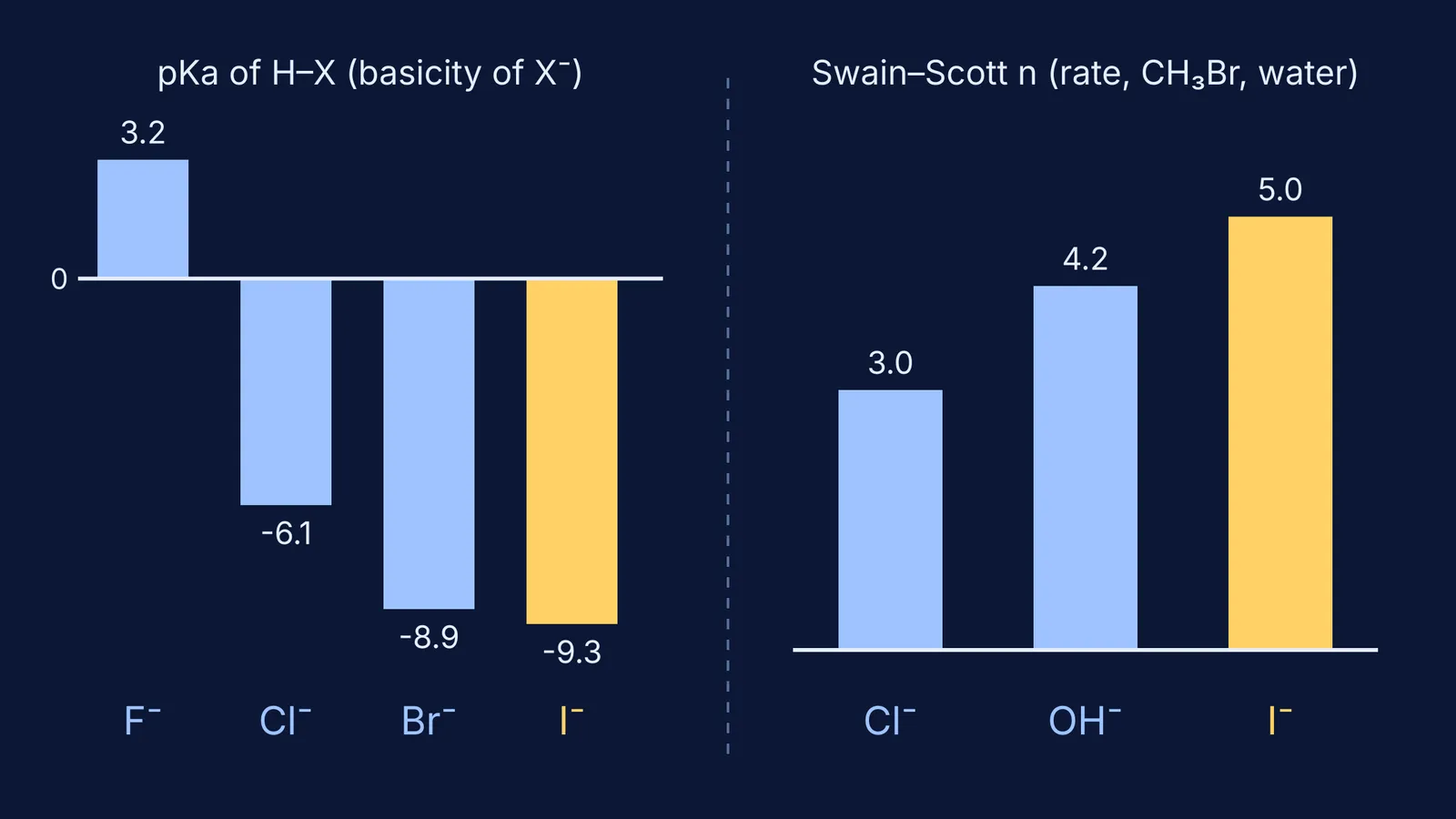
The hydrogen halides tell you directly. Their pKa values are 3.20 for HF, -6.1 for HCl, -8.9 for HBr and -9.3 for HI (LibreTexts, Brown et al. 16.10/16%3A_AcidBase_Equilibria/16.10%3A_Acid-Base_Behavior_and_Chemical_Structure)). The same table gives H-X bond energies falling from 570 kJ/mol in HF to 298 kJ/mol in HI.
The stronger the acid, the weaker its conjugate base. HI is the strongest of the four acids, so I- is the weakest base. Its charge is spread over a large, diffuse atom and the H-I bond is weak, so at equilibrium I- is happy to let the proton go.
Why is iodide a strong nucleophile in protic solvents?
Rate depends on what happens on the way to carbon, and in water or methanol the solvent gets in the way. Protic solvents solvate anions by hydrogen bonding, and this effect is strongest for small, basic anions (LibreTexts, Nucleophilicity and Solvent Effects/Alkyl_Halides/Reactivity_of_Alkyl_Halides/Alkyl_Halide_Reactions/Substitution_and_Elimination_Reactions_of_Alkyl_Halides/SN1_Substitution_Reactions/Nucleophilicity_and_Solvent_Effects)). Fluoride and chloride sit inside a tight shell of O-H bonds that must be partly stripped away before they can attack. Iodide is large, holds that shell loosely, and its electron cloud is easily distorted (polarisable).
The same LibreTexts page gives the measured order in methanol as CH3CO2- < Cl- < Br- < N3- < CH3O- < CN- ≈ SCN- < I- < CH3S-, a span of over 5,000-fold. In DMSO, a polar aprotic solvent that solvates anions poorly, the halide order flips: I- < Br- < Cl-, and methoxide comes out on top. Without the hydrogen-bond cage, nucleophilicity tracks basicity much more closely.
Worked example: reading the Swain-Scott numbers
In 1953 C. Gardner Swain and Carleton B. Scott proposed log(k/k0) = s·n, where k0 is the rate with water as the nucleophile and s = 1 for methyl bromide, measured in water at 25 °C (Swain and Scott, JACS 1953; values as listed on Wikipedia: Nucleophile). Typical n values are 5.0 for iodide, 4.2 for hydroxide and 3.0 for chloride.
Because n is a logarithm, each unit is a factor of 10 in rate:
I- vs Cl-: 5.0 - 3.0 = 2.0, so iodide reacts about 10^2 = 100 times faster with CH3Br in water.
I- vs OH-: 5.0 - 4.2 = 0.8, so iodide is about 10^0.8, roughly 6 times faster, even though hydroxide is by far the stronger base.
Now flip the question: which of these grabs H+ more strongly? Hydroxide, easily. Same two ions, opposite ranking, because one question is about rate and the other about equilibrium.
How do you decide in an exam question?
Use this four-step check whenever a question asks you to rank nucleophiles:
Are the attacking atoms from the same row of the periodic table (for example O vs N)? Then nucleophilicity usually follows basicity.
Are they in the same group (F, Cl, Br, I or O vs S)? Look at the solvent before ranking.
Protic solvent (water, alcohols): bigger, more polarisable atom wins, so I- > Br- > Cl- > F- and RS- > RO-.
Polar aprotic solvent (DMSO, DMF, acetone): ranking tends to follow basicity, so the halide order reverses to F- > Cl- > Br- > I-.
Go deeper with our guides to polar protic and aprotic solvents in SN1 and SN2, the HSAB principle of hard and soft acids and bases, and choosing between substitution and elimination when a strong base is present.
If the gap is in the ideas themselves, the Fermi Concept Library gives each concept in chemistry its own lesson and shows where it sits in the map, so nucleophiles, acid strength and solvent effects can be read side by side. To test the rule on real questions, the Fermi Problem Library has worked problems with a step-by-step solver that explains the reasoning rather than printing an answer.