

On this page
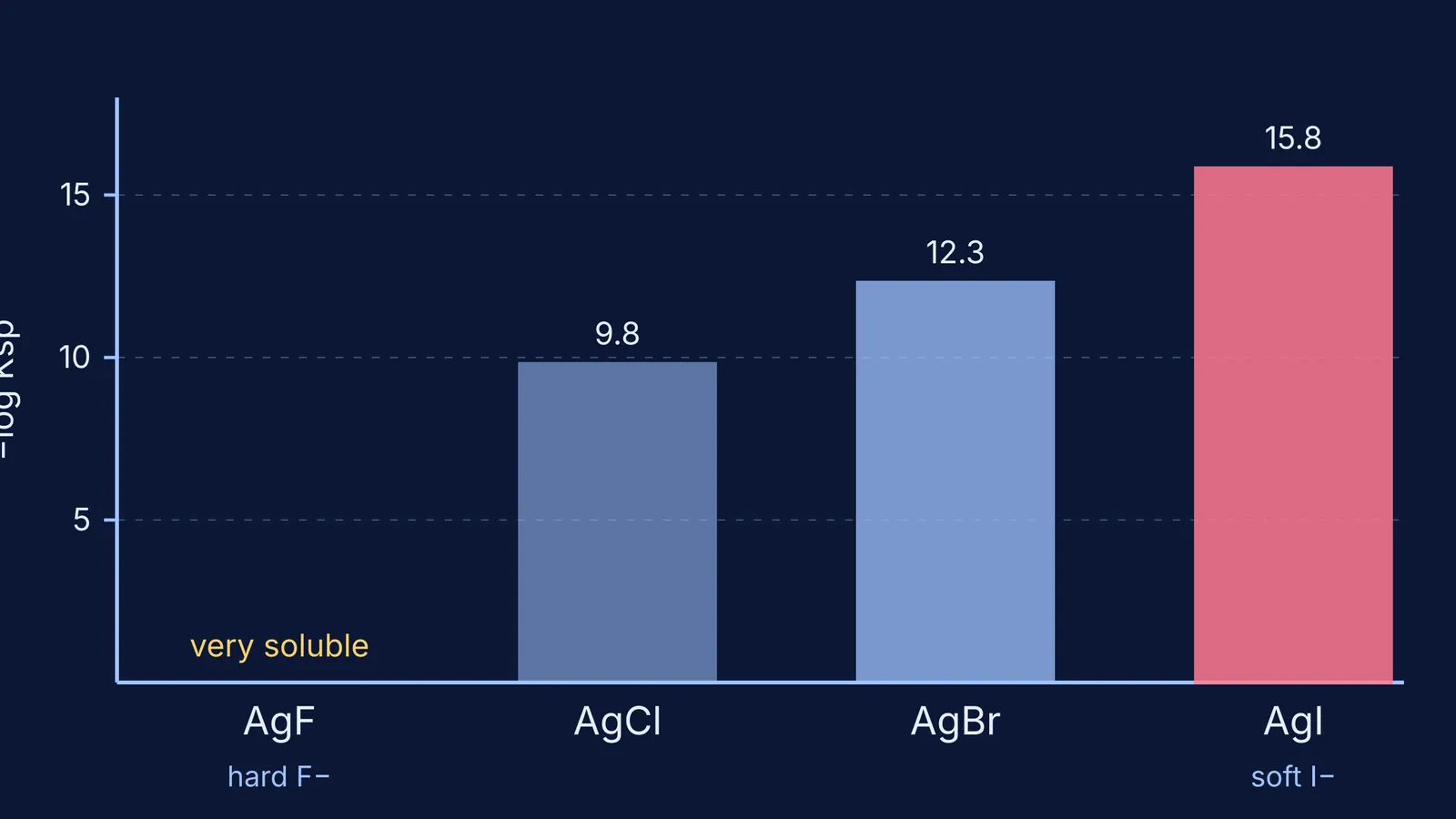
Chemistry textbooks often present the silver halides as a list to memorise: AgF dissolves, AgCl, AgBr and AgI do not, and they get less soluble down the group. The hard and soft acids and bases principle explains that pattern, and the same idea predicts which ligands a metal ion prefers.
What is the hard and soft acids and bases principle?
Ralph G. Pearson introduced the idea in a 1963 paper titled Hard and Soft Acids and Bases in the Journal of the American Chemical Society. It works with Lewis acids (electron-pair acceptors, usually metal ions) and Lewis bases (electron-pair donors, usually anions or molecules with lone pairs).
The principle in one sentence, as given in the HSAB theory overview: soft acids prefer to bond with soft bases, and hard acids prefer to bond with hard bases, all other factors being equal.
Hard species are small, carry a high charge, and are weakly polarisable: their electron cloud is hard to distort.
Soft species are large, carry a low charge, and are strongly polarisable: their electron cloud is easy to distort.
The same overview lists typical examples. Hard acids include H3O+, Li+, Na+ and Ti4+; soft acids include Ag+, Au+, Pt2+ and Pd2+. Hard bases include F-, OH- and NH3; soft bases include I-, H- and RS- (thiolates). Fe2+, Co2+ and Pb2+ sit on the borderline.
Why do hard prefer hard and soft prefer soft?
A hard acid and a hard base are both compact, with charge packed into a small space. They hold together mainly by electrostatic attraction, an ionic bond, and that attraction is strongest when the ions can get very close.
A soft acid and a soft base both have large, easily distorted electron clouds. Each can push its electron density towards the other and share it, so the bond gains a lot of covalent character. If you have met Fajans' rules for covalent character, this is the same physics: a polarising cation plus a polarisable anion gives a more covalent bond.
A mismatched pair gets neither benefit fully. Pearson and Robert Parr later put a number on hardness in a 1983 paper, Absolute hardness: companion parameter to absolute electronegativity; the HSAB theory overview gives the working approximation of their definition as η ≈ (I − A)/2, where I is ionisation energy and A is electron affinity.
Why does Ag+ bind I- better than F-?
Ag+ is a large ion with a single charge and a polarisable d10 electron shell, which makes it a soft acid. I- is the largest, most polarisable halide (soft). F- is the smallest and least polarisable (hard).
The solubility data show the preference clearly. In the LibreTexts solubility product table (adapted from OpenStax)/10%3A_Appendices/10.10%3A_Solubility_Products), the Ksp values at 25 °C are 1.6 × 10^-10 for AgCl, 5.0 × 10^-13 for AgBr and 1.5 × 10^-16 for AgI. AgF has no entry because it is not sparingly soluble: silver(I) fluoride dissolves to about 1800 g per litre_fluoride), unlike the other silver halides.
Worked example: how big is the gap?
Using the Ksp values from the LibreTexts table/10%3A_Appendices/10.10%3A_Solubility_Products), for a 1:1 salt AgX the molar solubility is s = √Ksp.
AgCl: s = √(1.6 × 10^-10) ≈ 1.3 × 10^-5 mol/L.
AgI: s = √(1.5 × 10^-16) ≈ 1.2 × 10^-8 mol/L.
The ratio of the Ksp values is 1.6 × 10^-10 ÷ 1.5 × 10^-16 ≈ 1 × 10^6, but the solubilities differ by only about 1000 times, because s is a square root.
In mass terms, AgI (molar mass about 234.8 g/mol) dissolves to roughly 1.2 × 10^-8 × 234.8 ≈ 3 × 10^-6 g per litre, about 3 micrograms. AgF dissolves to about 1800 g per litre.
Step 3 is a common exam trap: a Ksp ratio is not a solubility ratio, and s = √Ksp holds only for 1:1 salts.
How do you use HSAB in exam questions?
A four-step checklist works for most "predict the more stable compound" or "which complex forms" questions:
Classify the metal ion: small and highly charged (Al3+, Mg2+) means hard; large, low charge or heavy late metal (Ag+, Hg2+, Pt2+) means soft.
Classify the donor atom: F, O and N donors are hard; I, S and P donors are soft.
Match like with like: the matched pair gives the more stable compound or the less soluble salt.
Check for an override, such as hydration, chelation or a question that asks about kinetics rather than stability.
The silver halide order also explains the precipitate colours and solubilities in the silver nitrate test for chloride, bromide and iodide. If the Lewis definitions behind "acid" and "base" here feel shaky, read Lewis and Brønsted acid-base definitions first.
For more practice, the Fermi Problem Library has worked problems with a step-by-step solver that explains the reasoning rather than printing an answer. If polarisability itself is the gap, the Fermi Concept Library gives each chemistry concept its own lesson and shows its place in the map.


