

On this page
When you run a nucleophilic substitution in the laboratory, the solvent you choose is not just a passive background liquid. It actively participates in the reaction, effectively pushing the mechanism toward either the unimolecular SN1 pathway or the bimolecular SN2 pathway.
The rule is straightforward: polar protic solvents favour the two-step SN1 route, while polar aprotic solvents drive the one-step SN2 route. Understanding exactly how these liquids interact with your molecules takes the guesswork out of predicting the major product and explains why some reactions fail entirely when the wrong solvent is used.
What is a polar protic vs aprotic solvent?
A solvent is polar protic if it has a hydrogen atom bonded directly to an electronegative atom, usually oxygen or nitrogen. This O-H or N-H bond allows the solvent molecules to form strong hydrogen bonds. Common examples include water, methanol, ethanol and acetic acid.
A solvent is polar aprotic if it is polar but lacks those hydrogen-bonding protons. The molecules still have a dipole moment, but they cannot act as hydrogen-bond donors. Acetone, dimethyl sulfoxide (DMSO), dimethylformamide (DMF) and acetonitrile are classic polar aprotic solvents.
The role of dielectric constant and hydrogen bonding
When comparing solvents, two properties dictate their behaviour: the dielectric constant and their ability to donate hydrogen bonds. The dielectric constant measures a solvent's ability to insulate opposite charges from each other. Solvents with a high dielectric constant, like water, are excellent at separating the leaving group from the carbocation, preventing them from immediately recombining.
However, a high dielectric constant alone is not enough for an SN2 reaction. While a polar aprotic solvent like DMSO has a relatively high dielectric constant, it lacks the critical O-H or N-H bonds required to act as a hydrogen-bond donor. It can use its partially negative oxygen atom to solvate the spectator cation, but its bulky, partially positive groups cannot get close enough to form a tight cage around the negative nucleophile. This selective solvation is the key to accelerating the SN2 mechanism.
Why do polar protic solvents favour SN1?
An SN1 reaction happens in two steps. First, the leaving group breaks away, forming a positively charged carbocation. This is the rate-determining step. Second, the nucleophile attacks the carbocation.
Because forming the carbocation requires a lot of energy, the reaction relies on the solvent for help. Polar protic solvents are excellent at stabilising ions. Their partially negative oxygen atoms cluster around the positive carbocation, while their partially positive hydrogen atoms form hydrogen bonds with the departing negative leaving group.
By stabilising these charged intermediates, the solvent dramatically lowers the activation energy. For example, changing the solvent from pure ethanol to a water-rich mixture increases the SN1 solvolysis rate of *tert*-butyl chloride by a factor of over 300,000, simply because water is more polar and forms a tighter, more stable solvation shell around the ions. This is why allylic and benzylic halides react fast by the SN1 route when dissolved in water or alcohols.
Why do polar aprotic solvents speed up SN2?
An SN2 reaction is a one-step, concerted process. The nucleophile slams into the carbon atom from the back, pushing the leaving group out.
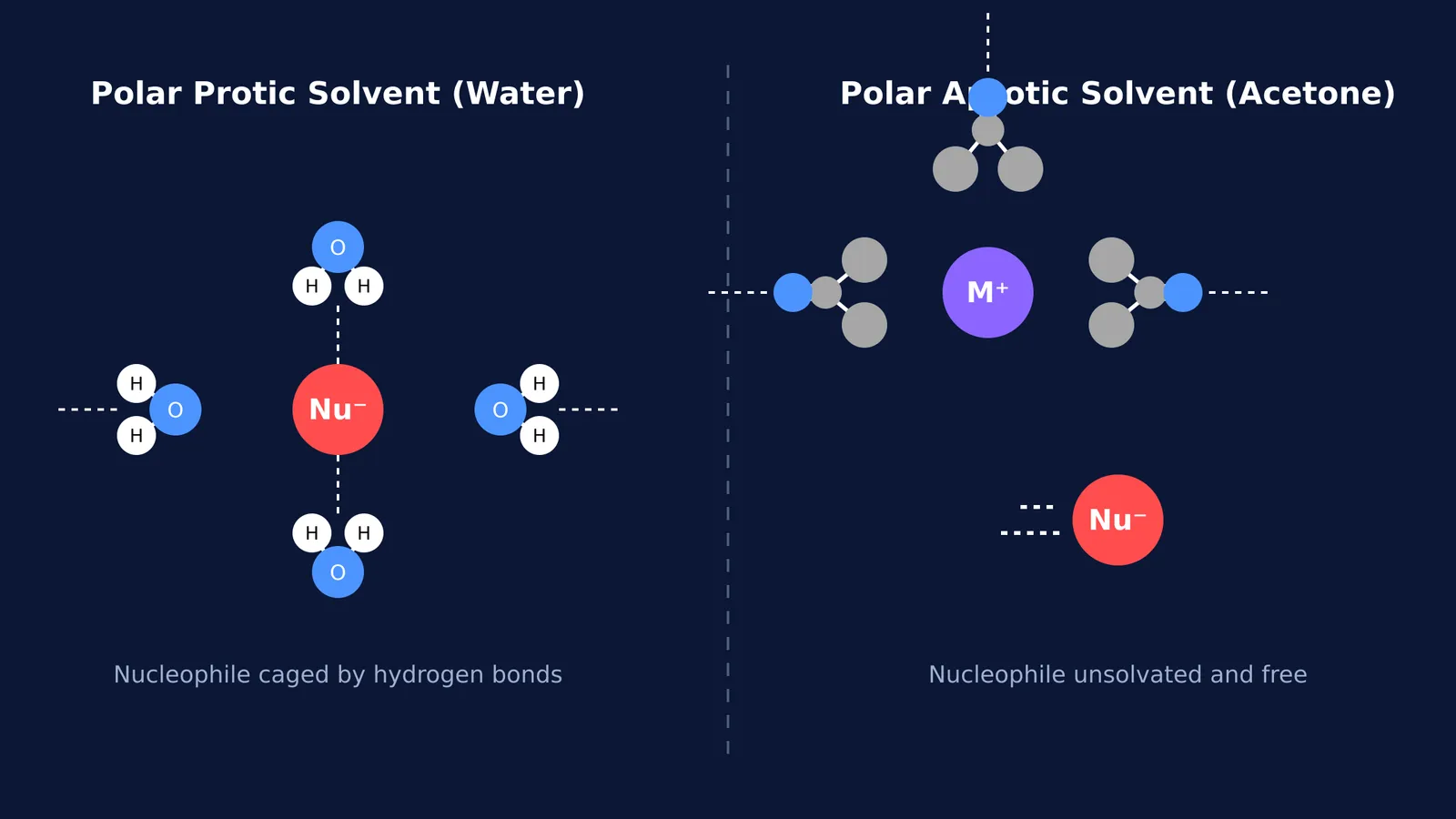
If you put a strong nucleophile into a polar protic solvent, the solvent molecules immediately surround it, trapping it in a "solvent cage" of hydrogen bonds. Before the nucleophile can attack the substrate, it has to shed this heavy coat of solvent molecules, which wastes energy and slows the reaction to a crawl.
Polar aprotic solvents solve this problem. Because they cannot form hydrogen bonds, they leave the negative nucleophile "naked" and unsolvated. The nucleophile remains highly reactive and free to strike. Switching from a protic to a polar aprotic solvent leaves the nucleophile free, massively speeding up the SN2 attack.
In named substitution reactions, this solvent choice is crucial. For instance, the Finkelstein reaction uses acetone, a polar aprotic solvent, to keep the iodide nucleophile free and drive a clean SN2 exchange of halogens. Furthermore, sodium iodide is soluble in acetone, whereas sodium chloride and sodium bromide precipitate out, pushing the equilibrium forward according to Le Chatelier's principle.
How to choose the right solvent for your reaction
When setting up a substitution reaction, use this framework to match the solvent to your desired path:
For an SN1 reaction: Choose a polar protic solvent like water, methanol or ethanol. You want a solvent that can stabilise the carbocation. Often, the solvent itself acts as a weak nucleophile.
For an SN2 reaction: Choose a polar aprotic solvent like acetone, DMSO or DMF. You must pair this with a strong, negatively charged nucleophile, ensuring it stays free to perform a backside attack.
Predicting whether a reaction will follow SN1 or SN2 is a classic stumbling block. If you are preparing for exams and mixing up substitution routes, the Fermi Concept Library has every concept in physics, chemistry, biology, mathematics and computing, each with its own lesson and its place in the map. When you tackle a problem, Fermi's AI tutor works out what you already know and builds a plan for the session, writing on a board to show you exactly how the solvent cages the ions.


