

On this page
In the ICSE 2025 Biology paper, part of one 3-mark question asked for "the collective term for the protective membranes" of the brain. The answer was one word, meninges. The CISCE examiners' report says most candidates listed the three layers instead. Here are the layers in order, how the fluid cushions the brain, and a five-line model answer.
How is the brain protected, from the outside in?
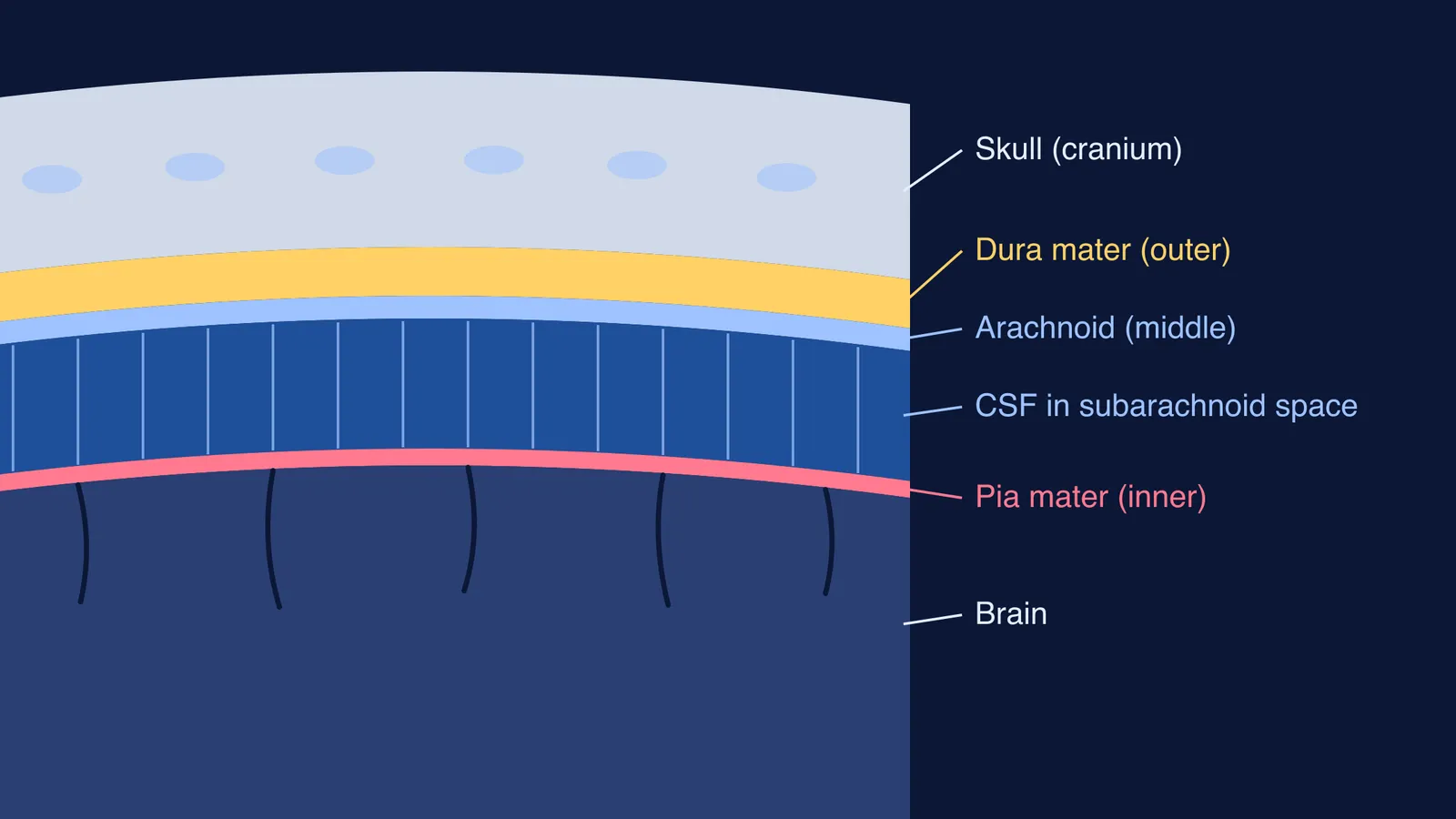
NCERT's Class 11 Biology book puts it in one sentence: "The human brain is well protected by the skull", and inside the skull it is covered by cranial meninges (Chapter 18, section 18.4). Going inwards from the outside, the layers are:
Skull (cranium): the bony box.
Dura mater: the outer layer, tough.
Arachnoid: NCERT calls it "a very thin middle layer".
Subarachnoid space: filled with cerebrospinal fluid (CSF).
Pia mater: the inner layer, "in contact with the brain tissue" in NCERT's words.
The word meninges means all three membranes together: dura mater, arachnoid and pia mater. CSF is not one of the meninges. It is the fluid that sits between two of them.
What do NCERT and ICSE call the layers?
NCERT Class 10 Science does not name the layers. Its section 6.1.3 says the brain "sits inside a bony box" and is "contained in a fluid-filled balloon which provides further shock absorption". Class 11 adds the three names, in the order dura mater, arachnoid, pia mater.
The ICSE syllabus for the 2028 exam lists "brain and spinal cord" under the Class X nervous system. In the 2025 report, CISCE's suggestions for teachers ask them to stress the names and the collective term, and give the mnemonic "D-P-A: Don't Push Anyone". The report's own notes describe dura mater as outermost, arachnoid as the middle layer and pia mater as innermost. So the letters help you recall the names, but if a question asks for the order, write dura, arachnoid, pia.
The same report shows a second trap. An assertion-reason question claimed the arachnoid layer helps speed up nerve impulses along axons, and the examiners noted that only a few candidates picked "both false". The meninges protect; they do not carry signals. For what does, see nerve vs neuron vs nerve fibre.
Why does cerebrospinal fluid work as a shock absorber?
A review in the European Annals of Otorhinolaryngology, Head and Neck Diseases, Sakka, Coll and Chazal (2011), gives the numbers. The mean CSF volume is 150 ml, with 25 ml in the brain's ventricles and 125 ml in the subarachnoid spaces. CSF is mainly secreted by the choroid plexuses and is renewed about four times every 24 hours. The authors list "hydromechanical protection of the central nervous system" as one of its jobs.
One part of that protection is buoyancy, the same Archimedes' principle you use in physics. A 2014 paper in the Asian Journal of Neurosurgery by Idris, Mustapha and Abdullah states that the average brain weighs 1,400 g without CSF and 50 g in CSF, and puts the difference down to CSF buoyancy.
How much lighter is a brain floating in CSF?
Using the 2014 paper's figures and g = 9.8 m/s²:
True weight: 1.4 kg × 9.8 = 13.7 N.
Apparent weight in CSF: 0.05 kg × 9.8 = 0.49 N.
Upthrust from the fluid: 13.7 − 0.49 ≈ 13.2 N.
Fraction of weight the fluid carries: 1,350 ÷ 1,400 ≈ 96%.
So in CSF the brain's effective weight is about a twenty-eighth of its true weight, and a layer of fluid sits between it and the bone. That helps explain the "further shock absorption" in NCERT's sentence.
How should you write this in a board exam?
Here is a model answer for "How is the human brain protected?":
The brain is enclosed in the bony skull (cranium).
Inside the skull it is covered by three membranes called the meninges.
From outside to inside they are the dura mater (tough), the arachnoid (thin, web-like) and the pia mater (delicate, in contact with brain tissue).
Cerebrospinal fluid fills the space between the arachnoid and the pia mater.
CSF cushions the brain like a shock absorber and buoys it up.
Before you submit, check:
Did you write the collective term "meninges" if the question asks for one word?
Are the layers outside to inside?
Did you place CSF between two layers, not call it a layer?
Next, revise multipolar, bipolar and unipolar neurons, and read how Thomas Willis mapped the circle of arteries in the brain.
If the chapter feels like a pile of separate names, the Fermi Concept Library gives every biology concept its own lesson and its place in the map. To practise physics arithmetic like the worked example, the Fermi Problem Library has worked problems with a step-by-step solver that explains the reasoning rather than printing an answer.


