On this page
Thomas Willis (1621–1675) was a pioneering English physician and a founding member of the Royal Society. Working during a turbulent century of civil war and scientific revolution, he helped shift medicine away from ancient, mystical theories and toward modern, observable anatomy. Today, his name is preserved in the centre of our heads.
Born on a farm in Wiltshire, Willis lived through the English Civil War as a Royalist. After qualifying in medicine at Oxford in 1646, he built a reputation that eventually led to him becoming the Sedleian Professor of Natural Philosophy. He worked alongside some of the greatest minds of the seventeenth century, including Robert Hooke, Robert Boyle, and the philosopher John Locke.
What is the Circle of Willis?
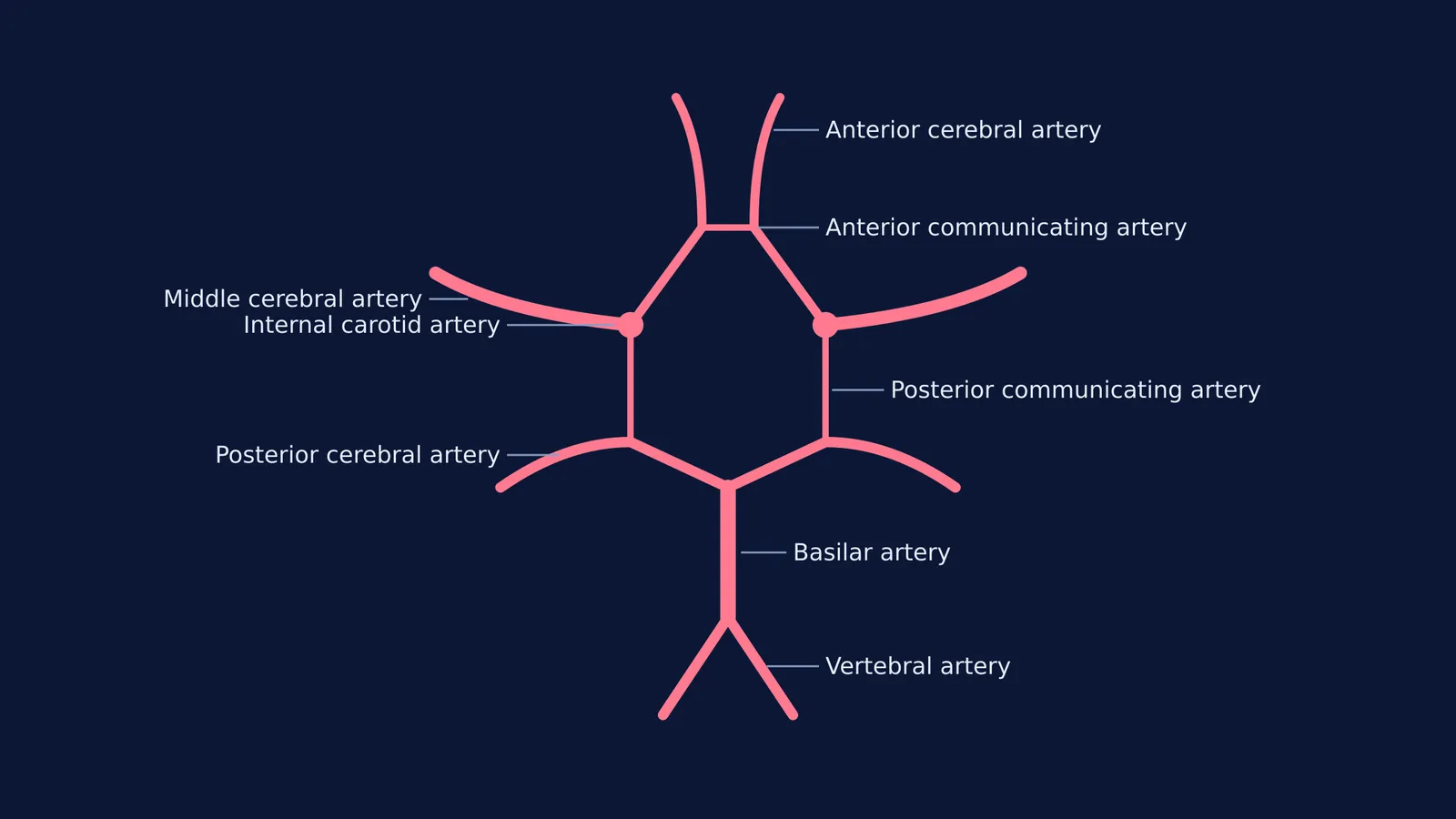
When students search for the Thomas Willis brain arteries circle, they are looking for what anatomists call the Circle of Willis—a circulatory anastomosis, or ring of connected arteries, located at the base of the brain. It acts as a meeting point for the major blood vessels that supply the brain with oxygen and nutrients.
The circle is composed of several key vessels:
The left and right internal carotid arteries, which supply the front parts of the brain.
The anterior cerebral arteries, connected by the anterior communicating artery.
The posterior cerebral arteries (fed by the basilar artery from the back of the neck), linked to the carotids by the posterior communicating arteries.
This circular arrangement is believed to create redundancy in the cerebral circulation. If one of the major arteries narrows or becomes blocked, blood from the other vessels can flow across the circle to keep the brain perfused and prevent tissue damage.
Interestingly, according to anatomical studies, natural human variation means that the classic, complete circle is seen in only about one-third of people (Circle of Willis). In others, certain connecting vessels might be exceptionally narrow or entirely absent, changing how blood routes through the brain during an emergency.
If you are studying human physiology and need to untangle how the circulatory and nervous systems interact, the Fermi Concept Library contains a lesson for every concept in biology, helping you map how these structures fit into the larger picture of the human body.
How did Thomas Willis map the brain's arteries?
In 1664, Willis published *Cerebri anatome* (Anatomy of the Brain), a minute and elaborate record of the anatomy of the brain and nerves. This work was a massive leap forward from the vague descriptions of his predecessors and even coined the term "neurology."
Willis did not work alone. He was part of a vibrant Oxford scientific circle. The famous architect Sir Christopher Wren provided the detailed, highly accurate drawings for the book, and Willis was assisted by fellow anatomists like Richard Lower. Through their careful dissections, Willis correctly identified the brain's cortex as the active substrate of cognition, replacing the older belief that thought happened purely within the fluid-filled ventricles.
He was also the first to number the cranial nerves in the order that anatomists still use today. For students exploring medical science now, visualising structures like the heart or the brain can be difficult from text alone. Just as Wren's drawings brought anatomy to life, modern interactive tools help you see how systems move. For instance, you can predict and watch pressure changes in a cardiac cycle pressure graph to understand blood flow beyond the brain.
Why did Thomas Willis taste urine?
Willis was not just a neuroanatomist; he was also a pioneer in the study of metabolism and disease. In 1674, he published *Pharmaceutice rationalis*, which contained his detailed observations on diabetes.
Before modern blood tests, physicians had to rely on their raw senses to diagnose illnesses. Ancient physicians in India, China, and the Arab world had known for centuries that the urine of diabetic patients was sweet.
Willis brought this observation into his own practice. He explicitly noted the sweetness of the urine (glycosuria) in his patients. His detailed clinical description led to the condition being temporarily known as "Willis's disease" in England. This sweet taste became a key diagnostic clue for what we now call diabetes mellitus.
Learning to separate and identify bodily messengers—like knowing the difference between a neurotransmitter and a hormone—is a core part of modern biology. Thomas Willis helped start that journey by looking closely at the brain's wiring and the body's chemical outputs, proving that careful observation is the foundation of science.