

On this page
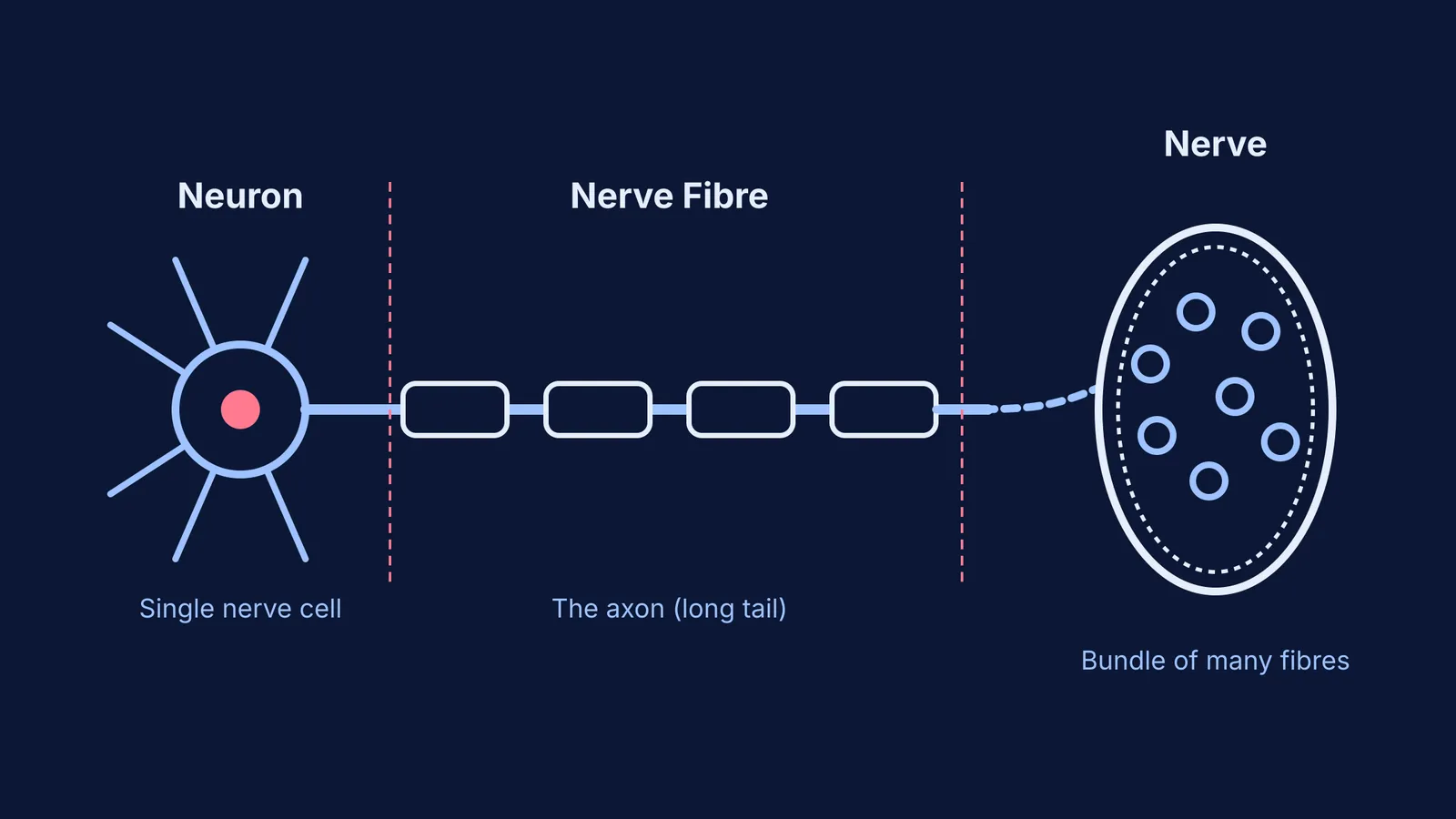
When studying the nervous system, three terms often get mixed up: neuron, nerve fibre, and nerve. They sound similar, but they refer to completely different structures.
To understand how your body sends signals, you need to know how these three pieces fit together.
What is a neuron?
A neuron (or nerve cell) is the fundamental functional unit of the nervous system. Its job is to generate and pass on electrical signals called action potentials.
According to Wikipedia's overview of neurons, a typical neuron consists of three main parts: a cell body (soma) containing the nucleus, short branching structures called dendrites that receive incoming signals, and one long projection called an axon that transmits the signal away to other cells.
What is a nerve fibre?
A nerve fibre is simply another name for the axon of a neuron. It is the individual microscopic "wire" that carries the electrical impulse.
In many nerve fibres, the axon is wrapped in an insulating layer called a myelin sheath, which helps the signal travel much faster. The axon of a human neuron can be up to 1 metre long, stretching from the base of the spine all the way down to the toes.
The myelin insulation is not continuous. It has small gaps called nodes of Ranvier, and each node is around one micrometre long. The electrical signal jumps from node to node, speeding up communication.
What is a nerve?
A nerve is an enclosed, cable-like bundle of many nerve fibres (axons) in the peripheral nervous system.
Just as a large fibre-optic cable contains thousands of thin glass strands, a nerve contains thousands of nerve fibres wrapped in protective connective tissue. According to basic neuroanatomy, each individual fibre is wrapped in endoneurium, bundles of fibres (fascicles) are wrapped in perineurium, and the entire nerve is enclosed in epineurium. Nerves act as the body's data highways, carrying sensory information to the brain and motor commands out to the muscles (like the rapid commands that explain why we sneeze).
Are nerves just bundles of neurons?
A common mistake is thinking a nerve is a bundle of entire neurons. It is not.
A nerve only contains the *axons* (nerve fibres) of those neurons. The cell bodies of these neurons are not inside the nerve itself. Instead, they sit safely inside the brain, the spinal cord, or in distinct clusters called ganglia near the spinal cord. If the bundle of nerve fibres is located entirely inside the central nervous system, it is not called a nerve at all; it is called a tract.
How to test your understanding
If you are revising for biology exams, use this quick checklist to make sure you have the concepts sorted:
The single cell: The fundamental unit generating the signal is the neuron.
The single thread: The long projection carrying the signal is the nerve fibre (axon).
The thick cable: The bundle of fibres in the peripheral nervous system is a nerve.
The CNS rule: A bundle of fibres inside the brain or spinal cord is called a tract.
When you are trying to picture these biological structures, reading a textbook is sometimes not enough. If you get stuck, you can explore the Fermi Concept Library. If you are struggling to tell these definitions apart, Fermi's AI tutor can work out what you already know, build a plan for the session, and teach through it — drawing the figure and checking understanding as it goes. Visualising how the microscopic nerve fibre forms the macroscopic nerve makes the whole system much easier to remember.


