

On this page
When you inhale dust, pollen, or pepper, these particles bypass the tiny hairs (cilia) that line the nasal cavity and settle on the mucous membrane. These microscopic, hair-like structures usually sweep mucus and trapped particles to the back of the throat to be swallowed. However, when a particle is large, sharp, or chemically irritating, it demands a faster, more forceful removal.
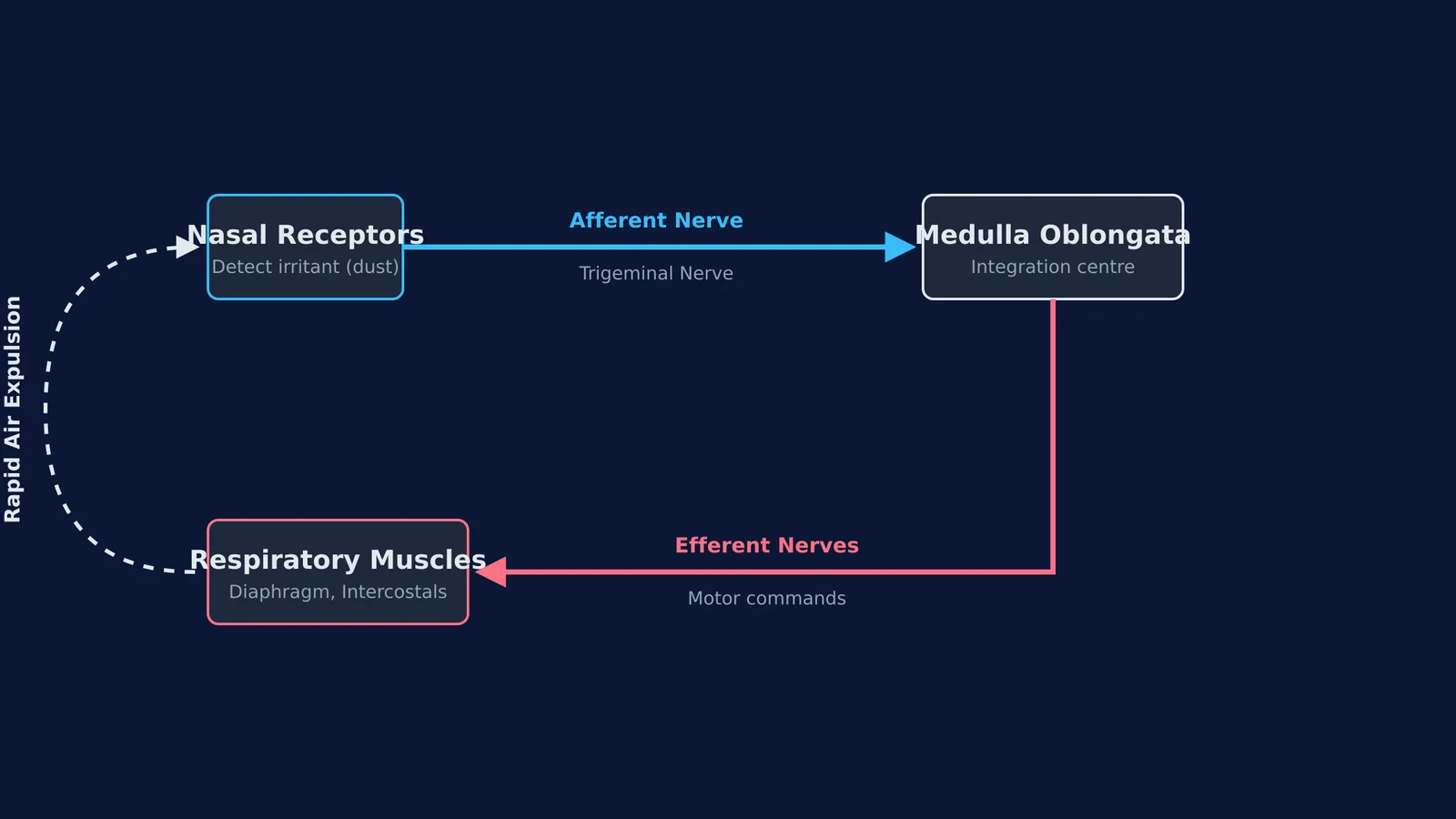
Here, the particles stimulate the nerve endings of the trigeminal nerve, the fifth cranial nerve responsible for sensation in the face. This irritation starts the sensory (afferent) phase of a reflex arc. According to research published in the journal *Cell* by Li et al., these sensory neurons release a neuropeptide called Neuromedin B, which carries the "urge to sneeze" signal to the brainstem (Li et al., 2021).
How does the brain process a sneeze?
The afferent signal travels to a specific region in the medulla oblongata called the Sneeze-Evoking Zone. This part of the hindbrain acts as the central processor for the reflex, integrating sensory inputs before making a decision. The medulla is a critical structure that controls many autonomic, involuntary functions, such as breathing, heart rate, and blood pressure. If the sensory signal is strong enough to pass the reflex threshold, the medulla coordinates a massive efferent (motor) response. It fires simultaneous commands down the spinal cord to the respiratory muscles, ensuring they act in perfect synchrony to generate the necessary force.
Understanding complex biological pathways like this is often easier when you can see them in action. In the Fermi Simulation Lab, you can interact with models of reflex arcs and neural pathways, which is especially useful for ideas that are easier to see than to read about.
What happens during the sneeze itself?
The physical sneeze happens in two rapid, highly coordinated phases:
The inspiratory phase: The diaphragm and external intercostal muscles contract forcefully, causing a deep, sudden inhalation of air. The glottis (the opening between the vocal cords) closes tightly to trap the inhaled air, allowing the chest cavity to build up substantial positive pressure in the lungs.
The expiratory phase: The abdominal muscles contract violently against the diaphragm while the glottis suddenly opens. The soft palate simultaneously shifts upwards to seal off the back of the throat, directing the high-pressure blast of air primarily out through the nasal passages and mouth to dislodge the irritant.
The result is a violent expulsion of air. A single sneeze can blast air at speeds of up to 30 metres per second (67 mph) and expel up to 40,000 droplets that can travel as far as 8 metres (26 feet) (Bourouiba, 2016; Cole & Cook, 199870046-x)).
Instead of simply firing independent droplets, a sneeze creates a complex, turbulent multiphase gas cloud. This warm, moist cloud dynamically traps the expelled droplets, helping them evade rapid evaporation in the surrounding air. The buoyancy of the cloud allows it to carry potential pathogens across a room much farther and faster than previously thought, highlighting why covering a sneeze is a vital physical intervention.
Why do some people sneeze in bright light?
While dust is a mechanical irritant, some of the population experiences the photic sneeze reflex—sometimes called ACHOO syndrome. For these individuals, stepping out of a dark room into bright sunlight triggers an involuntary sneeze response.
The exact cause is thought to be "optic-trigeminal summation". Because the optic nerve and the trigeminal nerve are located close to each other in the brainstem, sudden intense signals from the optic nerve can cross over and stimulate the sneeze centre, tricking the brain into thinking the nose is irritated.
If you are stuck mapping out neural pathways or struggling to connect the anatomy to the function, Fermi's AI tutor can work out what you already know and teach through the topic, drawing the figure and checking understanding as it goes.


