

On this page
Brain questions look easy until they are written as cases: a patient who cannot walk in a straight line, or a region whose damage stops breathing. Then two similar names, thalamus and hypothalamus, or pons and medulla, cost you the mark. This post sets out what each NCERT book says about the three parts of the brain and gives a method for turning a symptom into a region.
Where is the brain in the 2026-27 books?
The NEET (UG) 2026 syllabus lists the "central nervous system" under neural control and coordination. The detail is in section 18.4 of NCERT Class 11 Chapter 18, Neural Control and Coordination (reprint 2026-27).
For Class 10, the CBSE Science curriculum for 2026-27 lists the nervous system and "voluntary, involuntary and reflex action". The text is section 6.1.2 of NCERT Class 10 Chapter 6, Control and Coordination (reprint 2026-27).
The two books are not copies of each other. Class 11 names more parts. Class 10 is the one that says what the cerebellum does. If you prepare for NEET, read both.
What does the forebrain do?
From the Class 11 text:
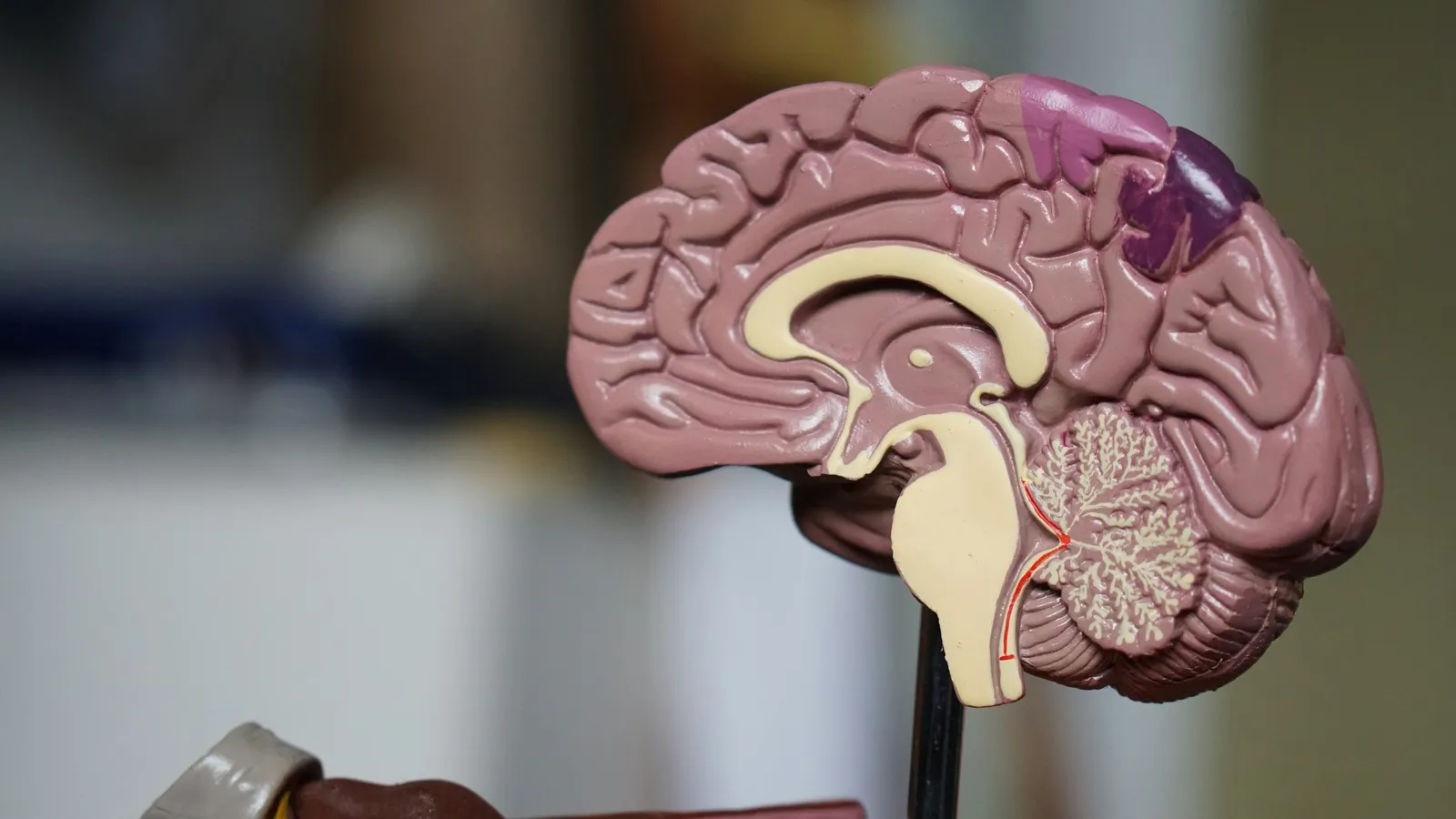
Cerebrum: the largest part. A deep cleft splits it into left and right hemispheres, joined by the corpus callosum. The outer cerebral cortex is grey matter, because neuron cell bodies are packed there. It has motor areas, sensory areas and association areas, which handle intersensory associations, memory and communication. The inner white matter is made of myelinated fibre tracts.
Thalamus: the cerebrum wraps around it. It is a major coordinating centre for sensory and motor signalling.
Hypothalamus: at the base of the thalamus. Its centres control body temperature and the urge to eat and drink, and its neurosecretory cells release hypothalamic hormones.
Limbic system: the inner parts of the hemispheres with deep structures such as the amygdala and hippocampus. With the hypothalamus, it regulates sexual behaviour, emotional reactions such as pleasure, rage and fear, and motivation.
Class 10 adds that the forebrain is the main thinking part, with separate areas for hearing, smell and sight, and that a centre in the forebrain tells you when you have eaten enough.
Clinical cases taught scientists much of this. In 1957, Scoville and Milner reported loss of recent memory after bilateral hippocampal lesions, that is, damage to the hippocampus on both sides of the brain. Our profile of Paul Broca and the speech area tells an earlier story of the same kind.
What do the midbrain and hindbrain do?
Midbrain: lies between the thalamus and hypothalamus above and the pons below. The cerebral aqueduct, a canal, passes through it. Its dorsal side has four round swellings, the corpora quadrigemina.
Pons: fibre tracts that connect different regions of the brain.
Cerebellum: a very folded surface that makes room for more neurons. Class 10 says it is responsible for precise voluntary actions and for keeping posture and balance, as in walking in a straight line, riding a bicycle or picking up a pencil.
Medulla oblongata: joins the spinal cord. Class 11 says it contains centres for respiration, cardiovascular reflexes and gastric secretions. Class 10 says involuntary actions such as blood pressure, salivation and vomiting are controlled by the medulla.
The brain stem is the midbrain, pons and medulla. It connects the brain to the spinal cord. Note what is missing: the cerebellum is part of the hindbrain but not of the brain stem.
Worked example: from symptom to region
Each case below is a made-up classroom example. Use two steps: place the job in a region, then pick the part.
A person has strong muscles but cannot walk in a straight line or pick up a pencil smoothly. Precision and balance: hindbrain, cerebellum.
Damage to a region would stop the body's breathing and heart-rate reflexes. Vital involuntary centres: hindbrain, medulla.
A person's body temperature and thirst are no longer regulated. Hindbrain or forebrain? These centres are in the forebrain, in the hypothalamus.
Signals cannot cross between the left and right hemispheres. Forebrain, corpus callosum.
Which is not part of the brain stem: midbrain, pons, cerebellum, medulla? Cerebellum.
Which part has the cerebral aqueduct passing through it? Midbrain.
Write the region before the part every time. It takes two seconds and blocks the commonest swaps.
Which mistakes cost marks?
Putting the cerebellum in the brain stem.
Placing the hypothalamus in the hindbrain because it controls involuntary functions.
Reversing grey and white matter. Grey is the outer cortex of cell bodies; white is the inner myelinated tracts.
Giving balance to the medulla, or breathing to the cerebellum.
Adding functions neither book states. If NCERT does not give a job for a part, do not invent one in a board answer.
Labels stick better when someone checks them as you go. Fermi's AI tutor draws the figure and checks understanding as it goes, so you can label a brain section and get feedback straight away.
A practice routine
Draw a sagittal section of the brain from memory and label every part named above.
Write one card per part with its region and job. Test yourself in mixed order.
Write five new symptom cases and solve them with the two-step method.
Revise the nerve impulse and synapse with our guide to neural control and coordination.
Tonight, list the three parts of the brain stem and the one hindbrain part that is not in it.


