

On this page
A can of peas or fish can sit in a cupboard, with no fridge, and stay safe. Canning heats the food enough to kill the microbes that could grow in it, then seals it so nothing gets back in. Each step also tells you which cans to throw out.
How does canned food stay preserved?
Under US federal food rules, commercial sterility means heat has made the food free of microorganisms that could grow in it without refrigeration, and of live microbes, including spores, that matter for public health. A hermetically sealed container is one designed to keep microorganisms out, so the food stays commercially sterile.
In France, Nicolas Appert preserved food by heating it and sealing it in containers that kept air out, publishing his method in 1810; he used glass bottles, not tins (Grace's Guide). On 25 August 1810, Peter Durand was granted a British patent for preserving food by heating and sealing, and wrote that he used tin cases instead of glass (Grace's Guide).
Why is pH 4.6 the number that matters?
Canning is designed above all to beat Clostridium botulinum. CDC explains that its spores act like protective coatings and usually do no harm when eaten, but with little oxygen, little acid and enough water they can grow and make one of the most lethal toxins known. A sealed can has little oxygen, so acidity decides the risk.
US rules define low-acid foods as those with a finished pH above 4.6 and a water activity above 0.85 (21 CFR 113.3). The National Center for Home Food Preservation says botulinum spores are very hard to destroy at boiling-water temperatures, and that low-acid foods should be sterilised at 240 to 250°F (about 116 to 121°C), which pressure canners reach at 10 to 15 PSIG. CDC adds that a boiling-water canner will not protect against botulism in low-acid foods.
Your pressure cooker works on the same principle: higher pressure, hotter boiling water. Milk is protected by heat too, as our post on pasteurised versus UHT milk explains.
Worked example: which side of 4.6?
Peas or fish: CDC lists fresh vegetables, meat, poultry, fish and seafood as low-acid foods. They need pressure processing.
Tomatoes: the federal definition does not count tomato products below pH 4.7 as low-acid. Some sit slightly above 4.6, so home canners add lemon juice or citric acid.
Pickles: an acidified food is a low-acid food with acid added to bring its pH to 4.6 or below, and may be called a pickle.
If pH feels shaky, the Fermi Concept Library has a lesson on every concept in chemistry and biology. Many packaged foods rely on chemistry rather than heat, covered in how sodium benzoate, sorbic acid and BHT keep food fresh.
What is a tin can made of?
A "tin can" is mostly steel. Tinplate is sheet steel coated with a thin layer of tin to slow rusting, and making tin cans is now its main use (Tinplate, Wikipedia). The same source notes that tin protects the iron only while the tin surface stays unbroken, which is why a deep dent or rust patch matters. Zinc works differently: see why galvanised iron does not rust.
Why is a bulging can dangerous?
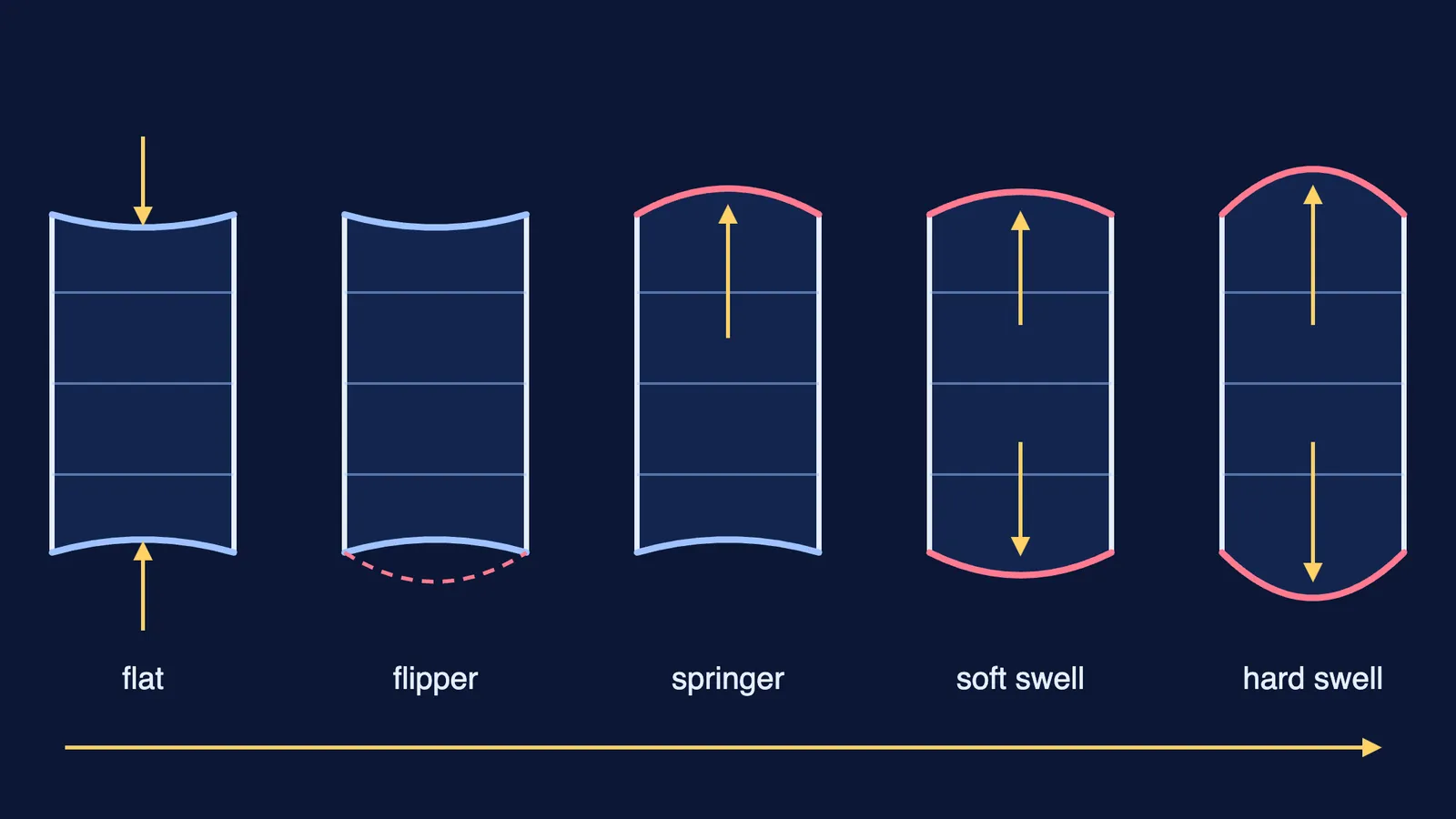
A healthy can has both ends curved inward. The FDA's laboratory manual for canned food calls this a flat can, and says that during spoilage cans may progress from normal to flipper, springer, soft swell and hard swell (FDA Bacteriological Analytical Manual, chapter 21A). It names microbial spoilage, and hydrogen made when acids in the food react with the can's metal, as the principal causes of swelling, and says spoilage usually follows leakage or underprocessing. It warns that badly swollen cans may spray out contents that may be toxic.
You cannot tell from outside whether toxin is present. CDC says to throw out any container that is leaking, bulging or swollen, or that spurts liquid or foam when opened. Some microbes spoil canned food without making gas, the FDA manual adds.
Botulism is a medical emergency: CDC says anyone with signs of it should see a doctor or go to the emergency room immediately.
How do you check a can before you eat from it?
The FDA manual's can conditions give a quick check at the shop or at home:
Look at each end: it should curve slightly in. An end that bulges or pops out is a springer or flipper: leave it.
Compare both ends. Any outward bulge, even slight, means throw it out.
Check seams and body for leaks, deep dents and rust, where the seal or tin layer fails.
On opening, watch for spurting liquid or foam, or a bad smell. If so, throw it out untasted.
Gas pressure pushing on a can's ends is easier to see than to read; the Fermi Simulation Lab has interactive simulations for ideas like that.


