

On this page
Two cartons of milk can sit in the same shop: one in the chiller, one on an open shelf. Both were heated to make them safe. The difference is how hot, for how long, and what that heat leaves alive. Here is what the official codes say.
What is the difference between pasteurised and UHT milk?
Pasteurisation is heating milk to cut any disease-causing micro-organisms down to a level where they are no longer a significant health hazard, as defined in the Codex Alimentarius Code of Hygienic Practice for Milk and Milk Products.
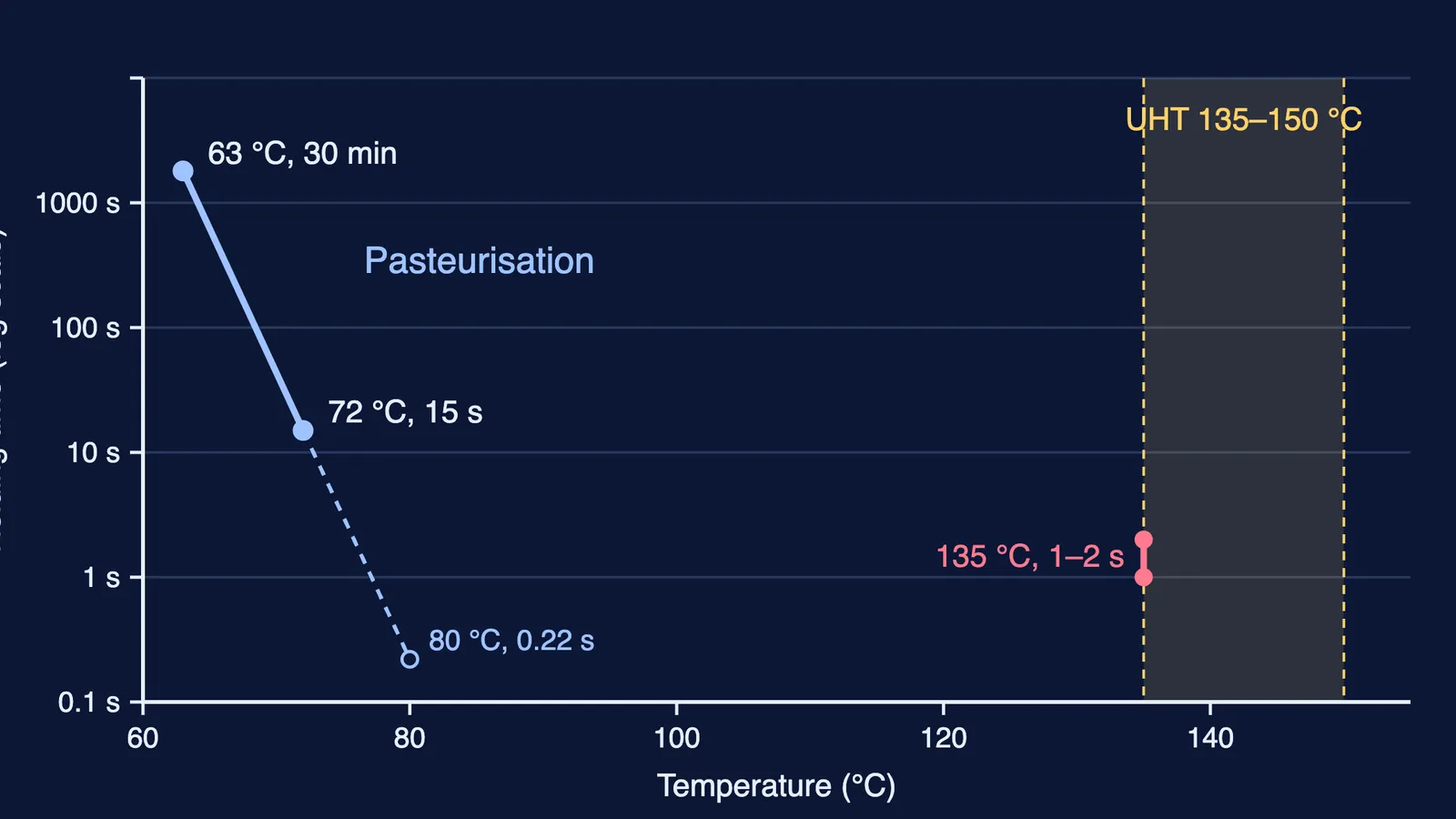
The minimum is 72°C for 15 seconds in a continuous flow (HTST, high temperature short time) or 63°C for 30 minutes in a batch (LTLT, low temperature long time), according to the Codex milk code.
UHT (ultra-high temperature) treatment is normally in the range of 135 to 150°C, held just long enough to make the milk commercially sterile, according to the same Codex milk code.
In India, FSSAI's audit checklist for milk processing lists 72°C for 15 seconds for HTST, 63°C for 30 minutes for batch pasteurisation and 135°C for 1–2 seconds for UHT. It also asks dairies to cool pasteurised milk to 4°C or lower immediately.
What does pasteurisation kill, and what survives?
Pasteurisation is designed around Coxiella burnetii, the most heat-resistant pathogen likely to be in milk that does not form spores. The Codex milk code sets it to achieve at least a 5-log reduction of that bacterium in whole milk.
What pasteurisation does not kill is spores. Hong Kong's Centre for Food Safety explains that it kills the vegetative (actively growing) cells of Bacillus cereus but not its heat-resistant spores, and that spores of Clostridium species survive too. B. cereus stops multiplying below 4°C, but at room temperature its spores germinate and grow quickly. That is why pasteurised milk lives in the fridge, where it keeps for several days, the CFS says.
Worked example: why a few degrees save so much time
Use the two Codex points: 63°C needs 1,800 seconds and 72°C needs 15 seconds (Codex milk code).
Ratio of times: 1,800 ÷ 15 = 120, over a 9°C rise.
On a log scale, log 120 ≈ 2.08, so the time falls tenfold for every 9 ÷ 2.08 ≈ 4.3°C.
Push on to 80°C, 8°C hotter than 72°C: 15 ÷ 10^(8 ÷ 4.3) ≈ 0.2 seconds.
The Codex code gives an extrapolated time of about 0.22 seconds at 80°C, close to our estimate. It also warns that extrapolating above 72°C needs great caution, because times that short are almost impossible to verify. Food scientists call that 4.3°C step the z-value. If logarithms still feel slippery, the Fermi Concept Library covers every concept in physics, chemistry, biology, mathematics and computing.
Why does UHT milk not need a fridge until opened?
It takes two things working together: enough heat, and a sealed, germ-free pack.
Commercially sterile means no living micro-organisms or spores that could grow in the closed container at normal, unrefrigerated temperatures, as defined in the Codex milk code. UHT is a continuous process: the milk is heated either by mixing steam straight into it or by passing it over a heat-exchanging surface, then filled and sealed aseptically. To check the process, the product must stay stable at room temperature, tested to the end of its shelf life or by 7 days at 55°C (or 15 days at 30°C), according to the same code.
The Centre for Food Safety puts it simply: sterilised milk can be stored at room temperature and has a longer shelf life than pasteurised milk. For how the layered carton keeps light and air out, read our post on how tetra pack milk lasts months without a fridge.
Once you open the carton, that protection is gone: air, a spoon or a glass can bring in microbes, so opened UHT milk needs the fridge.
How should you store pasteurised and UHT milk?
The Centre for Food Safety advises keeping milk that needs refrigeration at 4°C or below, or following the storage instructions on the label, and using perishable milk as soon as possible after opening (CFS advice). In practice:
Pasteurised pouch or bottle: check the use-by date when you buy it, and put it in the fridge as soon as you get home.
UHT carton, sealed: a cool cupboard is fine until the date on the pack.
UHT carton, opened: into the fridge, and finish it within the time printed on the carton.
No reliable fridge, a long journey or a power cut: a sealed UHT carton is the one that does not depend on cold.
Many Indian homes boil milk as well; our post on why boiled milk lasts longer than raw milk explains what that heat does. Cartons and pouches are often homogenised too, a separate step that the Codex code notes a UHT plant can include, and we explain it in what homogenised milk means.
Next time you hold a carton, look for one word, pasteurised or UHT: it tells you what the heat killed and where the milk should live.


