

On this page
Leave a glass of fresh milk from the local dairy in the fridge overnight and by morning a band of cream sits on top. A packet labelled "homogenised" does not do this. The difference is one machine step that squeezes the fat into smaller pieces, and it is a neat lesson in emulsions and Stokes' law.
What does homogenised milk mean?
Milk is an emulsion: droplets of one liquid (fat) spread through another (skim milk, the watery part that carries proteins, sugar and salts). Our explainer on types of colloids: aerosol, emulsion, foam and gel sets out the families.
Homogenisation is a mechanical treatment whose purpose is "stabilising fat emulsions against gravity separation", in the words of the Tetra Pak Dairy Processing Handbook. The same handbook says homogenisation cuts the average fat globule from about 3.5 µm in diameter to below 1 µm, and credits the invention of the process to Gaulin in 1899.
How does a homogeniser break the fat?
The Dairy Processing Handbook describes the steps:
The milk is warmed, normally to 55-80 °C, so the fat is liquid.
A pump pushes it at a pressure often in the range of 10-25 MPa (100-250 bar).
It is forced through a gap between a seat and a forcer of approximately 0.1 mm.
The milk leaves the gap as a fast, turbulent jet. Swirling eddies pull and stretch each globule until it breaks.
The new droplets are coated with proteins from the milk, mainly casein, instead of their original membrane.
Because the same fat is now split into many small droplets, the fat-water surface grows four- to six-fold, the handbook reports. It adds that homogenisation reduces creaming and may also reduce the tendency of globules to clump or coalesce.
That heat step is covered in how tetra pack milk lasts months without a fridge.
Why does smaller fat stop cream from rising?
Fat is lighter than skim milk, so each globule floats up slowly. The handbook's separator chapter works this out with Stokes' law, using a fat density of 980 kg/m³, a skim milk density of 1028 kg/m³ and a viscosity of 1.42 cP at about 35 °C.
Its result: a 3 µm fat globule rises at 0.6 mm per hour, and a globule twice that size rises at 2.4 mm per hour. Doubling the diameter makes it four times faster, because Stokes' law says the rising speed grows with the square of the diameter. Our post on why cream rises to the top of milk goes through the density side in more detail.
Stokes' law is only part of the story for raw milk. A chapter by Huppertz, Uniacke-Lowe and Kelly in Advanced Dairy Chemistry (2020) explains that the rate of creaming is set by interactions at the membrane around the fat globules that make them clump together, particularly at low temperatures. It also notes that homogenisation, centrifugal separation and heat treatment can change how milk creams.
Worked example: what happens to one globule?
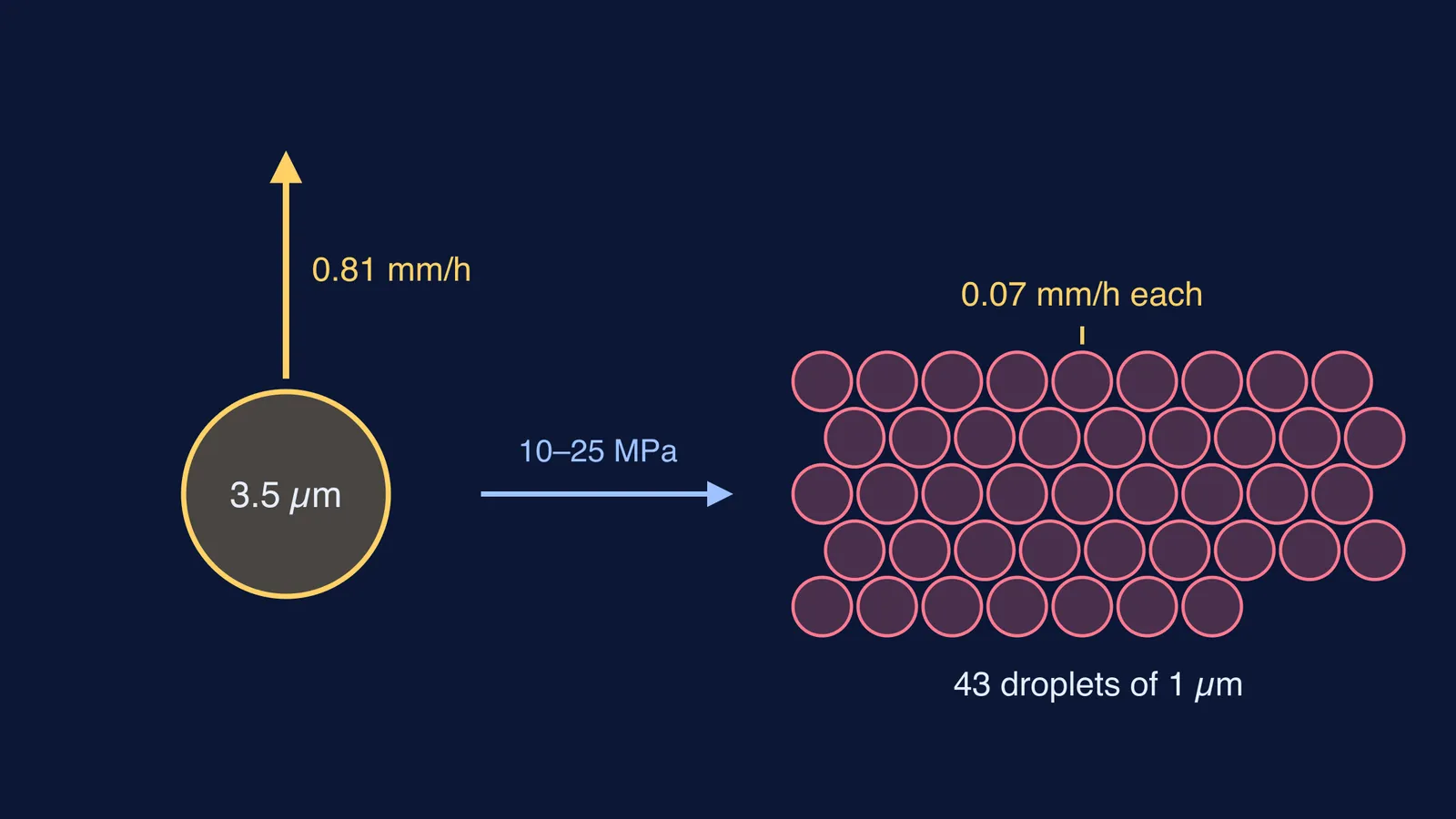
Take one average 3.5 µm globule, use the handbook's Stokes values, and break it into 1 µm droplets.
Count the droplets. Volume goes as diameter cubed, so the number is (3.5 ÷ 1)³ = 42.9, about 43 droplets.
Compare the surface. Area goes as diameter squared: 43 × 1² = 43 against 3.5² = 12.25, about 3.5 times more surface.
Compare the speed. Speed also goes as diameter squared, so each droplet rises (3.5)² = 12.25 times more slowly. With the handbook's values, our calculation gives about 0.8 mm per hour for the big globule and about 0.07 mm per hour for each small droplet.
Put it in a day. Over 24 hours the big globule could climb about 20 mm; each small droplet climbs under 2 mm, too little to build a visible cream layer.
The Fermi Simulation Lab has interactive simulations for the ideas that are easier to see than to read.
How can you check this at home?
You need two glasses, milk from a local dairy that has not been homogenised (boiled and cooled as usual), and a packet marked homogenised.
Fill both glasses to the same height and label them. If the boiled milk has a skin on top, lift it off first.
Leave both in the fridge overnight without stirring.
In the morning, look at the top of each glass from the side. Note whether there is a cream line and roughly how thick it is.
Explain each glass in one sentence using emulsion, droplet size and density.
If the colloid words in that answer still feel shaky, the Fermi Concept Library has a lesson for every concept in chemistry and physics, each with its place in the map.
Next time you pour from a packet, picture the 43 droplets that used to be one globule.


