On this page
Leave a bottle of raw milk in the fridge overnight and a thick, pale layer collects at the top. That layer is cream, and it ends up there because of an idea from Class 9 and 11 physics: density and buoyancy.
Milk is mostly water with fat suspended in it as tiny droplets called fat globules. In ordinary milk they average about 3.5 µm across, according to the Tetra Pak Dairy Processing Handbook chapter on homogenisers. Cream is simply milk in which these globules have crowded together. The watery part left behind, with its proteins, sugar and minerals, is skim milk.
Why does cream rise to the top of raw milk?
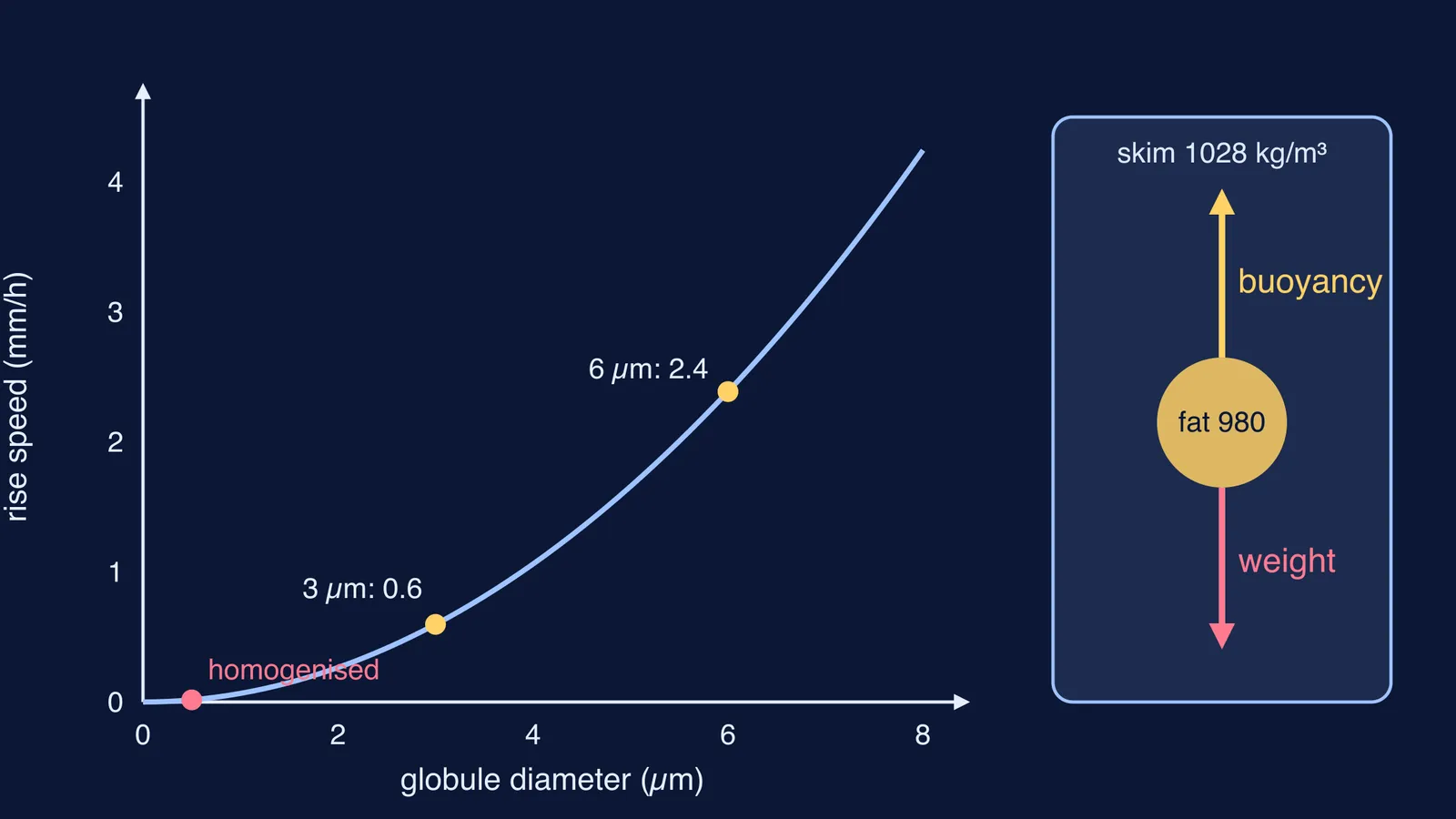
Milk fat has a density of about 980 kg/m³, while skim milk is about 1,028 kg/m³, according to the Dairy Processing Handbook chapter on centrifugal separators.
By Archimedes' principle, the upward push on a globule (buoyancy) equals the weight of the skim milk it displaces, which is about 5% more than the globule's own weight. That small net force makes the globule drift up, and over time the globules collect at the surface as cream.
The same handbook gives Stokes' law for how fast a small sphere rises or sinks: v = d²(ρp − ρl)g / 18η, where d is the diameter, ρp and ρl are the densities of the sphere and the liquid, g is gravity and η is the liquid's viscosity.
How fast does a fat globule rise? A worked example
The Dairy Processing Handbook works this out for a 3 µm globule in milk at about 35 °C, with a viscosity of 1.42 × 10⁻³ kg/m·s and a density difference of 48 kg/m³. The answer is about 0.6 mm per hour. You can check it yourself:
d² = (3 × 10⁻⁶ m)² = 9 × 10⁻¹² m²
d² × 48 × 9.81 ≈ 4.24 × 10⁻⁹
18 × 1.42 × 10⁻³ ≈ 0.0256
v ≈ 4.24 × 10⁻⁹ / 0.0256 ≈ 1.66 × 10⁻⁷ m/s, which is about 0.6 mm per hour
Now use the d² in the formula to see what size does:
Double the diameter to 6 µm: speed goes up four times, to about 2.4 mm per hour.
Shrink it to 0.5 µm: speed falls to 1/36 of the 3 µm value, about 0.017 mm per hour.
Rise through 10 cm of milk at 0.6 mm per hour: 100 ÷ 0.6 ≈ 167 hours, close to a week.
Why does cold raw milk form a cream line faster than the maths predicts?
At 0.6 mm an hour, a bottle would take days to separate. In reality, the Dairy Processing Handbook notes, globules cluster into larger aggregates that rise much faster, because of the d² term. In cold raw milk this clumping is called cold agglutination.
A 2018 study by Steffen Hansen, Lotte Larsen and Lars Wiking in the Journal of Dairy Research reports that agglutination causes firm cream layers in cow's milk and is believed to come from immunoglobulins interacting with fat globules. Tracking IgM, they saw clear agglutination at 5 °C, much less at 15 °C, and none they could detect at 20 °C or 37 °C. Raising the 20-second pasteurisation temperature from 69 °C to 71 °C and 73 °C inactivated progressively more IgM and reduced agglutination.
Why doesn't packet milk form a cream layer?
Many packet milks are homogenised: pushed at high pressure through a narrow gap to break up the fat. Homogenisation reduces fat globules from an average of 3.5 µm to below 1 µm, according to the Dairy Processing Handbook, which notes that smaller globules form a cream line more slowly, as Stokes' law predicts. The same handbook credits Gaulin with inventing the process in 1899.
How do dairies separate cream with centrifuges?
Gravity is slow, so dairies spin the milk: in a centrifugal separator, the g in Stokes' law is replaced by a much larger centrifugal acceleration. The handbook's example, a bowl spinning at 5,400 rpm with a radius of 0.2 m, separates about 6,500 times faster than gravity, according to the Dairy Processing Handbook. Our 3 µm globule would then move about 3.9 metres an hour instead of 0.6 mm. The heavier skim milk is flung outward and the lighter cream collects towards the centre.
The same chapter records that Gustaf de Laval demonstrated his continuous cream separator in Stockholm on 15 January 1879.
Try it: a kitchen check on the physics
Fill one tall clear glass with non-homogenised milk and another with homogenised packet milk.
Refrigerate both and mark the top of any cream layer every few hours.
Predict first: which glass shows a line, and how fast would it grow if globules rose alone?
Compare with the handbook's 0.6 mm per hour estimate. A much faster cream line is evidence of clumping.
If buoyancy and terminal velocity are easier to see than to read, the Fermi Simulation Lab has interactive simulations for exactly those ideas. For the formula itself, the Fermi Concept Library gives each physics concept its own lesson.