

On this page
A carton of milk can sit in a kitchen cupboard for months, yet a pouch of pasteurised milk has to live in the fridge. The difference is two pieces of science working together: a very hot, very short heat treatment, and a package that is sterile inside and closed to light and air.
What does UHT treatment actually do to milk?
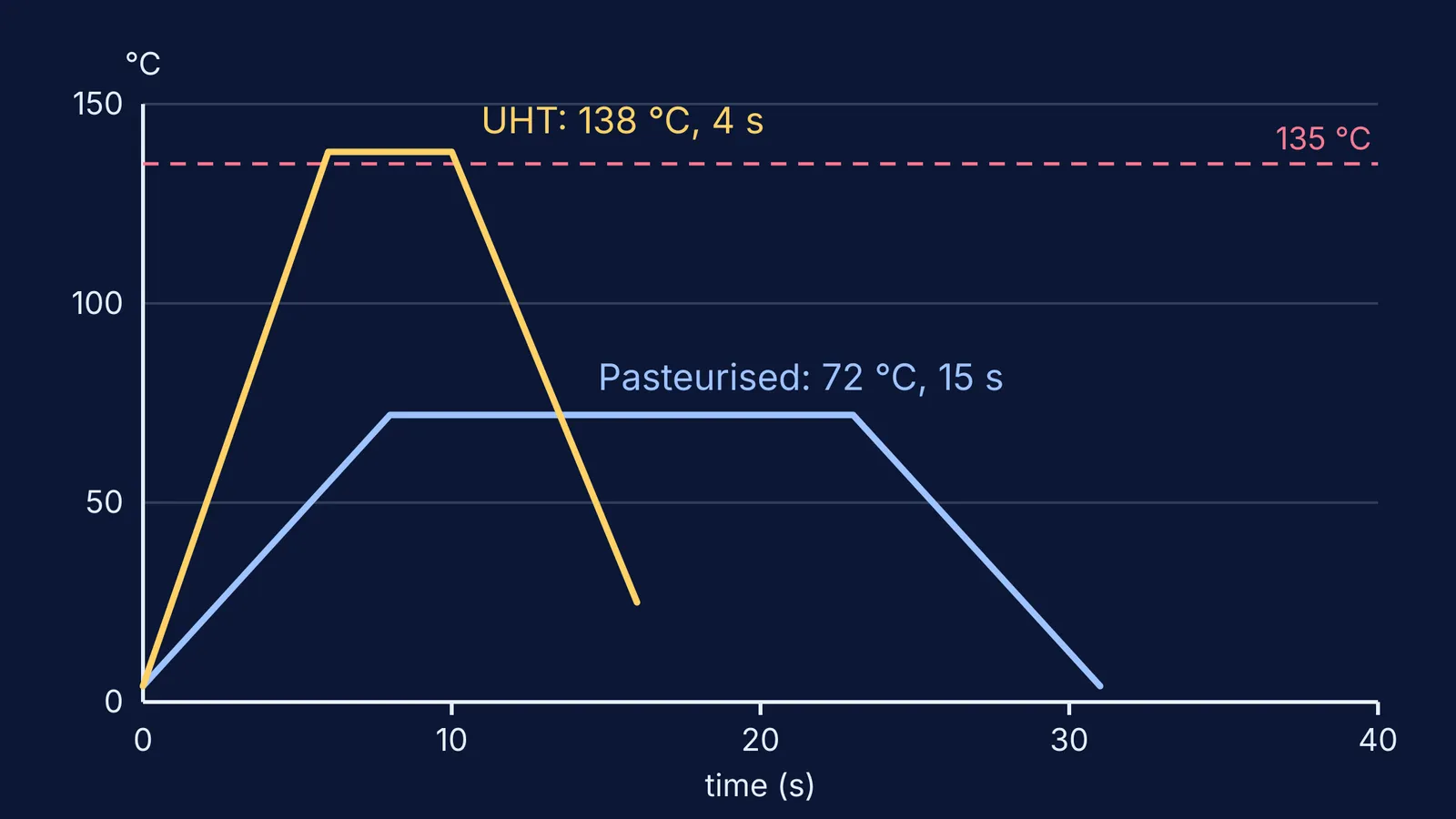
UHT stands for ultra-high temperature. According to Tetra Pak's Dairy Processing Handbook, UHT usually means heating milk to 137–142 °C for 4–6 seconds, depending on the product, and the EU definition it quotes sets the floor at not less than 135 °C with a suitable holding time. Fast heating and fast cooling keep changes to taste and colour small.
Compare that with ordinary pasteurised milk. Hong Kong's Centre for Food Safety gives 72 °C for more than 15 seconds as a typical pasteurisation. That is a much gentler treatment, so the milk must be kept chilled. The same page gives 132 °C for more than 1 second as a UHT example and says this "destroys virtually all microorganisms". For the older method, read our explainer on how pasteurisation preserves food.
Does all that heat ruin the nutrition? The handbook reports thiamine (vitamin B1) losses of less than 3% in UHT milk. It concludes that UHT and pasteurised milk are "of about the same quality". Milk sterilised for much longer inside its bottle loses more, about 20–50% of its thiamine.
Why is a few seconds of heat enough to kill the germs?
The hardest things to kill in milk are bacterial spores, tough resting forms that survive heat which kills ordinary bacteria. You can read how bacterial endospores were discovered on Fermi News. This is also why boiling water does not kill every germ.
Food scientists measure killing power in decimal reductions, each one cutting the number of living spores by a factor of ten. The Dairy Processing Handbook explains that a sterilising effect of 9 means that out of 10⁹ spores fed into the process, only 1 survives.
Worked example. Suppose (an invented number, for practice) that raw milk carries 1,000 spores per litre, and a dairy fills one million 1-litre cartons.
Spores going in: 1,000 × 1,000,000 = 10⁹.
A sterilising effect of 9 divides that by 10⁹.
Spores expected to survive: about 1, across the whole million cartons.
That is the logic of heat treatment: you never reach zero, but you make survival very unlikely. Exponential decay like this is easier to see than to read, which is where the Fermi Simulation Lab can help, with interactive simulations for ideas like this.
What do the layers of a tetra pack do?
Killing the microbes only helps if nothing new gets in. The handbook defines aseptic packaging as filling a commercially sterile product into sterilised containers and sealing them so that microbes cannot get back in.
The carton itself is a laminate. Tetra Pak's packaging materials page says about 70% of a carton is paperboard, which gives it shape and strength. Polymer layers keep out moisture and bond the board to a layer of aluminium foil eight times thinner than a human hair. That foil protects the milk from light and oxygen; the handbook says a package for long unrefrigerated storage must give high protection against both.
Even sterile milk does not last forever. The handbook notes that a carton might carry 3 months of shelf life for a local market or 9 months for export. What eventually limits it is slow chemistry, such as enzymes that survive heating and cause gelling or bitter flavours. A 2005 study in Ciência e Tecnologia de Alimentos found the heat-resistant spore-former *Bacillus sporothermodurans* in 54.5% of the whole and skimmed UHT milk products it tested from southern Brazil. The authors note it is described as not causing disease, though they call for more study because it was so common.
How long does tetra pack milk last after opening?
Once you open the carton, air and microbes get in and it becomes ordinary milk again. The Centre for Food Safety advises refrigerating opened UHT milk at 4 °C or below and finishing it within the period printed on the pack, usually two to seven days.
A quick carton checklist for your home:
Before buying: check the expiry date.
Before opening: an unopened carton can stay at room temperature until that date.
After opening: write the date on the carton and put it straight in the fridge.
Before drinking: smell it and look at it; a sour smell or a change in texture means throw it out.
Next time you open a carton, read the label for "UHT" and the storage instructions. If you want to revise sterilisation, spores or enzymes, the Fermi Concept Library has a lesson for every concept in biology and chemistry.


