

On this page
Before refrigeration, humanity survived the winter by manipulating chemistry. Today, whether you are studying for a biology exam or deciding how long to keep a jar of homemade garlic oil, the rules of food preservation remain the same: you must create an environment where microbes cannot survive.
From osmosis to protein denaturation, every traditional preservation method targets a specific vulnerability in a bacterial cell.
How do salt and sugar preserve food?
Salt and sugar do not actively kill bacteria; they dry them out through osmosis. When you pack meat in salt or boil fruit in syrup, you are adding solutes that bind to the free water in the food.
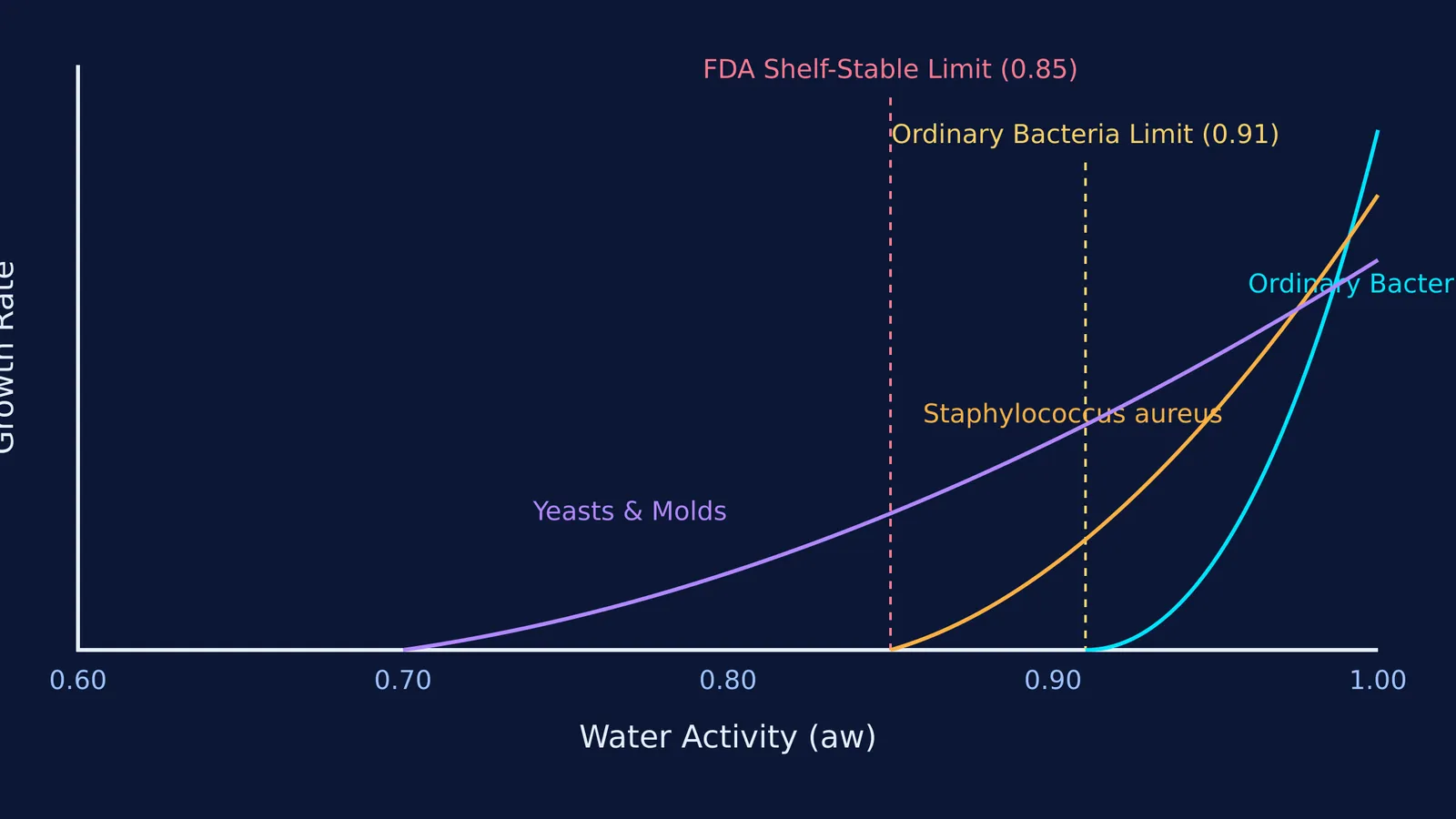
Food scientists measure this available free water as "water activity" (aw), where pure water is 1.0. Most ordinary spoilage bacteria require an aw above 0.91 to grow. If you lower it beneath that line, the water inside the bacterial cell rushes out to balance the concentration gradient, causing the cell membrane to shrivel and the microbe to become inactive.
The FDA considers foods to be shelf-stable without refrigeration only when their water activity drops to 0.85 or less, which is the minimum threshold needed to inhibit the highly drought-tolerant pathogen *Staphylococcus aureus*. It takes a 13% salt solution or a 55% sugar solution to reduce water activity to 0.91. If you are struggling to picture how water moves across the cell membrane, the Fermi Concept Library explains osmosis and concentration gradients step by step.
How does vinegar stop microbes?
While salt starves microbes of water, vinegar attacks their internal chemistry. Vinegar is a dilute solution of acetic acid, and it preserves food by drastically lowering its pH.
Unlike the infectious agents covered in our guide to viruses, viroids and lichens: the misfits of five-kingdom biology, the bacteria that cause foodborne illness are living cells with strict chemical requirements. A microbial cell is typically neutral inside. When submerged in an acidic environment, hydrogen ions penetrate the bacterial cell wall, forcing the microbe to spend all its energy pumping protons back out.
For food safety, the magic number is pH 4.6. The FDA strictly regulates canned foods because *Clostridium botulinum*—the bacterium that causes botulism—cannot grow or produce its deadly toxin in environments with a pH of 4.6 or below. As long as your pickling brine stays highly acidic, these dangerous spores remain dormant.
Why does oil preserve food (and when is it dangerous)?
Oil works differently from salt and vinegar: it is a physical barrier. Submerging food in oil blocks oxygen from reaching the surface, preventing the growth of aerobic molds and bacteria.
However, this oxygen-free (anaerobic) environment is exactly what some of the most dangerous pathogens prefer. The Centers for Disease Control and Prevention (CDC) warns that storing raw garlic in oil at room temperature creates the perfect breeding ground for botulism. Garlic is a low-acid vegetable, and the oil removes the oxygen. To stay safe, the CDC advises that homemade garlic-in-oil mixtures must be refrigerated immediately and used within four days.
How do pasteurisation and chemical preservatives work?
When physical barriers and pH drops are not enough, we rely on heat and chemical interference.
Named after Louis Pasteur, pasteurisation is a thermal process that uses heat to denature the proteins and metabolic enzymes inside microorganisms. Unlike full sterilisation, pasteurisation does not wipe out every spore. Instead, the standard High-Temperature Short-Time (HTST) method heats milk to roughly 72°C for 15 seconds, killing pathogenic bacteria and reducing the spoilage load while leaving the liquid's taste and nutrients intact.
Chemical preservatives like sodium benzoate are often added to commercial juices and jams. Curiously, sodium benzoate is almost useless in plain water. It requires an acidic environment to work. In foods with a pH below 4.5, it converts into undissociated benzoic acid, which is fat-soluble enough to slip through the microbe's fatty cell membrane and shut down its respiratory enzymes from the inside.
If you are exploring how pH affects chemical reactions, our article on why neutral pH is not always 7: how Kw changes with temperature shows the maths behind the scale.
The Food Preservation Safety Checklist
When deciding how to store a food safely, ask yourself which microbial vulnerability you are targeting:
Are you removing water? (Salt, sugar, dehydration). Target: Lower aw below 0.85 to stop all major pathogens.
Are you changing the pH? (Vinegar, pickling). Target: Drop pH below 4.6 to shut down *C. botulinum*.
Are you blocking oxygen? (Oil, vacuum sealing). Warning: This only stops aerobic spoilage. If the food is low-acid (like garlic), blocking oxygen creates a deadly botulism risk at room temperature.
Are you applying heat? (Pasteurisation, canning). Target: 72°C kills active pathogens; 116°C to 121°C under pressure is required to destroy heat-resistant spores.


