On this page
"Boil the water before you drink it" is advice most Indian families have heard during the monsoon, after a pipe burst or on a school trip. It is good advice for one problem: germs. It does nothing for a second problem, chemicals dissolved in the water, and many people don't realise the two are different.
Does boiling water kill all germs?
Almost all the ones that matter. The World Health Organization's technical brief on boiling water says heating water to a rolling boil "is sufficient to inactivate pathogenic bacteria, viruses and protozoa." Heat damages the proteins and membranes a microbe needs to stay alive.
The word "all" needs one exception. A 2025 article on boil-water guidance by CDC scientists in Emerging Infectious Diseases notes that bacterial spores "are highly heat resistant and may survive boiling," but adds that they rarely cause human disease and are considered a tolerable risk in drinking water. Citing time-temperature models from earlier research, the same article says that at boiling temperatures all the pathogens it lists reach their target reductions in 1 minute or less, from sea level up to 10,000 feet.
So boiled water is not sterile, but for germs it is safe to drink.
How long should you boil water to make it safe?
The US Centers for Disease Control and Prevention (CDC) says to bring clear water to a rolling boil for 1 minute, or 3 minutes at elevations above 6,500 feet (about 1,981 m). WHO is more relaxed: according to the 2025 article, WHO says water can come off the heat as soon as it reaches a rolling boil and needs no adjustment at high altitude.
Why does altitude come up at all? Air pressure falls as you climb, so water boils at a lower temperature. The same article gives an example: in Denver, at 1,585 m, water boils at about 94 °C. Our post on why water boils at a lower temperature in the mountains walks through how pressure moves the boiling point.
Two steps matter as much as the boil itself, according to the CDC's emergency water guidance:
If the water is cloudy, filter it first through a clean cloth, paper towel or coffee filter.
Let the boiled water cool and store it in clean, sanitised containers with tight covers.
At home, that means a clean steel vessel with a lid and a ladle, not a hand dipped in.
What does boiling not remove from water?
Anything dissolved that does not evaporate stays behind: salts, metals, nitrate, fluoride, pesticides. The CDC is blunt that you cannot make water containing fuel, toxic chemicals or radioactive materials safe by boiling. The US Environmental Protection Agency goes further for nitrate: boiling makes nitrate levels worse because some water evaporates but the nitrate does not.
This matters in India because much drinking water comes from the ground. The Central Ground Water Board's Annual Groundwater Quality Report 2024 sampled 15,259 locations, according to a Ministry of Jal Shakti reply in Parliament. In that report, 19.8% of samples had nitrate beyond the permissible limit, 9.04% had too much fluoride and 3.1% had too much arsenic. The same release uses 45 mg/L as the nitrate cut-off.
What happens if you boil water for too long?
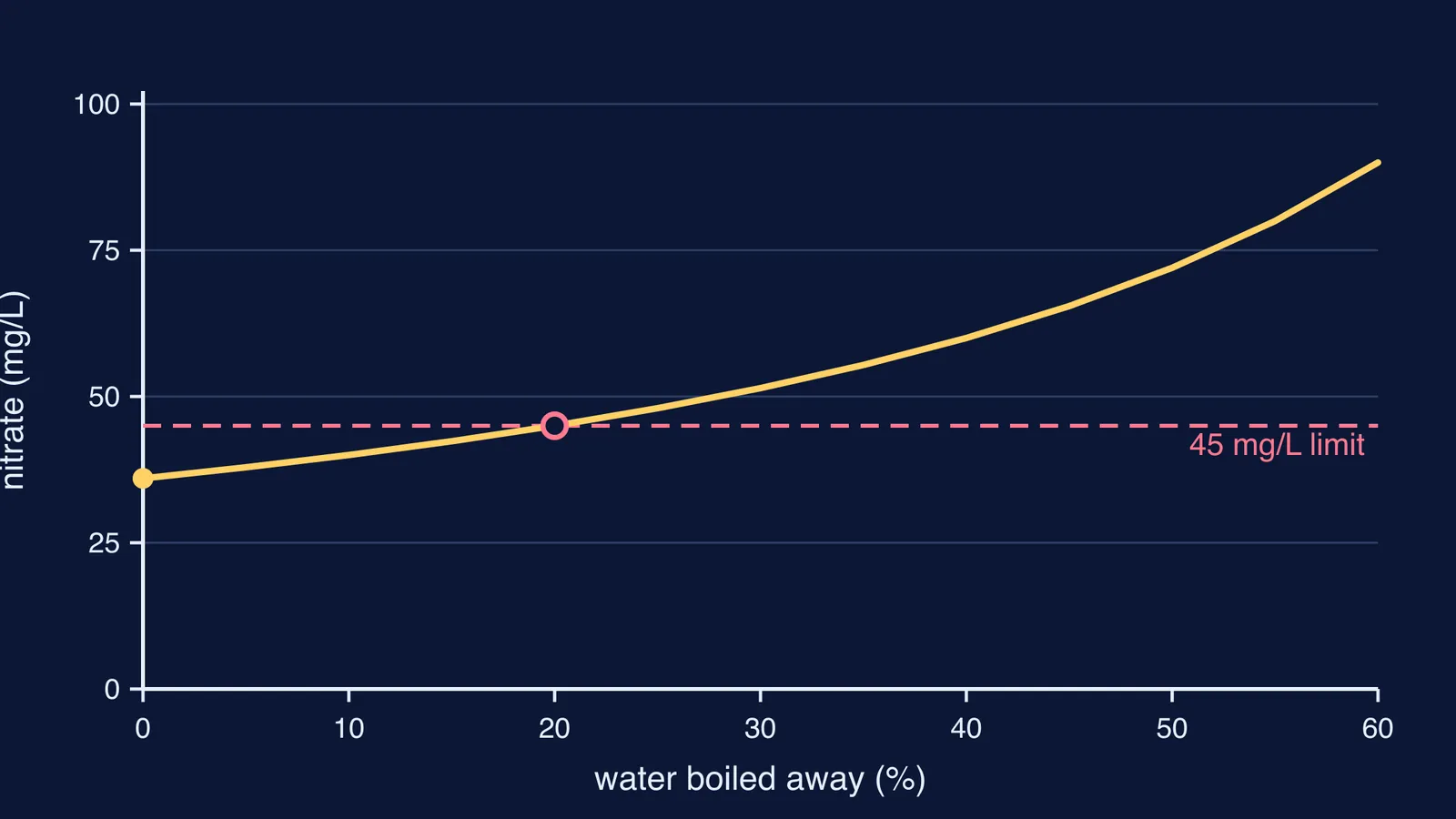
Say you have 1 litre of borewell water with 36 mg/L of nitrate, below the 45 mg/L cut-off in the groundwater report. That litre holds 36 mg of nitrate.
You leave it on a high flame and 200 mL boils away. Now 36 mg sits in 0.8 L: 36 ÷ 0.8 = 45 mg/L, right at the limit.
Leave it longer, until 300 mL is gone: 36 ÷ 0.7 ≈ 51 mg/L, above the limit.
The germs are dead, but the water is chemically worse than when you started. The same arithmetic applies to arsenic and fluoride.
Should you boil, filter or use an RO purifier?
Match the method to the problem. Use this checklist:
A boil-water notice, monsoon flooding or a broken pipe: germs are the worry, so boil.
Muddy or cloudy water: let it settle or strain it through cloth first, then boil. Our explainer on how alum clears muddy water shows the chemistry of settling.
Borewell water in an area known for arsenic, fluoride or nitrate: boiling will not help. Get the water tested at a water-testing lab first, then pick a treatment that targets the contaminant. Our guide to how RO water purifiers work explains how a membrane holds back dissolved ions.
Water that smells of fuel or chemicals: do not drink it, even boiled. Use bottled water and contact your local health or water authority.
For a biology or chemistry exam, this is a good case to explain in your own words: why heat kills a cell but cannot pull an ion out of solution. The Fermi Concept Library gives each concept in biology and chemistry its own lesson, and for ideas like pressure and boiling point that are easier to see than to read, the Fermi Simulation Lab has interactive simulations.
Next time someone says "just boil it," ask the second question: is the problem germs, or something dissolved?