

On this page
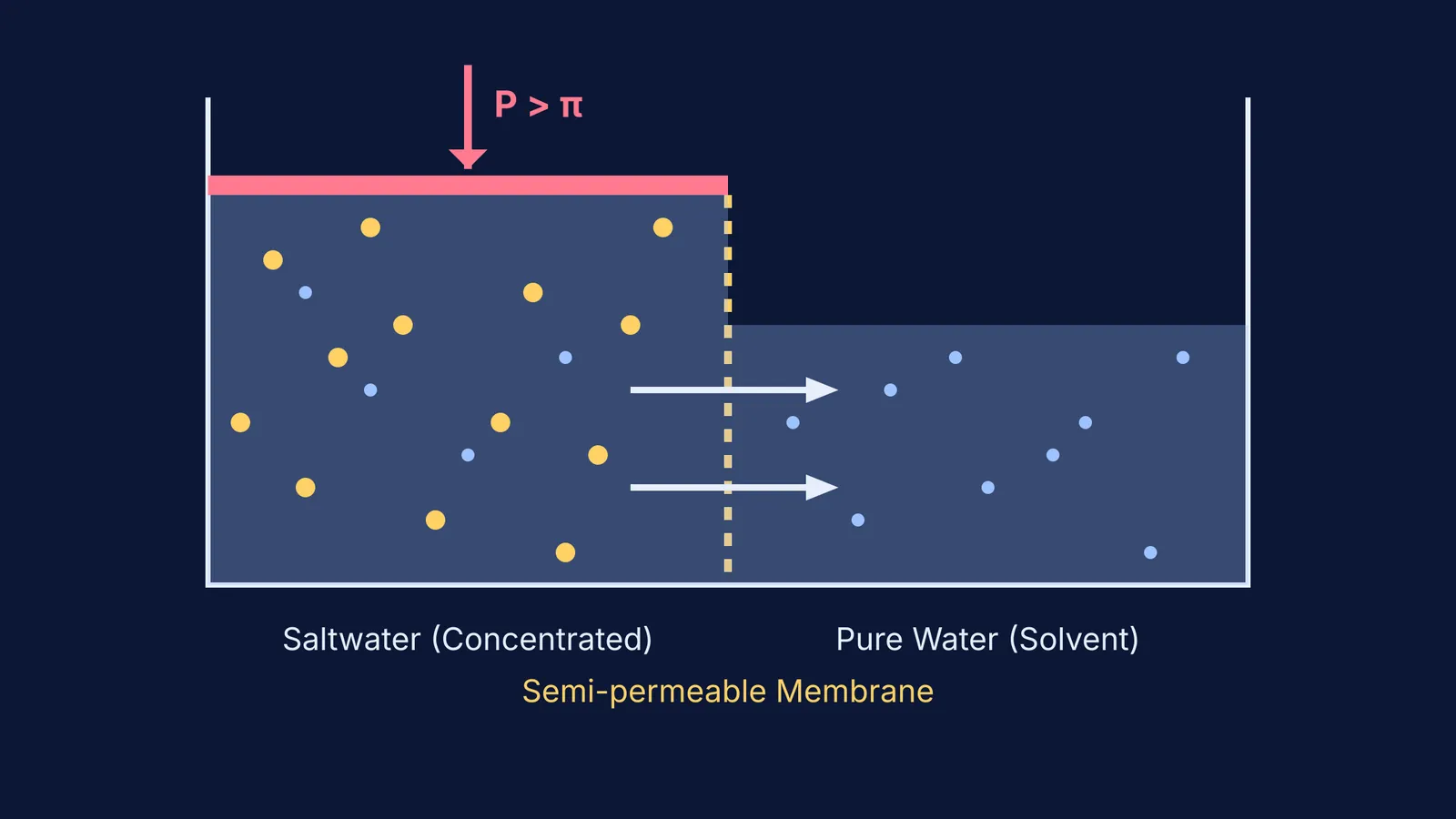
If you have looked at Class 12 chemistry, you have already met the physics inside your kitchen water purifier. Chapter 2 (Solutions) introduces osmotic pressure—the natural force that pulls pure water towards a salty solution. A reverse osmosis (RO) purifier simply applies a greater pressure in the opposite direction, pushing pure water out of the salty mix.
Understanding this balance of pressures explains why an RO purifier wastes water, why it is slow, and when you need a booster pump.
What is osmotic pressure?
In natural osmosis, water flows through a membrane from a pure side to a salty side to balance the concentrations. Osmotic pressure is the natural "back-pressure" created by the dissolved solids pulling water towards them. To stop this natural flow, you must apply a matching pressure.
A standard rule of thumb in water treatment is that every 100 parts per million (ppm) of Total Dissolved Solids (TDS) creates about 1 psi of osmotic pressure (WQA). If your tap water has a TDS of 500 ppm, it has a natural osmotic pressure of about 5 psi. You must apply more than 5 psi just to stop the water from moving the wrong way across the membrane.
This relationship is a practical application of the van't Hoff equation (π = iCRT), which states that osmotic pressure (π) depends on the concentration of the solute (C) and temperature (T). Because most common water contaminants behave similarly at room temperature, water treatment professionals can rely on the 100 ppm to 1 psi estimate as a highly reliable shortcut for designing these systems.
How does an RO water purifier work?
To actually produce purified water, the applied pressure must significantly exceed the osmotic pressure. This difference is called the Net Driving Pressure (NDP).
An RO purifier uses a pump or your home's natural plumbing pressure to force water molecules through a semi-permeable membrane, typically made of cellulose acetate or a similar polymer. The membrane's pores are roughly 0.0001 microns wide, which is small enough to block 95–99% of dissolved salts, bacteria, and chemicals (Axeon Water). The pure water collects in a storage tank, while the rejected salts are flushed down the drain as waste water.
Because the membrane is so tight, a standard residential RO system requires a minimum pressure of 40 psi to function effectively (Axeon Water). Without this pressure, the system cannot overcome the osmotic pressure and the physical resistance of the membrane. When pressure is too low, the purifier produces pure water very slowly and sends a much higher ratio of water to the drain.
As the RO membrane filters out pure water, the salt concentration on the "dirty" side of the membrane increases. This phenomenon, known as concentration polarization, raises the local osmotic pressure even further. Consequently, the pump must work even harder to maintain the same flow rate as the water gets saltier. This is why RO systems cannot recover 100% of the water; they must continuously flush the concentrated brine away to prevent the osmotic pressure from becoming too high to overcome.
For desalination of seawater, the stakes are much higher. Seawater has a TDS of roughly 35,000 ppm, creating an osmotic pressure of about 350 psi. Industrial desalination plants must apply 800 to 1,000 psi to force fresh water out of the ocean (Applied Membranes).
What else is inside the purifier?
While the RO membrane does the heavy lifting against osmotic pressure, it is fragile. A standard system uses a multi-stage process to protect it:
Sediment filter: Removes large particles like sand, rust, and dust that could physically clog the tiny pores.
Carbon pre-filter: Removes chlorine and organic chemicals that can chemically degrade the RO membrane.
RO membrane: The core stage where reverse osmosis happens under pressure.
Post-carbon filter: A final polishing stage to improve the taste of the water before it reaches your glass.
How can you visualise this process?
It can be hard to picture the random motion of molecules pushing against a membrane. The Fermi Simulation Lab lets you run interactive simulations of osmosis and diffusion, so you can change the concentration and watch how the osmotic pressure responds in real time.
When studying for board exams or competitive tests like JEE Main and NEET-UG, connecting the theory of solutions to a household appliance makes the physics stick. Instead of memorising the formula for osmotic pressure, you can see it as the exact force the pump under your sink is fighting every day. If you want to test your understanding of these concepts on real exam questions, or practice finding molar mass from osmotic pressure, the Fermi Problem Library breaks down the reasoning step by step. You can also explore related physical chemistry topics like calculating cell EMF to Gibbs energy to see how thermodynamics applies across different systems.


