

On this page
Have you ever wondered how a small piece of alum (phitkari) can turn a bucket of muddy brown water completely clear very quickly? It is not a filter, and it does not dissolve the dirt. Instead, it relies on the physical chemistry of surfaces and electrical charges.
The secret lies in a process called coagulation, which is governed by the Hardy-Schulze rule.
Why does muddy water never settle on its own?
If you scoop up a glass of muddy water, you will notice that the larger grains of sand sink to the bottom almost immediately. However, the water stays cloudy and brown for days. This cloudiness is caused by microscopic clay particles.
Because these particles are so small, they form a colloidal solution. They do not settle under gravity for two reasons:
Brownian motion: The constant, random bombardment by moving water molecules keeps the tiny particles suspended.
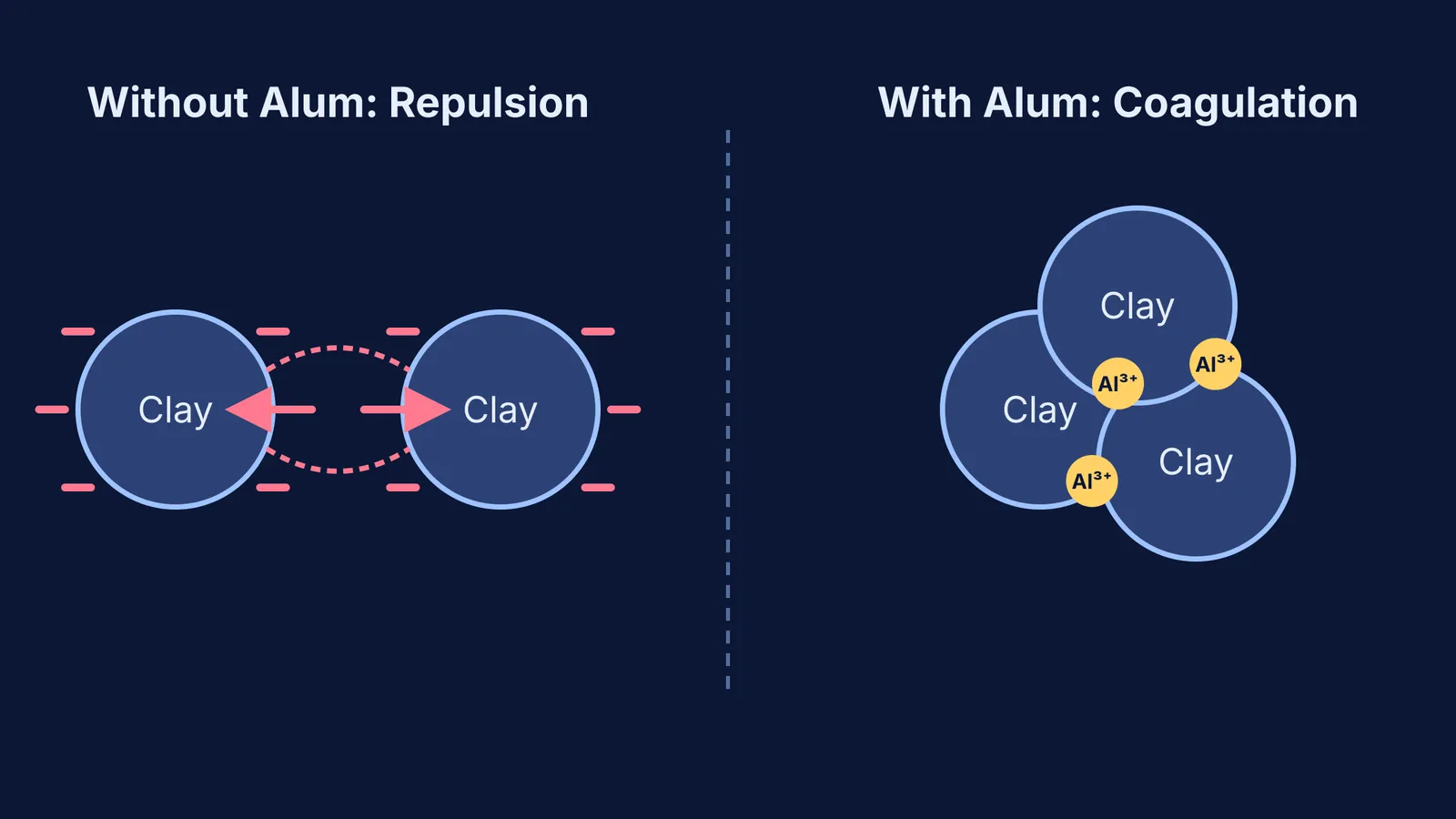
Electrostatic repulsion: Clay particles naturally carry a negative electrical charge on their surface. Because every particle has the same negative charge, they repel each other. This is similar to how the hydrophobic tails of soap molecules form charged spheres that repel one another, as seen in how soaps clean: micelles and hard water in Class 10 carbon.
As long as this negative charge remains, the clay particles will never clump together. They need a chemical intervention.
How does alum make muddy water clear?
Alum, formally known as potassium aluminium sulphate, acts as a coagulant. When you add it to the muddy water, it dissolves and separates into ions. The most important of these is the aluminium ion, Al³⁺.
This highly positive trivalent ion is strongly attracted to the negatively charged clay particles. When the Al³⁺ ions surround a clay particle, they neutralise its negative surface charge. Without the repulsive force keeping them apart, the clay particles are free to collide and stick to each other.
This clumping process is called flocculation. As the particles join together, they form larger, heavier aggregates known as floc. Once these flocs grow to a sufficient size, they become too heavy for Brownian motion to keep them afloat. Gravity pulls the floc to the bottom of the container, leaving perfectly clear water above.
While alum is excellent for removing suspended physical solids from muddy water, removing dissolved organic waste requires entirely different biological methods, such as the microbial processes used in sewage treatment and BOD. However, for drinking water, coagulation is vital. According to the World Health Organization, optimizing this coagulation and flocculation process in municipal treatment plants is widely used to reduce microorganism levels, which are trapped and pulled down by the sinking floc. Health Canada's guidelines similarly note that under-dosing coagulants causes a substantial deterioration in pathogen removal capability.
What is the Hardy-Schulze rule?
Why do we use alum specifically, rather than common table salt (NaCl)? The answer is summarised by the Hardy-Schulze rule, a core principle of surface chemistry that frequently appears in JEE and NEET exams.
The Hardy-Schulze rule states that the coagulating power of an ion is directly proportional to its valency (its electrical charge). The higher the charge of the flocculating ion, the more effective it is at neutralising the colloid and causing precipitation.
A monovalent ion like sodium (Na⁺) from table salt has a valency of +1. It has very weak coagulating power.
A divalent ion like magnesium (Mg²⁺) has a valency of +2 and is significantly more effective.
A trivalent ion like aluminium (Al³⁺) from alum has a valency of +3 and is exceptionally powerful.
Because the coagulating power increases rapidly with valency, the Al³⁺ ion is far more effective at clearing clay colloids than a simple Na⁺ ion. This makes alum a highly effective, low-cost tool for water purification.
Visualising how invisible ions push and pull against each other can be difficult when you are reading from a textbook. If you want to see these electrostatic forces in action, you can use the Fermi Simulation Lab to manipulate charged particles and watch how their fields interact in real time.
A simple flocculation experiment
You can observe the Hardy-Schulze rule at home with a quick experiment:
Fill two identical clear glasses with muddy water.
In the first glass, stir in a teaspoon of table salt (Na⁺).
In the second glass, stir in a crushed piece of alum (Al³⁺).
Leave both glasses undisturbed.
You will see the alum-treated water clear up much faster. The salt water will remain muddy for a long time because the +1 charge of sodium is too weak to rapidly neutralise the clay particles. This simple visual proof demonstrates exactly why valency matters in coagulation.


