

On this page
Sewage treatment looks like a short section of the Microbes in Human Welfare chapter, but it hides one idea students often get backwards (BOD) and one number they rarely see worked out. This post walks through the two stages, explains what BOD actually measures, and calculates it from a dilution test.
Where is this in the syllabus?
The NEET (UG) 2026 syllabus lists microbes in "sewage treatment" and "energy generation" in Unit 8, Biology and Human Welfare, and the CBSE Class XII Biology curriculum for 2026-27 has the same line. The text is section 8.3 of the NCERT Class 12 Biology chapter, Microbes in Human Welfare (2026-27 reprint).
One change matters. The old Environmental Issues chapter, which discussed water pollution, is not in the NEET 2026 ecology unit, and CBSE now assesses it only formatively through reading material. So for NEET, this section is where BOD lives. Check the syllabus for your exam year.
What happens in primary treatment?
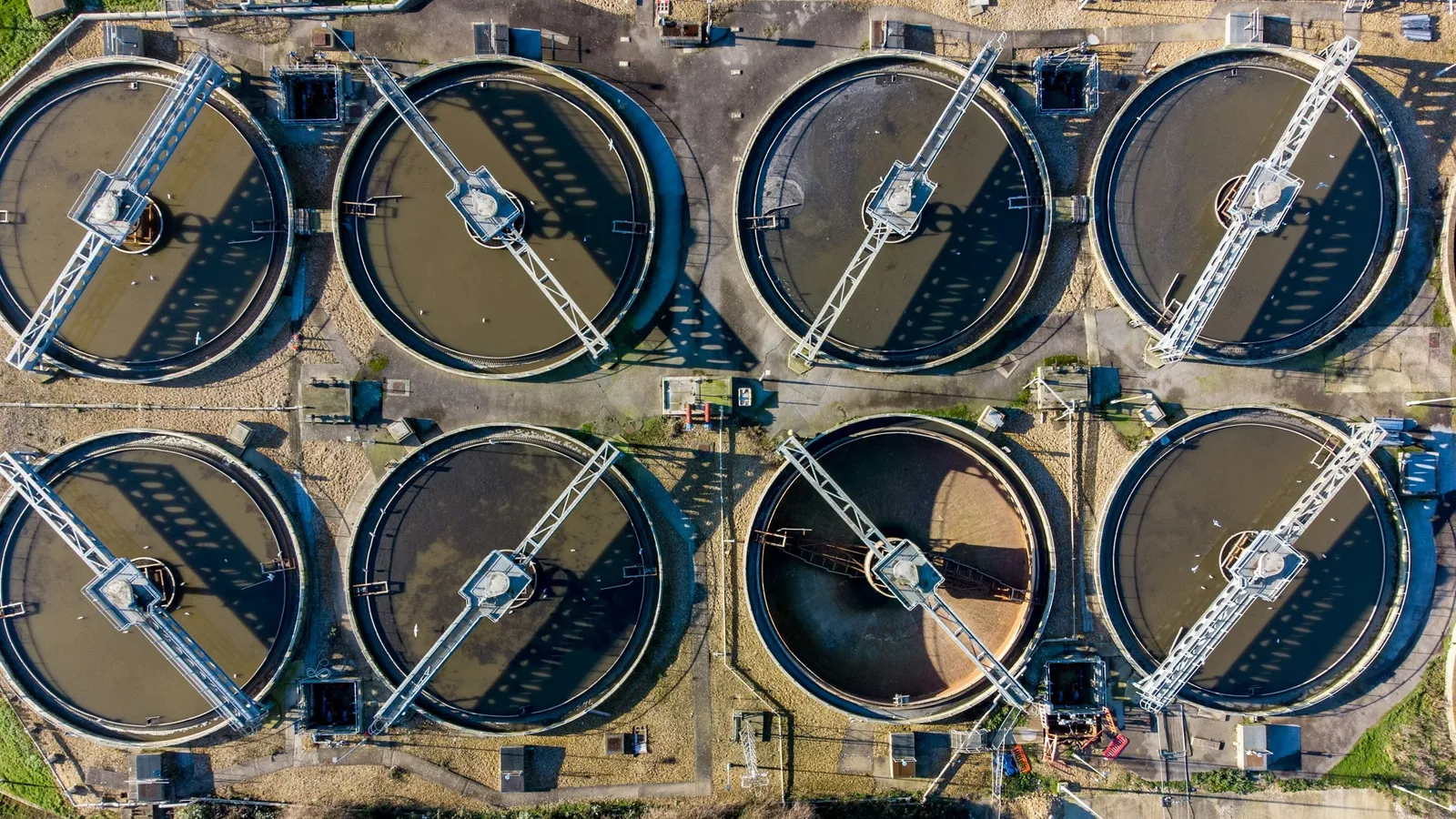
Primary treatment is physical. NCERT says floating debris is removed by sequential filtration, then grit (soil and small pebbles) is removed by sedimentation. Everything that settles is the primary sludge; the liquid above it, the supernatant, is the effluent that moves on. No microbes have been put to work yet.
What happens in secondary treatment?
Secondary treatment is biological. The primary effluent goes into large aeration tanks, where it is agitated and air is pumped in. Useful aerobic microbes grow into flocs, masses of bacteria tied together by fungal filaments. While growing, they consume most of the organic matter, which lowers the BOD.
When the BOD has dropped enough, the effluent passes to a settling tank, where the flocs settle as activated sludge. A small part goes back to the aeration tank as inoculum. The rest goes to anaerobic sludge digesters, where anaerobic bacteria digest the bacteria and fungi in the sludge and release methane, hydrogen sulphide and CO2: biogas. The treated effluent is generally released into rivers and streams. NCERT also notes the Ganga Action Plan and Yamuna Action Plan, which proposed more treatment plants so only treated sewage reaches those rivers.
What does BOD actually measure?
NCERT defines BOD as the oxygen that would be consumed if all the organic matter in one litre of water were oxidised by bacteria. The test measures oxygen uptake by microbes, so it is an indirect measure of organic matter. The greater the BOD, the more polluting the water.
In practice the test runs for a set time. The US EPA's monitoring guide describes it as oxygen consumed over usually 5 days at 20 °C: measure dissolved oxygen (DO) at the start, incubate a second bottle in the dark, measure again. Its table gives about 9.07 mg/L as the most oxygen water can hold at 20 °C. Strong sewage would use all of that before day 5, so the sample is diluted first.
Worked example: BOD from a dilution test
These are sample numbers for a classroom example. As the EPA guide describes, take the drop in DO over the 5 days and scale it up by the dilution factor. Here D1 and D2 are the DO at the start and after 5 days, and the dilution factor is bottle volume divided by sample volume. Written as a formula, BOD = (D1 − D2) × (bottle volume / sample volume).
Raw sewage. 6 mL of sewage is made up to 300 mL with dilution water, so the dilution factor is 300 / 6 = 50. D1 = 8.6 mg/L, D2 = 4.4 mg/L.
BOD = (8.6 − 4.4) × 50 = 4.2 × 50 = 210 mg/L.
After secondary treatment. 30 mL of effluent in 300 mL, so the dilution factor is 10. D1 = 8.5 mg/L, D2 = 6.3 mg/L.
BOD = (8.5 − 6.3) × 10 = 22 mg/L.
Removal. (210 − 22) / 210 = 0.895, so about 90 percent of the oxygen demand has gone.
Now compare with India's Central Pollution Control Board water quality criteria: BOD (5 days, 20 °C) of 2 mg/L or less for class A (drinking water source without conventional treatment) and 3 mg/L or less for class B (organised outdoor bathing). Even well-treated effluent at 22 mg/L is far above those values, which is why untreated or poorly treated sewage harms a river.
Which mistakes cost marks?
Reading BOD as oxygen in the water. It is oxygen used up. Higher is worse.
Putting microbes in primary treatment. Primary is filtration and settling only.
Mixing up the two sludges. Primary sludge is settled solids; activated sludge is settled flocs.
Saying the digester is aerobic. Sludge digesters are anaerobic; that is why they make methane.
Forgetting the dilution factor. If you report D1 − D2 = 4.2 mg/L for raw sewage, you are 50 times too low.
A practice routine
Draw the plant from memory as boxes: screens, grit settling, aeration tank, settling tank, digester. Label what leaves each box.
Write the BOD formula and redo both calculations above with dilution factors of 100 and 20.
Answer one NCERT exercise on sewage aloud, in four sentences, without notes.
Revisit after three days. Our guide to the full chapter, Microbes in Human Welfare for NEET, has the organism tables to test alongside it.
If the link between microbes, oxygen and organic matter still feels loose, the Fermi Concept Library covers every concept in biology and chemistry, each with its own lesson, so you can revise aerobic respiration and come back to the aeration tank.
Tonight, sketch the five boxes of a sewage plant and write the BOD at the start and end.


