

On this page
When a Pew Research Center science survey, reported in September 2015, asked whether water boils at a different temperature in Denver than in Los Angeles, only 34% of Americans knew it boils at a lower temperature in the higher city. The reason fits in one sentence, and you can test it yourself with three predictions.
Why does water boil at a lower temperature in the mountains?
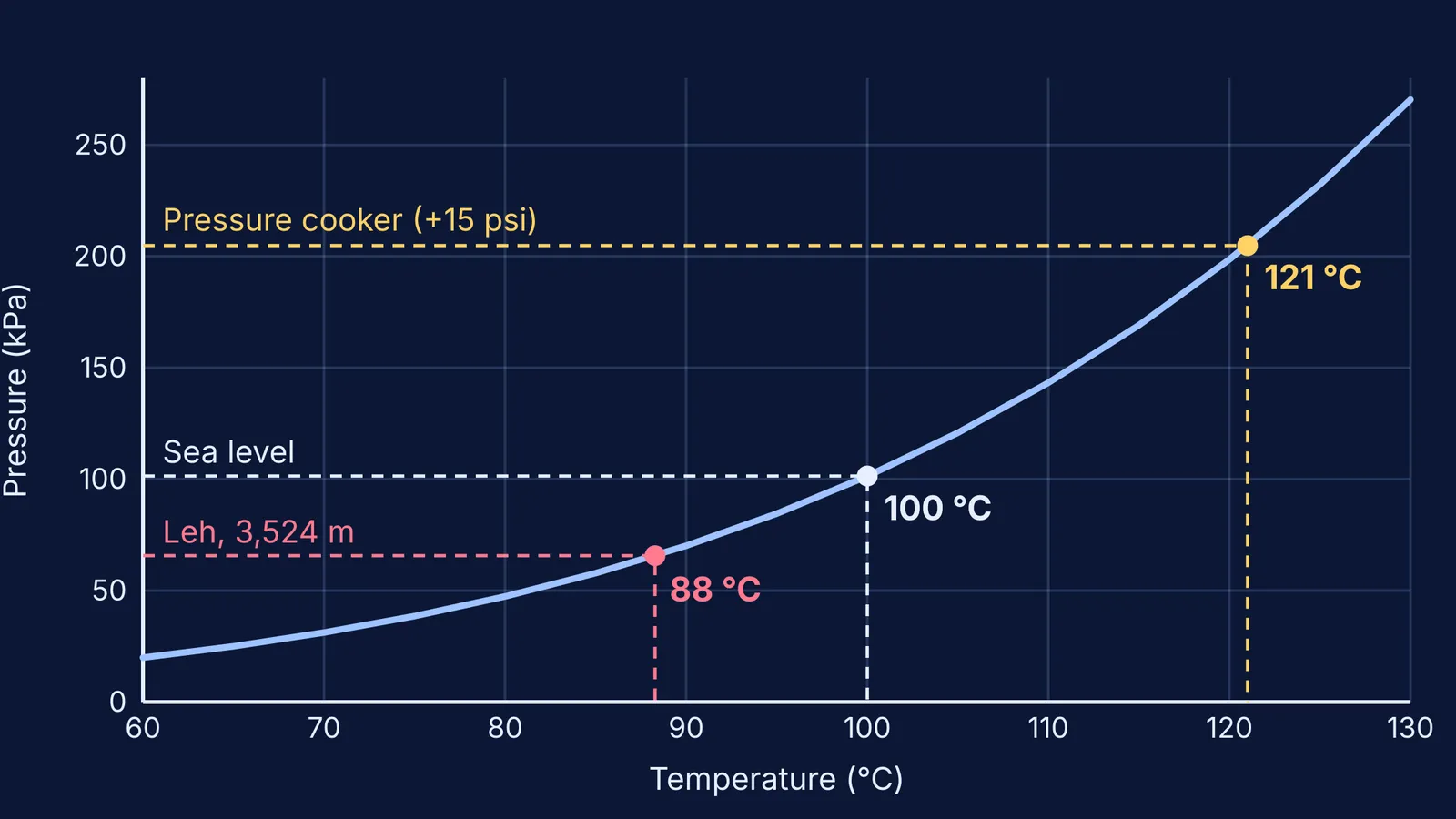
Water boils when its vapour pressure equals the pressure of the air pressing down on its surface. Vapour pressure, the push of water molecules escaping into the gas above, climbs steeply with temperature: the NIST Chemistry WebBook saturation table for water lists about 37 kPa at 74.2 °C, 111 kPa at 102.5 °C and 221 kPa at 123.4 °C.
At sea level the air presses down with about 101 kPa, so water has to reach 100 °C before its vapour pressure catches up. On a mountain the air presses less, so the vapour catches up sooner, at a lower temperature.
How low is the air pressure at a hill station like Leh?
NASA's Earth atmosphere model gives the troposphere temperature as T = 15.04 − 0.00649h and the pressure as p = 101.29 × [(T + 273.1)/288.08]^5.256 kPa, with h in metres. Leh town sits at about 3,524 m.
Put h = 3,524 m into the model and you get T ≈ −7.8 °C and p ≈ 65.7 kPa, roughly two-thirds of the model's sea-level value of 101.4 kPa. That is the pressure your pot of water has to match.
Try it: three predictions before you check
Write down a guess for each case first.
Sea level, about 101.4 kPa in the NASA model. Your prediction: ____ °C
Leh, about 65.7 kPa. Your prediction: ____ °C
A pressure cooker at sea level. A cooker vents at about 15 pounds per square inch above atmospheric pressure, which is about 103 kPa extra, so the total is near 205 kPa. Your prediction: ____ °C
Now check. NIST lists Antoine-equation constants for water, log10(P) = A − B/(T + C), with P in bar and T in kelvin. For 344 to 373 K the NIST Antoine parameters for water are A = 5.08354, B = 1663.125 and C = −45.622. Rearranged, T = B/(A − log10 P) − C.
Sea level: P = 1.014 bar gives T ≈ 373.2 K, which is 100.0 °C.
Leh: P = 0.657 bar, so log10 P ≈ −0.183 and T ≈ 1663.125/5.266 + 45.6 ≈ 361.4 K, which is about 88 °C.
Pressure cooker: P = 2.048 bar gives T ≈ 394.1 K, about 121 °C, matching the 121 °C on the HyperPhysics page above. This is outside the 344 to 373 K range the constants were fitted for, so we checked the formula against the NIST saturation table: at 123.4 °C it gives 221.2 kPa against NIST's 221.25 kPa.
A boiling point that moves with pressure is easier to see than to read, which is what the Fermi Simulation Lab and its interactive simulations are for.
Why does a pressure cooker cook faster, even in Leh?
A sealed cooker traps steam, so the pressure inside climbs until the weight lifts and steam escapes. Higher pressure means the water must get hotter before its vapour pressure matches, so your dal sits in water at about 121 °C instead of 100 °C.
Run the same calculation for a cooker in Leh: 65.7 kPa outside plus about 103 kPa extra gives about 169 kPa, and the NIST Antoine equation puts that near 115 °C. That is cooler than the same cooker at sea level, but far hotter than the 88 °C of an open pot in Leh. At altitude the cooker matters even more.
Turning up the flame under an open pot does not help: the water boils away faster, but no hotter.
How do you read the vapour pressure curve?
Find the pressure on the vertical axis, move across until you meet the curve, then drop straight down to read the temperature. The diagram at the top of this post does exactly that for Leh, sea level and the cooker.
Three mistakes to watch for:
Treating 100 °C as the definition of boiling. It is the boiling point at one pressure, about 1 atmosphere (NIST Antoine data).
Mixing gauge and absolute pressure. A cooker's 15 psi is extra pressure on top of the air, so add atmospheric pressure before you read the curve.
Assuming the curve is a straight line. It bends upward, so near the top each extra kPa raises the boiling point by less than it does near the bottom.
The same idea explains why dissolving something in water changes its boiling point: see our Raoult's law simulation on how vapour pressure falls and the boiling point elevation numericals using Kb and molality.
If the logarithm step in the rearranged Antoine equation trips you up, the Fermi Concept Library gives each concept in physics, chemistry and mathematics its own lesson, so you can fill that gap and come back to the curve.


