

On this page
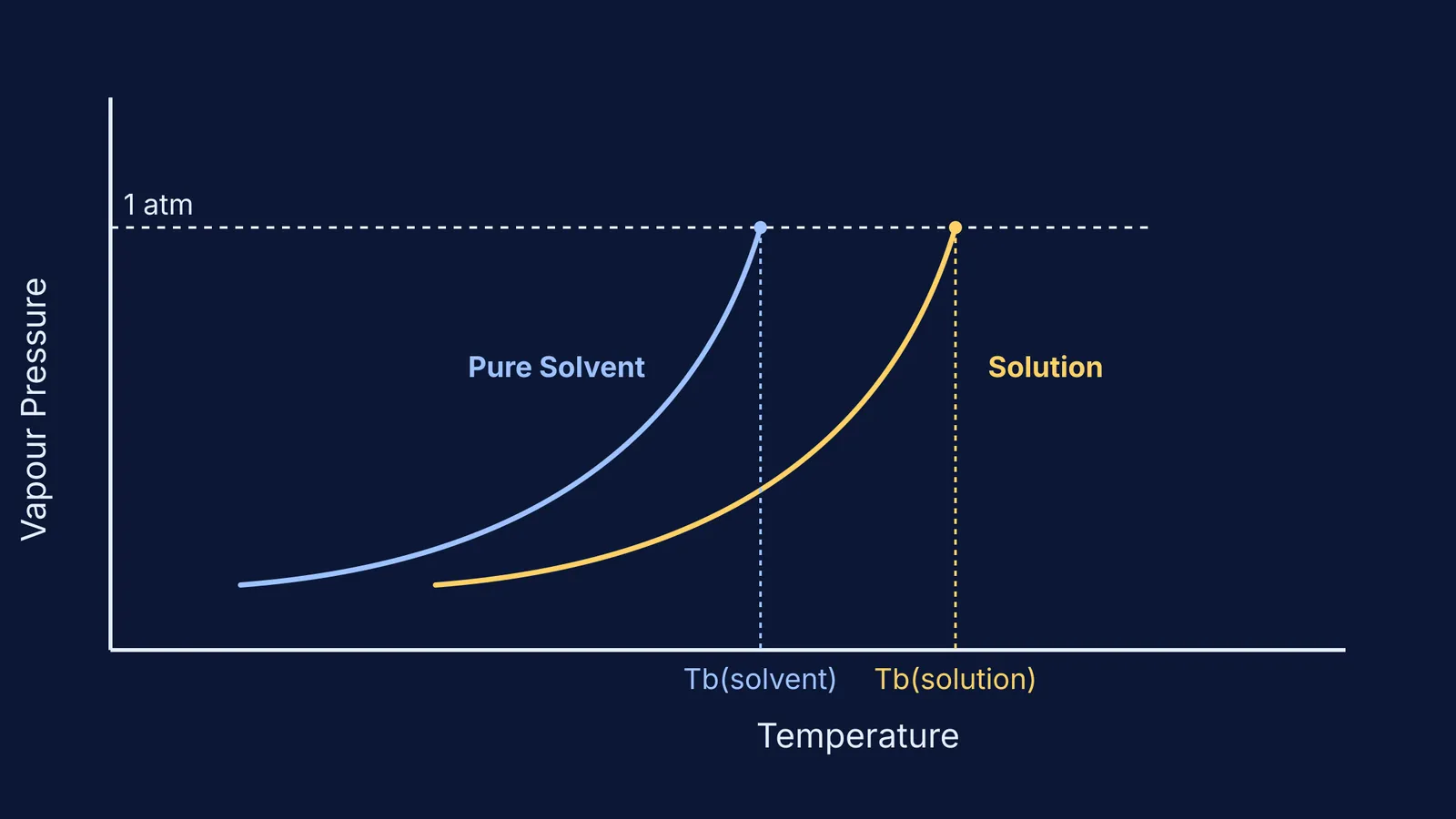
When you dissolve a solute like salt or glucose into a liquid, the solution boils at a higher temperature than the pure solvent. This is the elevation of boiling point, a colligative property that depends purely on the number of solute particles you add.
A liquid boils when its vapour pressure equals atmospheric pressure. Adding a non-volatile solute lowers this vapour pressure, because solute particles block solvent molecules from escaping the surface. To bring the vapour pressure back up, you must heat the solution to a higher temperature.
Calculations on this topic are standard fare in exam preparation. But students often stumble over one critical detail: using molarity instead of molality.
Here is how to set up ΔTb = i × Kb × m, and why molality is the only concentration term that works across temperature changes.
What is the formula for elevation in boiling point?
The elevation in boiling point (ΔTb) is the difference between the boiling point of the solution and the pure solvent.
According to Chemistry LibreTexts/Physical_Properties_of_Matter/Solutions_and_Mixtures/Colligative_Properties/Boiling_Point_Elevation), the standard calculation is:
ΔTb = i × Kb × m
ΔTb: The elevation in boiling point (in Kelvin or °C).
i: The van 't Hoff factor, which accounts for how many particles the solute splits into. For a non-electrolyte like glucose, i = 1. For a strong electrolyte like NaCl, i = 2.
Kb: The molal boiling point elevation constant, or ebullioscopic constant. It is specific to the solvent.
m: The molality of the solution.
Why is molality used instead of molarity for elevation in boiling point?
This is a classic conceptual question. Many students default to molarity (M) because it is the most common way to express concentration in chemistry.
Molarity is defined as moles of solute per litre of *solution*. Because liquids expand as they heat up, the total volume of the solution changes as you approach the boiling point. This means the molarity of your solution is not constant; it physically shifts as the temperature rises.
Molality (m) is defined as moles of solute per kilogram of *solvent*. Since solvent mass does not change with temperature, the molality remains constant as the liquid heats up. This gives you a stable concentration, essential for thermal properties.
How do you calculate elevation in boiling point using a worked example?
Let's apply the formula to a typical numerical problem using grams of solute and solvent.
The Problem: Calculate the boiling point of a solution containing 11.7 g of sodium chloride (NaCl, molar mass = 58.5 g/mol) in 100 g of water. Assume complete dissociation of NaCl. (Kb for water = 0.52 K kg/mol, boiling point of pure water = 100 °C).
Step 1: Find the moles of the solute. Moles = Mass of solute / Molar mass. Moles of NaCl = 11.7 g / 58.5 g/mol = 0.2 mol.
Step 2: Convert the mass of the solvent to kilograms. Mass of water = 100 g = 0.100 kg. *Watch out:* A common mistake is dividing by the mass of the entire *solution*. Molality uses only the mass of the *solvent*. If you add the 11.7 g of solute to the 100 g of water to find the total mass, your calculation will be wrong.
Step 3: Calculate the molality (m). Molality = Moles of solute / Mass of solvent in kg. m = 0.2 mol / 0.100 kg = 2.0 mol/kg.
Step 4: Determine the van 't Hoff factor (i). Account for how the molecule behaves in water. Glucose does not break apart, so i = 1. NaCl dissociates completely into two ions (Na⁺ and Cl⁻), making i = 2.
Step 5: Calculate the elevation (ΔTb). ΔTb = i × Kb × m. ΔTb = 2 × 0.52 × 2.0 = 2.08 K.
Step 6: Find the new boiling point. Boiling point = Pure boiling point + ΔTb. Boiling point = 100 °C + 2.08 °C = 102.08 °C. *Note:* A temperature difference in Kelvin equals the same difference in Celsius, so you can add the change directly.
Where can you practice elevation in boiling point numericals?
Getting these steps right requires practice, especially when problems ask you to work backwards from an observed boiling point to identify an unknown compound.
If you get stuck, the Fermi Problem Library acts as a reliable guide. Instead of just handing you the answer, Fermi's AI tutor builds a plan for the session and helps you work through the reasoning step by step. For reviewing foundational topics, consult the Concept Library.
For related calculations, explore finding molar mass from osmotic pressure, or how phases interact in heterogeneous equilibria. Keeping your formulas straight and separating solute from solvent makes these numericals straightforward.


