

On this page
Every colloid is a two-component heterogeneous mixture consisting of finely divided particles suspended within a continuous background substance. In 1861, Scottish chemist Thomas Graham introduced the term "colloid"—derived from the Greek word *kolla*, meaning glue—in his study of liquid diffusion in the Philosophical Transactions of the Royal Society to describe substances like gelatin that diffuse slowly through membranes.
According to IUPAC definitions in colloid and surface chemistry, a colloidal system contains particles with at least one dimension between 1 nanometre and 1 micrometre (1 nm to 1000 nm). Because thermal motion prevents these particles from settling, they form a stable state between true solutions and coarse suspensions.
To classify any colloid, you identify two components:
Dispersed phase: The substance divided into fine droplets, solid particles, or gas bubbles distributed through the mixture.
Dispersion medium: The continuous substance in which the dispersed particles are suspended.
How do you name a colloid from its phase and medium?
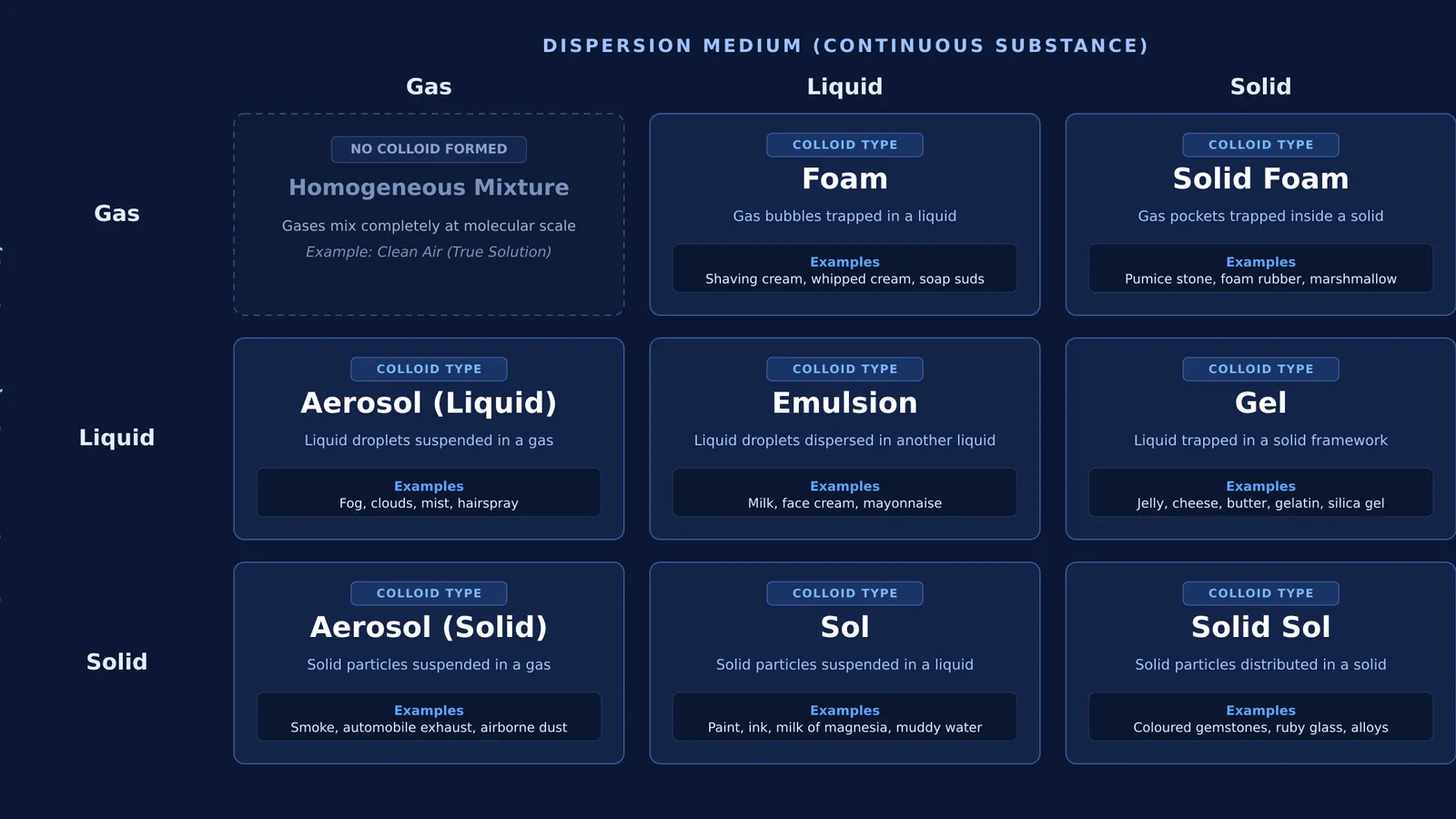
Because matter exists as a gas, liquid, or solid, you might expect nine combinations. However, gases mix completely at the molecular level through diffusion to form homogeneous solutions rather than colloidal dispersions. As outlined in IUPAC recommendations on dispersed systems, this leaves eight recognized types:
Liquid in gas (Aerosol): Liquid droplets suspended in a gas.
Solid in gas (Aerosol): Solid particles suspended in a gas.
Gas in liquid (Foam): Gas bubbles trapped inside a liquid.
Liquid in liquid (Emulsion): Droplets of one liquid dispersed in an immiscible liquid.
Solid in liquid (Sol): Fine solid particles suspended in a liquid.
Gas in solid (Solid foam): Gas pockets trapped throughout a solid.
Liquid in solid (Gel): Liquid trapped within a continuous solid matrix.
Solid in solid (Solid sol): Solid particles distributed evenly in a solid matrix.
What types of colloids do fog, milk, shaving cream, jelly, and smoke represent?
Examiners frequently test whether you can identify everyday examples:
Fog (Liquid in gas, Aerosol): When water vapour condenses into liquid droplets suspended in air, it forms an aerosol. Clouds and mist share this classification.
Milk (Liquid in liquid, Emulsion): Milk consists of liquid butterfat globules dispersed in water. Casein proteins act as emulsifiers to keep the droplets stable, much like how soap molecules assemble into micelles to trap grease.
Shaving cream (Gas in liquid, Foam): Air or propellant gas bubbles trapped inside a soapy liquid film form a foam.
Jelly (Liquid in solid, Gel): Gelatin proteins form a solid structural network that holds liquid water inside its pores. Chemist Otto Wichterle later used cross-linked polymer networks on the same principle for Otto Wichterle's hydrogel lenses.
Smoke (Solid in gas, Aerosol): Tiny solid carbon and ash particles suspended in air form an aerosol (often termed a solid aerosol).
How do you distinguish a colloid from a true solution or suspension?
The distinction between these mixtures depends on particle size and physical behaviour, summarized in IUPAC physical chemistry standards:
Particle size: Solute particles in a true solution measure under 1 nanometre. Colloidal particles span 1 nanometre to 1000 nanometres, while suspension particles exceed 1000 nanometres.
Settling and filtration: Suspensions settle over time and separate on standard filter paper. Colloids and true solutions pass through filter paper without settling.
Tyndall effect: True solutions do not scatter visible light. Colloidal particles scatter light beams, making the path visible. John Tyndall demonstrated this in his 1869 Royal Society paper on light scattering by cloudy matter.
Physicist Richard Zsigmondy applied this scattering effect in Richard Zsigmondy's ultramicroscope to detect individual colloidal particles that conventional optical microscopes could not resolve.
The Fermi Concept Library covers every concept in physics, chemistry, biology, mathematics and computing, each with its own lesson and its place in the map. For problem-solving practice, the Fermi Problem Library provides worked problems with a step-by-step solver that explains the reasoning rather than printing an answer. When preparing for tests, Fermi's AI tutor can work out what you already know and build a plan for the session, guiding you through tricky phase classifications.


