On this page
Leave a pan of milk on the kitchen counter on a hot afternoon and by evening it may smell sour and split into lumps. Boil the same milk first and it usually lasts longer. The reason is a race between heat and microorganisms.
What makes milk go sour?
Milk is not sterile when it leaves the animal. A 2017 review in Frontiers in Microbiology notes that raw milk straight after milking generally contains lactic acid bacteria such as Lactococcus, Lactobacillus, Streptococcus and Leuconostoc (Machado et al., 2017).
Lactic acid bacteria use lactose, the sugar in milk, and convert it to lactic acid, which lowers the pH. A 2023 review describing how yogurt is made explains that once the pH drops below 5.2, the casein particles in milk lose their charge and clump together (Sumi et al., 2023, Nutrients). The acid gives the sour taste; the clumps are the curdling you see.
So spoilage is a numbers game: more bacteria, more acid, sooner.
Why does boiled milk last longer than raw milk?
Heat kills most of the bacteria, so the count restarts near zero and the few survivors need a long time to multiply back.
A team in Italy measured this in real homes. Consumers who bought raw milk from vending machines heated 50 samples the way they normally did, and the researchers tested 35 of them before and after (Colavita et al., 2012, Italian Journal of Food Safety). In the raw milk, total coliforms reached up to 10,000 per millilitre. After heating, coliforms were undetectable, and only 4 of the 35 heated samples still had a countable total bacterial load.
Worked example: how big is the head start?
Bacteria grow by doubling. Take round, made-up numbers to see the effect: raw milk with 100,000 bacteria per millilitre, and boiled milk with 10 survivors per millilitre.
Divide: 100,000 / 10 = 10,000.
Ask how many doublings make 10,000: 2 to the power 13 is 8,192 and 2 to the power 14 is 16,384.
So the boiled milk needs between 13 and 14 doublings just to get back to where the raw milk started.
If both batches grow at the same rate, the boiled milk keeps that head start whatever the doubling time. A warm kitchen just makes each doubling quicker.
Why does boiled milk still go bad?
Boiling is not sterilisation. Some bacteria, such as the Bacillus cereus group, form tough spores. The same 2017 review says that because these spores resist pasteurisation, the main way pasteurised milk spoils is that they later germinate and grow (Machado et al., 2017). It also notes that in some dairies, contamination after heating, mainly by Pseudomonas bacteria, still leads to spoiled packs.
Cold slows this down but does not stop it. The World Health Organization says a refrigerator set below 5°C protects most foods "but not indefinitely", and that cool temperatures slow bacterial growth without stopping it completely (WHO Europe).
How is boiling different from pasteurisation?
India's food regulator, FSSAI, defines each heat treatment in its milk standards (FSSAI Food Products Standards compendium, 2021):
Boiling: heating milk continuously until it boils at atmospheric pressure.
Pasteurisation: heating every particle of milk to at least 63°C for at least 30 minutes, or to at least 72°C for at least 15 seconds, then cooling it immediately to 4°C or less.
Sterilisation: heating milk in sealed containers to at least 115°C for 15 minutes, so it keeps at room temperature for at least 30 days.
UHT: heating to at least 135°C for one second or more, then packing it aseptically, so it keeps at room temperature for at least 15 days.
The same FSSAI definition says pasteurisation must be designed to destroy disease-causing organisms such as Mycobacterium tuberculosis and Coxiella burnetii.
How do you make boiled milk last longer at home?
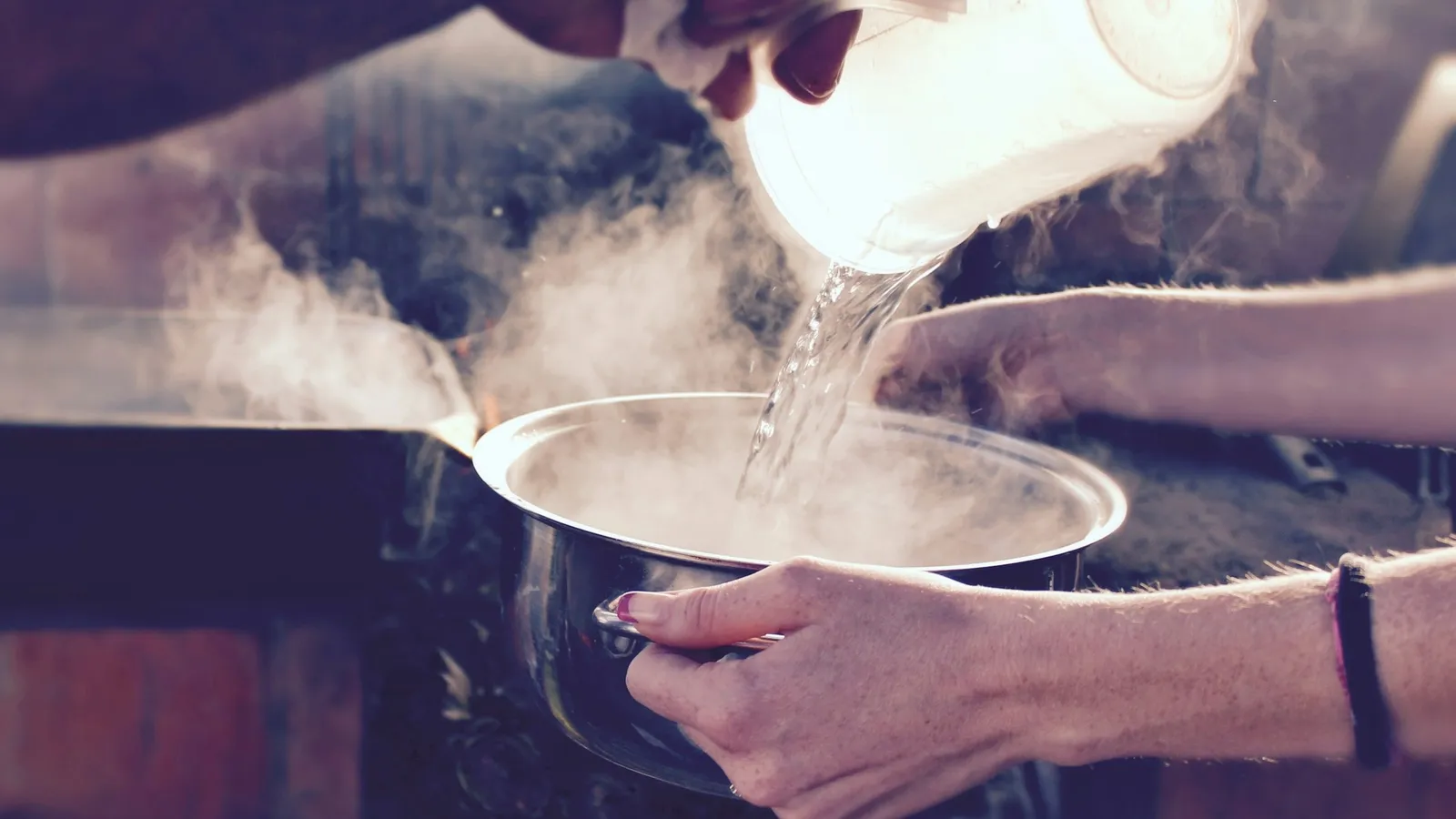
Bring the milk to a proper boil. When the froth rises, lower the flame and stir so the whole pan heats, not just the top.
Cover it and let it cool, then move it to the fridge. WHO advises not leaving cooked food at room temperature for more than 2 hours and refrigerating it promptly, preferably below 5°C (WHO Europe).
Store it in a clean, covered vessel and pour rather than dipping a used spoon in.
Check the packet. FSSAI rules require the label to state the heat treatment, and milk sold with none must have its name preceded by the word "Raw".
If milk smells sour or has curdled, do not drink it.
If the doubling idea is hard to picture, the Fermi Simulation Lab has interactive simulations for ideas that are easier to see than to read. The Fermi Concept Library has a lesson for every concept in biology and chemistry, from microorganisms to pH.
Next time someone at home asks why the milk must be boiled, you can answer in three words: fewer bacteria, slower acid.