On this page
A hydrogen atom has exactly one electron, so a fair question in Class 11 is: how can one electron make a whole spectrum? The answer is that you never look at one atom. You look at a tube of gas, and different atoms are doing different jumps at the same moment.
What makes a single spectral line?
When an electron drops from a higher energy level to a lower one, the energy difference leaves as one photon, as the OpenStax Chemistry 2e chapter on the Bohr model explains. One jump gives one photon of one wavelength.
In the Bohr model the energy of level n is En = −13.6 eV/n², according to OpenStax University Physics, Volume 3. So the levels sit at −13.6, −3.40, −1.51 and −0.85 eV for n = 1 to 4. If the minus sign puzzles you, read why hydrogen's electron energy is negative.
Why does hydrogen have many spectral lines with one electron?
Three things happen together in a discharge tube.
Atoms get different kicks. The discharge excites some atoms to n = 2, some to n = 3, some to n = 4 and higher.
Each atom can fall by different routes. An atom may return to its lowest state in one jump, or in steps, stopping at intermediate levels on the way down, as OpenStax Astronomy 2e describes.
There are a great many atoms. So every allowed jump is happening somewhere in the tube at any instant, and the spectrometer records all the lines at once.
One electron per atom limits what a single atom can do, not what the spectrum shows.
How many spectral lines come from n = 4?
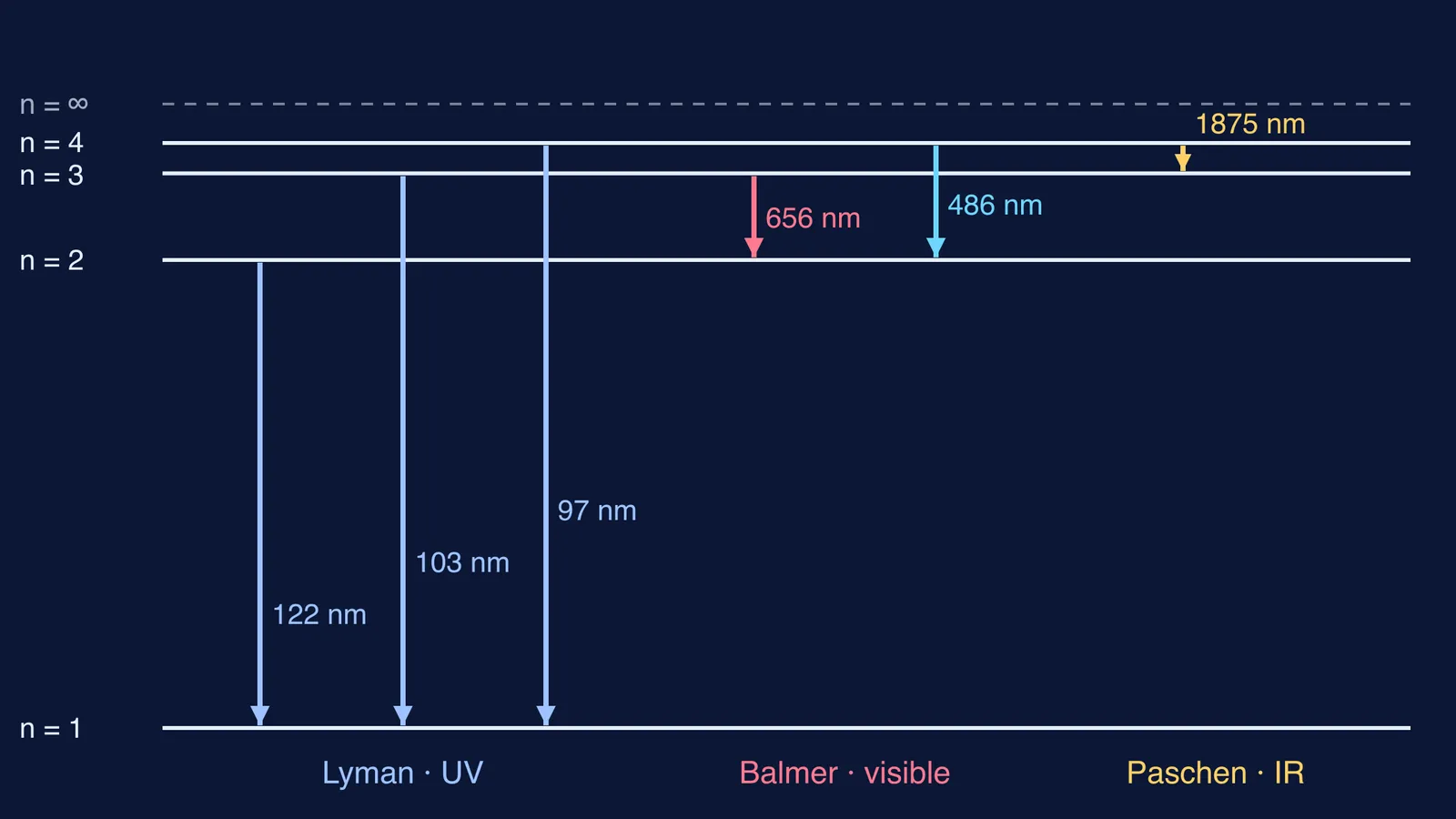
Every line is a pair of levels: an upper one and a lower one. From n = 4 down to n = 1 there are four levels, and the number of ways to choose two of them is 4C2 = 4 × 3 / 2 = 6. In general, a sample excited to level n gives n(n − 1)/2 lines.
Here are all six, with ΔE from the energies above and wavelengths from the NIST table of strong hydrogen lines. The table gives vacuum wavelengths for the ultraviolet lines and air wavelengths for the visible and infrared ones.
4 → 3: 0.66 eV, 1875.1 nm (infrared, Paschen series)
4 → 2: 2.55 eV, 486.1 nm (blue-green, Balmer series)
4 → 1: 12.75 eV, 97.3 nm (ultraviolet, Lyman series)
3 → 2: 1.89 eV, 656.3 nm (red, Balmer series)
3 → 1: 12.09 eV, 102.6 nm (ultraviolet, Lyman series)
2 → 1: 10.20 eV, 121.6 nm (ultraviolet, Lyman series)
The bigger the gap, the shorter the wavelength. The Lyman lines (ending on n = 1) are ultraviolet and the Balmer lines (ending on n = 2) are visible, matching what OpenStax Astronomy says. That is why hydrogen glows red: the 656 nm line is the most intense of its visible lines, as Chemistry LibreTexts/08%3A_Electrons_in_Atoms/8.02%3A_Atomic_Spectra) notes. Only two of the six n = 4 lines are visible at all.
For where each series ends, see our post on the series limit in the hydrogen spectrum.
Which exam traps hide in this question?
Run this four-step check before you write a number.
Find the real top level. "Third excited state" means n = 4, because the ground state is n = 1.
Find the bottom level. For lines between n = 4 and n = 2 only, count pairs inside that range: 3 levels give 3C2 = 3 lines.
One atom or many? One atom: at most n − 1. A sample: n(n − 1)/2.
Visible only? Keep just the Balmer lines, the ones ending on n = 2.
Self-test: atoms are excited to n = 5. How many lines does the sample emit, and how many could one atom emit at most? (Answers: 10 and 4.)
To see how an absorbed jump matches an emitted one, work through why n = 1 to n = 3 absorbs 12.09 eV.
How should you practise this?
Draw the level lines yourself and every downward arrow before counting. If the diagram and the formula disagree, you have probably misread the top level.
For more counting and ΔE questions, the Fermi Problem Library has worked problems with a step-by-step solver that explains the reasoning rather than printing an answer. If the energy-level idea itself still feels shaky, the Fermi Concept Library gives each concept in physics and chemistry its own lesson and its place in the map.
Next time someone asks how one electron makes a rainbow of lines, you can answer in one sentence: many atoms, many routes, all at once.