

On this page
A question from Class 11 chemistry, Class 12 physics and JEE Main: how much energy does hydrogen absorb when its electron jumps from n = 1 to n = 3? The answer is 12.09 eV. Here is the working, why the number is the same in both directions, and the sign slip that costs marks.
What is the energy of each level in hydrogen?
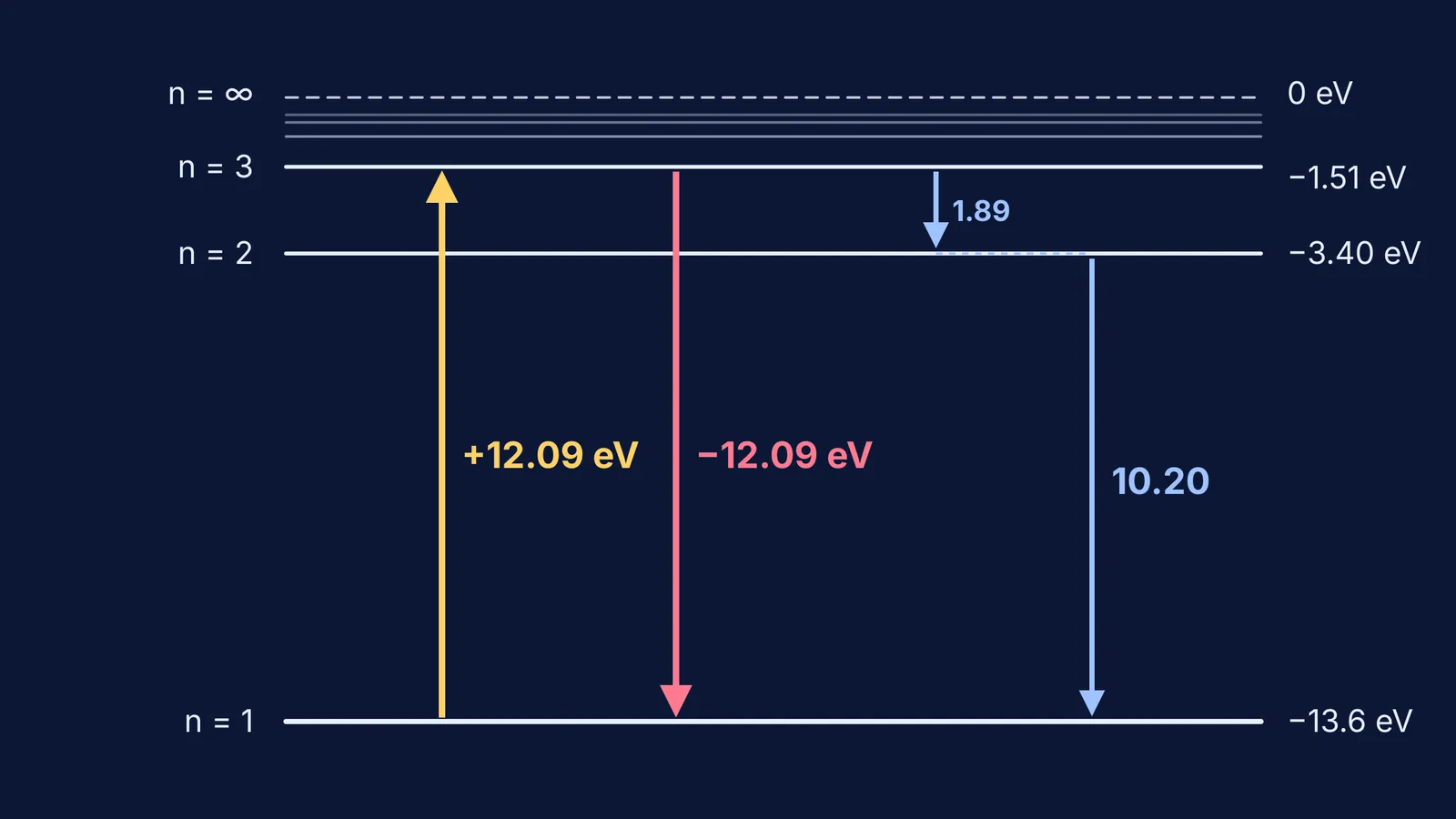
In the Bohr model, the electron in hydrogen can only have the energies En = −k/n², where n = 1, 2, 3 and so on, as set out in the OpenStax Chemistry 2e section on the Bohr model/06%3A_Electronic_Structure_and_Periodic_Properties/6.03%3A_The_Bohr_Model). The constant k is 2.179 × 10⁻¹⁸ J in that textbook. In electron volts it is the Rydberg energy, which NIST lists as 13.605 693 eV. Rounded to 13.6 eV, that gives:
E1 = −13.6 eV (the ground state)
E2 = −13.6/4 = −3.40 eV
E3 = −13.6/9 = −1.51 eV
The minus sign means the electron is bound; zero means it has just escaped. Higher levels are less negative, so they hold more energy. If electron volts are new to you, our explainer on the electron volt as an energy unit covers the basics.
How much energy is absorbed from n = 1 to n = 3?
The same OpenStax page gives the rule for any jump: the energy change is |ΔE| = |Ef − Ei| = hν = hc/λ. Here is the working.
Write the rule as final minus initial: ΔE = E3 − E1.
Put in the values: ΔE = (−1.51) − (−13.6) eV.
Watch the double negative: ΔE = −1.51 + 13.6 = +12.09 eV.
A positive ΔE means the atom gained energy, so it was absorbed.
With fractions you get 13.6 × (1 − 1/9) = 13.6 × 8/9 = 12.09 eV. This checks out against measurement too. NIST's table of hydrogen energy levels puts the n = 3 level 97,492 cm⁻¹ above the ground state, which works out to 12.09 eV.
What wavelength of light does this need?
Use λ = hc/ΔE. With Planck's constant at 4.135 667 696 × 10⁻¹⁵ eV s (NIST) and the speed of light at an exact 299 792 458 m/s (NIST), hc comes to about 1240 eV nm. Then λ = 1240/12.09 ≈ 102.6 nm, which is in the far ultraviolet. NIST's list of strong hydrogen lines has a line at 1025.72 Å, which is 102.57 nm. This is the second line of the Lyman series. For a shortcut, see our post on photon energy as 1240 over lambda.
The photon has to match the gap exactly. Shine 11 eV or 12.5 eV light at ground-state hydrogen and neither photon will lift the electron to n = 3. Neither can it free the electron, because both fall short of 13.6 eV.
Why is the emitted energy the same as the absorbed energy?
Energy is conserved, and the levels don't move. Coming back down from n = 3 to n = 1, the atom has to lose exactly what it gained. There are two ways down:
Direct: n = 3 to n = 1, one photon of 12.09 eV at about 102.6 nm.
Cascade: n = 3 to n = 2 releases 13.6 × (1/4 − 1/9) = 1.89 eV, the red line NIST lists near 656.3 nm. Then n = 2 to n = 1 releases 13.6 × (1 − 1/4) = 10.20 eV, the Lyman line near 121.6 nm in the same NIST table.
Add the cascade: 1.89 + 10.20 = 12.09 eV. Same total, different photons. This is also why absorption lines sit at the same wavelengths as emission lines, as our guide to emission and absorption spectra explains.
How do you check your own answer?
Run through these four checks on any transition question:
Did I do final minus initial and keep both minus signs?
Is my answer less than 13.6 eV, the Rydberg energy from NIST? Every jump that starts from n = 1 and stays inside the atom must be.
Does the sign match the direction: plus going up, minus coming down?
Does λ = 1240/ΔE land in the right region (ultraviolet for jumps to n = 1, mostly visible for jumps down to n = 2)?
Now try it with n = 2 to n = 4 (answer: 2.55 eV) and n = 1 to n = 4 (answer: 12.75 eV). If your answers keep going wrong and you can't see why, the Fermi Problem Library has worked problems with a step-by-step solver that explains the reasoning rather than printing an answer. If the levels themselves feel abstract, the Fermi Concept Library gives each concept its own lesson and shows where it fits on the map.


