

On this page
A question says an electron is "accelerated through 200 V" and asks for its speed. The energy is already sitting in the question, in a unit called the electron volt. Once you see why, these questions take four lines.
What is an electron volt?
The BIPM SI Brochure defines the electronvolt as "the kinetic energy acquired by an electron in passing through a potential difference of one volt in vacuum". It is not an SI unit, but the brochure lists it in Table 8 among non-SI units with an agreed value in joules.
The idea comes straight from potential difference. When a charge q moves through a potential difference V, the field does work W = qV on it. Put q = e and V = 1 V, and that work is 1 eV.
So the rule you will use in every problem is simple: energy in eV = charge in units of e × voltage in volts.
An electron through 250 V gains 250 eV.
A proton through 250 V also gains 250 eV. Mass does not enter the energy at all.
An alpha particle (charge 2e) through 250 V gains 500 eV.
How do you convert electron volts to joules?
NIST lists the value as 1 eV = 1.602 176 634 × 10⁻¹⁹ J, with the uncertainty marked "exact". Those are the same digits as the elementary charge, e = 1.602 176 634 × 10⁻¹⁹ C, because 1 eV is just e multiplied by 1 V. The SI Brochure notes that the factor has been exact since Resolution 1 of the 26th CGPM in 2018 fixed the value of e.
eV to joules: multiply by 1.602 × 10⁻¹⁹.
Joules to eV: divide by 1.602 × 10⁻¹⁹ (the same as multiplying by about 6.24 × 10¹⁸).
keV, MeV and GeV use the ordinary SI prefixes: 10³, 10⁶ and 10⁹.
For example, 5 MeV = 5 × 10⁶ × 1.602 × 10⁻¹⁹ J = 8.01 × 10⁻¹³ J. Energies of atoms and photons are easier to compare in eV, which is why work functions in photoelectric effect problems are usually given in eV.
How fast is an electron after an accelerating voltage?
Starting from rest, the energy gained becomes kinetic energy: qV = ½mv², so v = √(2qV/m). You need the masses from NIST: the electron is 9.109 × 10⁻³¹ kg and the proton is 1.673 × 10⁻²⁷ kg.
Worked example: an electron through 100 V.
Energy: K = 100 eV = 100 × 1.602 × 10⁻¹⁹ J = 1.602 × 10⁻¹⁷ J.
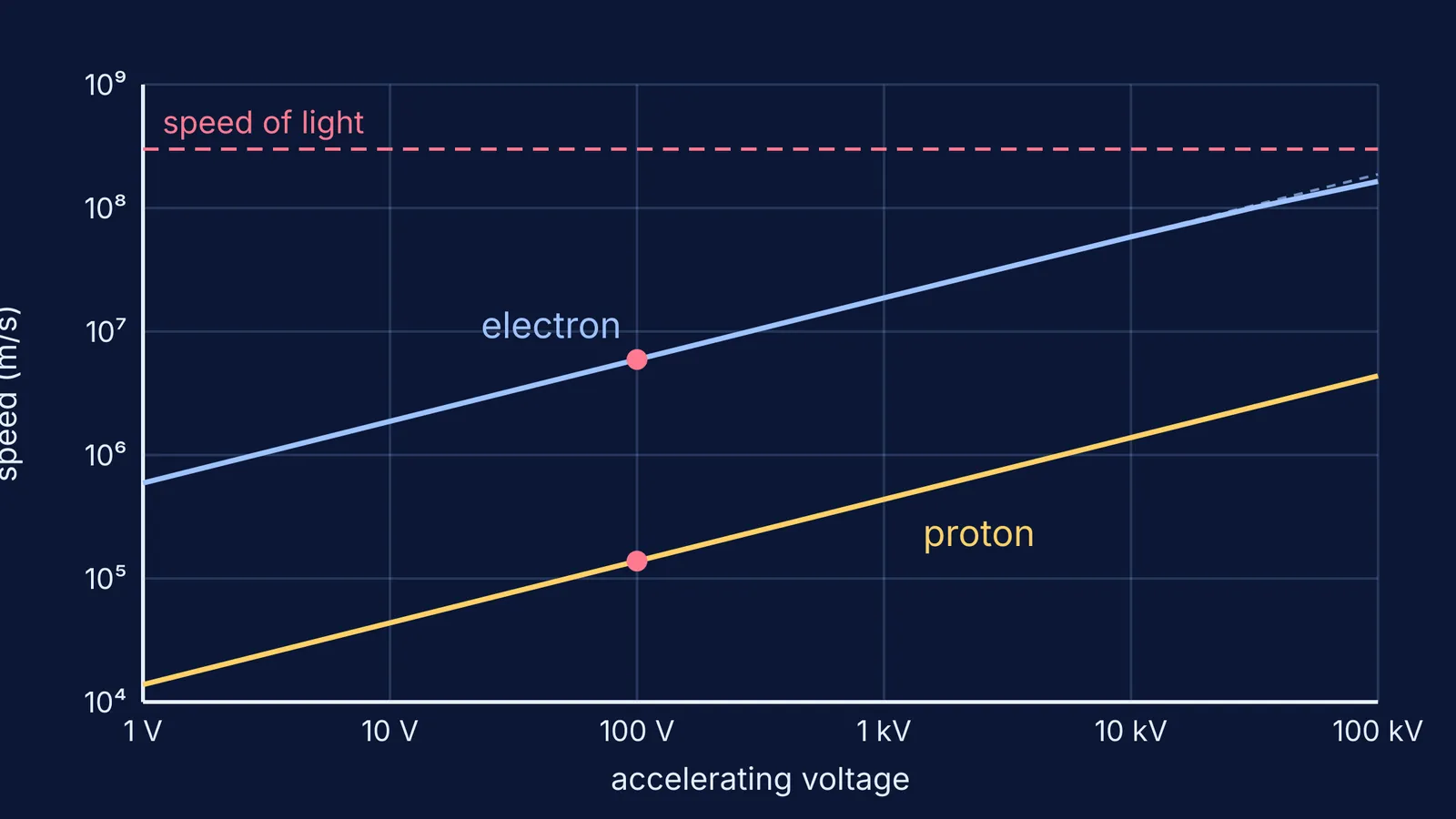
Speed: v = √(2 × 1.602 × 10⁻¹⁷ / 9.109 × 10⁻³¹) = √(3.518 × 10¹³) = 5.93 × 10⁶ m/s.
Worked example: a proton through the same 100 V.
Energy: the charge is the same, so K is again 1.602 × 10⁻¹⁷ J.
Speed: v = √(2 × 1.602 × 10⁻¹⁷ / 1.673 × 10⁻²⁷) = √(1.916 × 10¹⁰) = 1.38 × 10⁵ m/s.
Same energy, very different speeds. The proton is slower by √(mₚ/mₑ), about 42.9, because it is about 1836 times heavier. Two shortcuts follow from these constants, with V in volts: an electron reaches about 5.93 × 10⁵ √V m/s, and a proton about 1.38 × 10⁴ √V m/s.
From here, momentum is one step away with p = √(2mK), which is the route in kinetic energy and momentum problems and in de Broglie wavelength problems with electrons, protons and voltage.
When does ½mv² stop working?
Compare the kinetic energy with the particle's rest energy. NIST gives 0.511 MeV for the electron and 938.272 MeV for the proton.
An electron through 10 kV has about 2% of its rest energy. The classical formula gives 5.93 × 10⁷ m/s against a relativistic 5.85 × 10⁷ m/s, about 1.5% too high.
An electron through 100 kV has about 20% of its rest energy. The classical formula gives 1.88 × 10⁸ m/s against a relativistic 1.64 × 10⁸ m/s, about 14% too high.
A proton through 100 kV has about 0.01% of its rest energy, so ½mv² is still fine.
A checklist for any eV problem
Find the charge in units of e.
Energy in eV = charge number × voltage.
Convert to joules only if you need speed or momentum.
Use v = √(2K/m) with K in joules and m in kilograms.
Compare K with mc² before trusting the classical answer.
Sanity check: at the same voltage, a lighter particle must come out faster.
If your answer keeps disagreeing with the key, the Fermi Problem Library has worked problems with a step-by-step solver that explains the reasoning rather than printing an answer. To see how the electron volt connects to work, potential and energy, the Fermi Concept Library gives each concept its own lesson and its place in the map.
Try the 200 V electron from the start: with the NIST electron mass you should get about 8.4 × 10⁶ m/s.


