On this page
The photoelectric effect is one of the most predictable chapters in JEE and NEET physics. The same equation and the same three graphs come back year after year, and so do the same traps. This guide uses NCERT's Class 12 chapter on the dual nature of radiation and matter as the reference.
What does the photoelectric equation say?
Einstein's equation, as NCERT writes it, is K_max = hν − φ₀, or equivalently eV₀ = hν − φ₀, where φ₀ is the work function of the metal and V₀ is the stopping potential. Emission is only possible if hν > φ₀, which defines the threshold frequency ν₀ = φ₀/h.
NCERT summarises the experimental observations like this:
Above the threshold, photoelectric current is directly proportional to the intensity of the light.
Saturation current is proportional to intensity, "whereas the stopping potential is independent of its intensity".
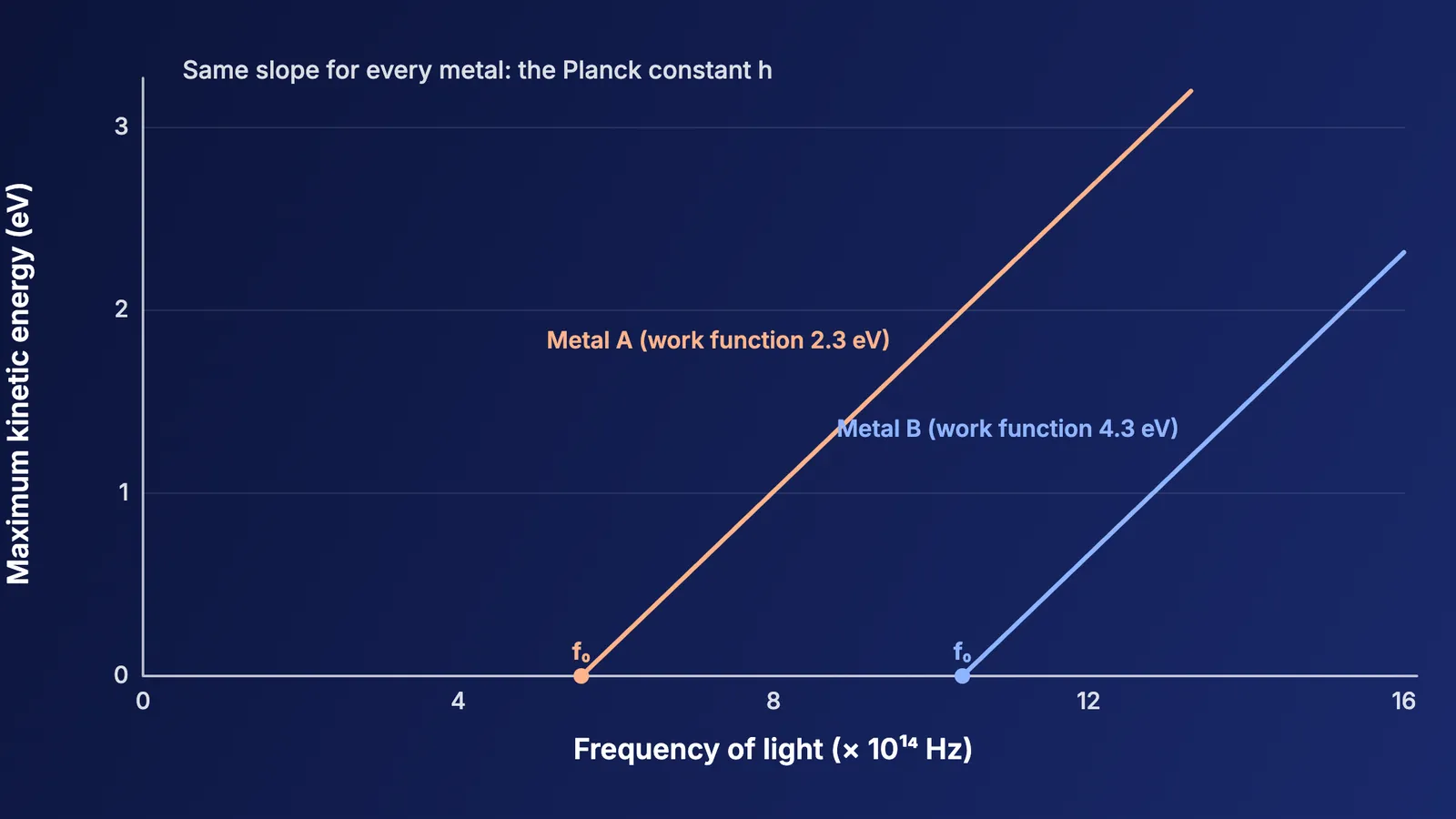
Below the threshold frequency, "no emission of photoelectrons takes place, no matter how intense the incident light is". Above it, the maximum kinetic energy increases linearly with frequency.
Emission is instantaneous, within about 10⁻⁹ s or less, even for very dim light.
In Einstein's picture, intensity sets how many photons arrive, and so how many electrons come out. Frequency sets how much energy each photon carries, and so how fast the fastest electron is.
Worked example: caesium
NCERT's Example 11.2 gives the work function of caesium as 2.14 eV and works out the threshold frequency as 5.16 × 10¹⁴ Hz. Let us extend it.
A useful shortcut: hc ≈ (6.63 × 10⁻³⁴)(3 × 10⁸) ≈ 1.99 × 10⁻²⁵ J m. Dividing by 1.6 × 10⁻¹⁹ J per eV gives about 1.24 × 10⁻⁶ eV m. So photon energy in eV ≈ 1240 divided by wavelength in nm.
Light of 400 nm falls on caesium.
Photon energy: 1240/400 = 3.10 eV.
K_max = 3.10 − 2.14 = 0.96 eV.
Stopping potential: V₀ = 0.96 V. In volts, it is numerically equal to K_max in eV.
Threshold wavelength: 1240/2.14 ≈ 579 nm. Light with a longer wavelength than this ejects no electrons from caesium, however intense.
How do you read the three standard graphs?
Current against intensity (fixed frequency above threshold): a straight line through the origin.
Current against collector potential: brighter light raises the saturation current, but for the same frequency every curve reaches zero current at the same stopping potential. A higher frequency needs a larger stopping potential.
Stopping potential against frequency: NCERT shows this is a straight line with slope h/e, "independent of the nature of the material". It cuts the frequency axis at ν₀. So lines for different metals are parallel, shifted by their different work functions. NCERT also notes that Millikan measured this slope for sodium and, in 1916, confirmed Einstein's equation.
If graph questions in general trip you up, our guide to reading and sketching physics graphs covers slopes, intercepts and areas.
Which traps do examiners set?
"Double the intensity": the stopping potential and K_max do not change. Only the current changes.
"Double the frequency": K_max does not double. With 3.10 eV photons on caesium, K_max = 0.96 eV. Double the photon energy to 6.20 eV and K_max = 4.06 eV, not 1.92 eV, because the work function is subtracted once.
"Leave it on longer": below threshold, NCERT says no emission happens "no matter how intense the incident radiation may be or how long it falls on the surface".
Joules and eV mixed: 1 eV = 1.6 × 10⁻¹⁹ J. Mixing them in one line is a frequent arithmetic slip.
"Each electron has K_max": K_max is the most energetic electron. Others leave with less.
Graph slopes: the slope of V₀ against ν is h/e, not h. The slope of K_max (in joules) against ν is h.
A quick routine for any photoelectric question
Write the work function and photon energy in eV.
Check that the photon energy exceeds the work function. If not, the answer is zero emission.
Subtract to get K_max, and read V₀ off in volts.
Ask whether the question changed intensity (affects current only) or frequency (affects energy).
If you are stronger in biology than physics and preparing for NEET, this chapter is a good place to collect marks; see NEET physics for students who are strong in biology. For practice with explanations, the Fermi Problem Library has worked problems with a step-by-step solver that explains the reasoning rather than printing an answer.