On this page
Almost every catalysis classification question comes down to one move: write the phase of every substance, including the catalyst, and compare. Below we do that for three classic textbook examples, then walk through the adsorption theory that explains how the heterogeneous ones work.
What is the difference between homogeneous and heterogeneous catalysis?
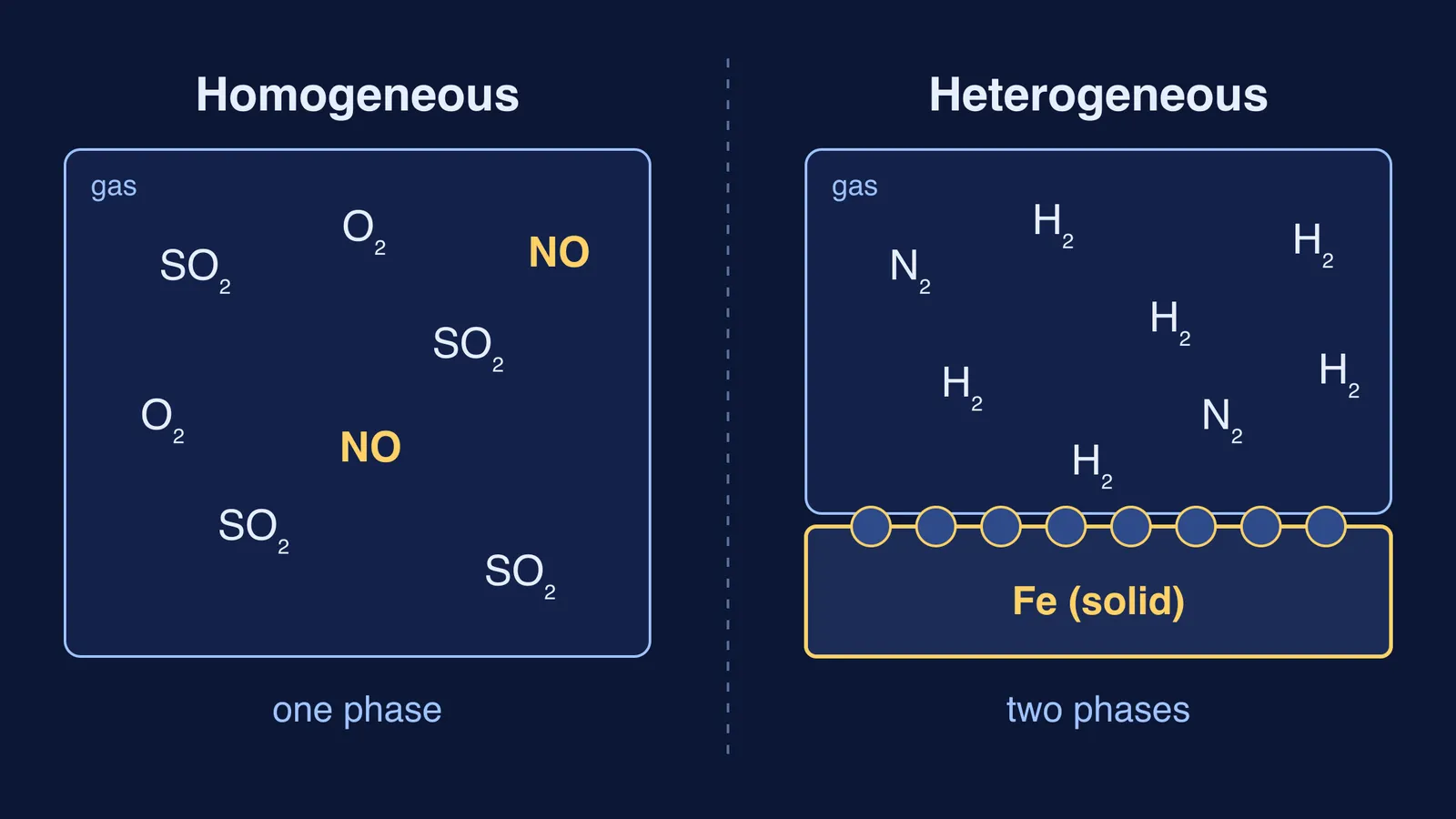
Homogeneous catalysis is when “the reactants and the catalyst are in the same phase (i.e., liquid or gas)”, according to the Surface Chemistry chapter of NCERT's Class 12 chemistry textbook (2015-16 edition).
Heterogeneous catalysis is when the reactants and the catalyst are in different phases (NCERT). Usually the catalyst is a solid and the reactants are gases, so the reaction happens at the solid surface, which is why it is also called surface catalysis (Chemistry LibreTexts/18:_Chemical_Kinetics/18.12:_Heterogeneous_Catalysis)).
Notice what decides it: the catalyst's phase compared with the reactants'. The reaction on its own never tells you.
How do you classify the lead chamber, ester hydrolysis and Haber processes?
Here are the three, worked the same way, using the equations and state symbols from the NCERT chapter.
Lead chamber process. 2SO₂(g) + O₂(g) → 2SO₃(g), catalysed by nitric oxide, NO(g). Reactants are gases and the catalyst is a gas: homogeneous.
Hydrolysis of an ester. CH₃COOCH₃(l) + H₂O(l) → CH₃COOH(aq) + CH₃OH(aq), catalysed by H⁺ ions from hydrochloric acid. Reactants and catalyst are in one liquid phase: homogeneous.
Haber's process. N₂(g) + 3H₂(g) → 2NH₃(g) over finely divided iron, Fe(s). Gaseous reactants, solid catalyst: heterogeneous. NCERT adds that molybdenum acts as a promoter for the iron catalyst.
One more case catches students out. In the hydrogenation of vegetable oils, the oil is a liquid, hydrogen is a gas and finely divided nickel is a solid. Three phases, but the catalyst differs from the reactants, so it is heterogeneous (NCERT). For a spongy nickel catalyst built to hold hydrogen, see our post on what Raney nickel is and why it holds hydrogen.
A quick check for any catalysis question
Write the state symbol for each reactant: (g), (l), (aq) or (s).
Write the state symbol for the catalyst. Ions supplied by an acid in water, such as H⁺, are in solution.
If the catalyst is in the same single phase as all the reactants, it is homogeneous. If its phase differs, it is heterogeneous.
Write the reason in your answer: gaseous reactants, solid Fe catalyst, so heterogeneous. A one-word answer gives the examiner nothing to check.
Try it on two more NCERT examples before reading the answers. Ostwald's process oxidises NH₃(g) with O₂(g) over platinum gauze. Cane sugar is hydrolysed in solution by H⁺ ions from sulphuric acid. Answers: the first is heterogeneous (solid Pt, gaseous reactants); the second is homogeneous (everything in solution).
What are the steps of the adsorption theory of heterogeneous catalysis?
The older adsorption theory said that reactants are adsorbed on the solid catalyst, the higher concentration on the surface raises the rate, and the heat released by adsorption, an exothermic process, helps too (NCERT). The modern theory combines this with intermediate compound formation, and places the catalytic activity on the surface of the catalyst.
Here are NCERT's five steps, applied to ammonia on iron:
Diffusion of reactants to the surface: N₂ and H₂ molecules travel from the gas to the iron.
Adsorption of reactant molecules on the surface. Surface atoms, unlike those in the bulk, have free valencies, so gas molecules are held there by loose chemical combination.
Reaction on the surface through an intermediate: species adsorbed side by side react and form new bonds.
Desorption of the product: NH₃ leaves, which frees the surface for more reaction.
Diffusion of the product away from the surface.
The same textbook section explains why the strength of adsorption matters. Reactants must be held reasonably strongly to become active, but not so strongly that they are immobilised and block space for other reactants (NCERT). How much gas a surface holds at a given pressure is the subject of our guide to the Freundlich adsorption isotherm graph.
The five steps describe a surface, so they do not apply to the lead chamber process or ester hydrolysis, where there is no solid surface at all. For those, the intermediate compound idea is the explanation to reach for. A car's catalytic converter is heterogeneous catalysis in everyday use.
Where to practise next
If you can classify these but lose marks on longer surface chemistry or kinetics problems, the Fermi Problem Library has worked problems with a step-by-step solver that explains the reasoning rather than printing an answer. If the gap is the idea itself, the Fermi Concept Library gives each chemistry concept its own lesson and shows where it sits in the map.