On this page
Raney nickel turns up in Class 12 and JEE organic chemistry as "Raney Ni" written over a reaction arrow, usually with no explanation. You will see it do two jobs: adding hydrogen and removing sulphur.
What is Raney nickel?
Raney nickel is a fine-grained, grey, spongy solid made mostly of nickel, derived from a nickel-aluminium alloy and used as a catalyst in organic chemistry, especially for hydrogenation (Wikipedia: Raney nickel). Commercial Raney nickel has an average nickel surface area of about 100 m² per gram of catalyst, according to the same article.
It is named after Murray Raney, whose patent US 1,628,190, "Method of producing finely-divided nickel" was filed on 14 May 1926 and granted on 10 May 1927. W. R. Grace, which sells the RANEY brand today, says he was developing a catalyst to turn cottonseed oil into shortening in the early 1920s, first by leaching silicon out of a nickel-silicon alloy and later using aluminium instead.
How is Raney nickel made from a nickel-aluminium alloy?
Melt nickel with aluminium to make an alloy. Raney's patent covers alloys from 10% to 85% nickel; the 1:1 Ni/Al alloy he went on to use is still a common composition (Wikipedia).
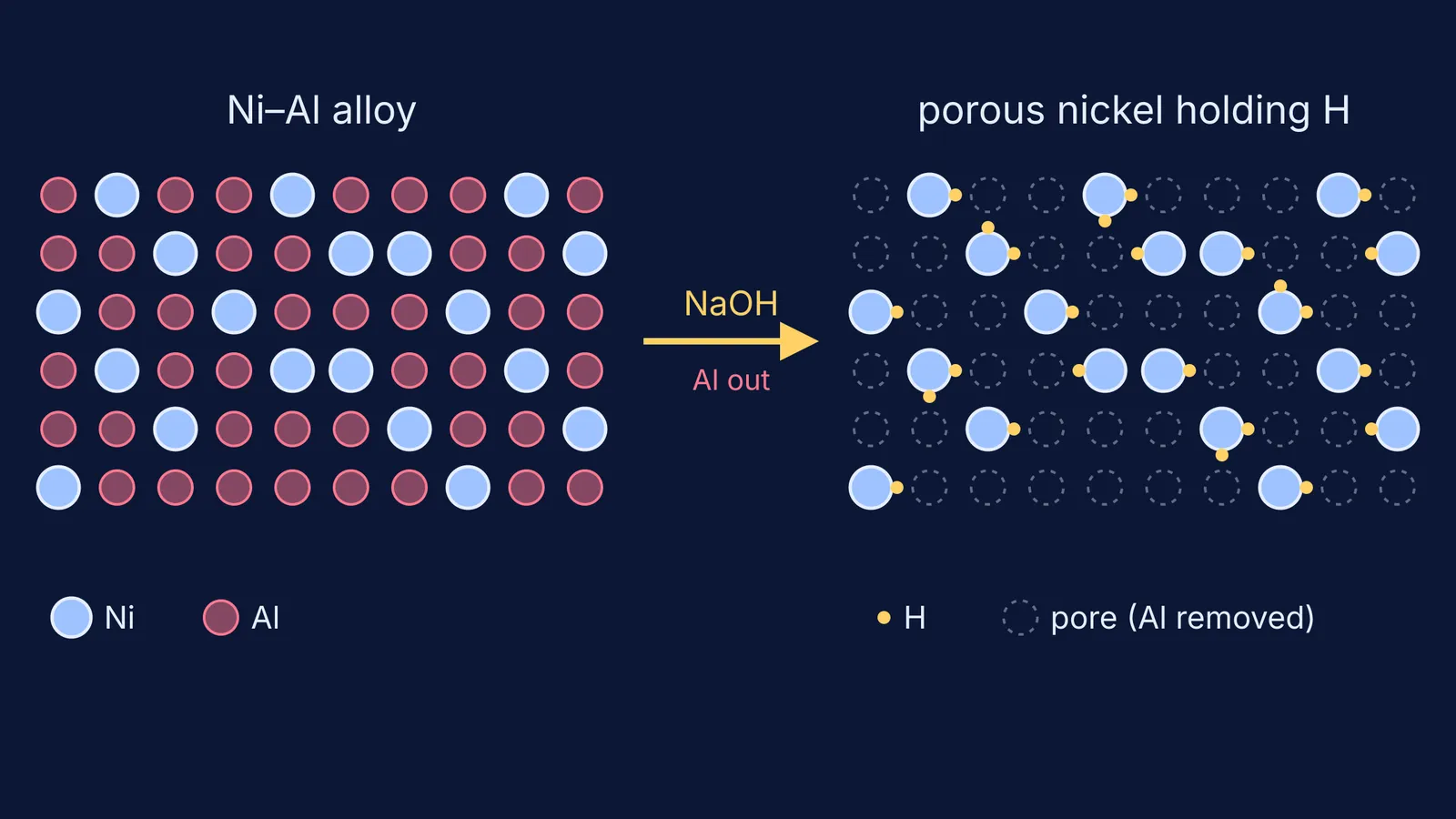
Powder the alloy and treat it with concentrated sodium hydroxide, at concentrations of up to 5 M and commonly at 70 to 100 °C (same source). Aluminium is amphoteric, so it dissolves in alkali; nickel does not.
Wash away the sodium aluminate. What is left is nickel full of holes where the aluminium used to be.
The leaching reaction is 2Al + 2NaOH + 6H₂O → 2Na[Al(OH)₄] + 3H₂. The removal is not complete: most of the nickel stays behind as a NiAl phase, so the finished catalyst still contains some aluminium.
How much hydrogen does leaching give off?
Suppose you leach 50 g of an alloy that is half nickel and half aluminium by mass, and all of the aluminium dissolves, using the equation above from the Raney nickel article. Because some aluminium stays behind as NiAl, treat the answer as an upper limit.
Aluminium present: 25 g ÷ 26.98 g/mol = 0.927 mol.
2 mol Al gives 3 mol H₂, so H₂ = 0.927 × 3/2 = 1.39 mol.
At 273 K and 1 atm (22.4 L/mol), that is about 31 L of hydrogen.
NaOH used: 1 mol per mol of Al, so 0.927 mol, or about 37 g.
Why does Raney nickel already contain hydrogen?
Hydrogen is absorbed into the pores of the catalyst during activation, and even after a reaction, used Raney nickel still contains significant amounts of hydrogen (Wikipedia).
That stored hydrogen is also the danger. Dry, activated Raney nickel is pyrophoric, meaning it can catch fire on contact with air, so it is handled under an inert atmosphere and usually supplied as a 50% slurry in water (same article).
What is Raney nickel used for?
Hydrogenation. It adds hydrogen across multiple bonds. Examples include benzene to cyclohexane and the reduction of alkynes, nitriles and nitro compounds (Wikipedia). For the mechanism on the metal surface, see our guide to catalytic hydrogenation of alkenes and alkynes over Ni, Pt and Pd; for the history, read about Paul Sabatier and hydrogenation with nickel.
Desulphurisation. Raney nickel breaks carbon-sulphur bonds and puts C-H bonds in their place. Ralph Mozingo, Donald Wolf, Stanton Harris and Karl Folkers reported this kind of reaction in a 1943 Journal of the American Chemical Society paper, "Hydrogenolysis of Sulfur Compounds by Raney Nickel Catalyst". In exam questions, its most common use is turning a C=O group into CH₂:
Cyclohexanone + HS-CH₂CH₂-SH (acid catalyst) → a cyclic thioacetal.
Thioacetal + Raney Ni → cyclohexane. Both C-S bonds are replaced by C-H, and the sulphur ends up on the nickel.
This gives the same result as the reductions in our Clemmensen vs Wolff-Kishner comparison, but without the strong acid of one or the hot base of the other.
How do you answer Raney nickel questions in exams?
Run this checklist each time:
Spot the reagent: "Raney Ni" or "Ra-Ni".
Does the starting compound contain sulphur (thioacetal, thioether, thiol)? If yes, replace each C-S bond with C-H and draw the sulphur-free product.
If no sulphur, treat it as hydrogenation: C=C and C≡C go to the alkane, C≡N to CH₂NH₂, NO₂ to NH₂. To stop an alkyne at the cis-alkene, the exam expects Lindlar's catalyst instead.
If you keep getting the steps right but the product wrong, the Fermi Problem Library has worked problems with a step-by-step solver that explains the reasoning rather than printing an answer. If the gap is the idea underneath, such as adsorption or heterogeneous catalysis, the Fermi Concept Library gives every chemistry concept its own lesson and its place in the map.
Next time you see Raney Ni over an arrow, ask one question first: is there sulphur?