

On this page
Catalytic hydrogenation looks like one arrow with "Pt/Pd/Ni" written above it. Three questions sit behind that arrow: what the metal does, which face the hydrogen comes from, and how you stop an alkyne halfway. Get those right and most board and JEE questions on it become quick marks.
What is catalytic hydrogenation of alkenes and alkynes?
The NCERT Class 11 chemistry textbook defines it directly: dihydrogen adds to alkenes and alkynes in the presence of finely divided platinum, palladium or nickel to form alkanes, and this process is called hydrogenation (NCERT Class 11 Chemistry, Unit 9, Hydrocarbons).
The same page explains why the metal matters: these metals adsorb dihydrogen on their surfaces and activate the H–H bond. It also gives the conditions you are expected to remember. Platinum and palladium catalyse the reaction at room temperature, while nickel needs a relatively higher temperature and pressure.
The reaction happens on the metal surface, so a powder or a metal spread on charcoal gives far more surface than a lump. Paul Sabatier shared the 1912 Nobel Prize in Chemistry, awarded to him "for his method of hydrogenating organic compounds in the presence of finely disintegrated metals" (Nobel Prize facts page). For the same reaction in an Indian kitchen, read why vegetable oils are hydrogenated to make vanaspati.
Why is catalytic hydrogenation a syn addition?
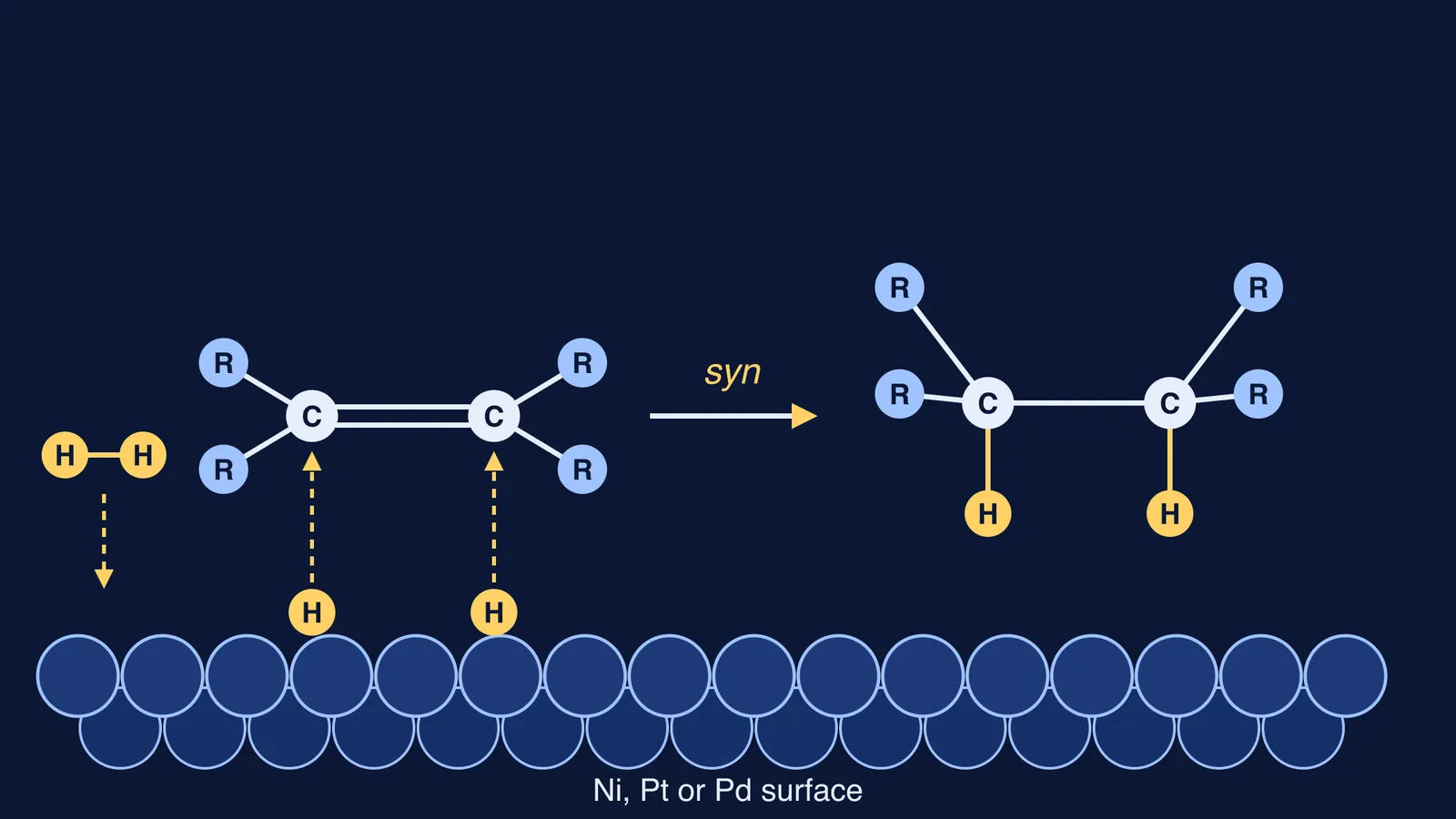
Picture the steps on the metal, as LibreTexts lays them out (Reduction of Alkenes: Hydrogenation/08%3A_Alkenes-_Reactions_and_Synthesis/8.06%3A_Reduction_of_Alkenes_-_Hydrogenation)):
Hydrogen is adsorbed on the metal surface, which activates the H–H bond.
The alkene is adsorbed too, with one face of its double bond against the metal.
Two hydrogens shift from the metal surface to the two carbons of the double bond.
The saturated product, more weakly adsorbed, leaves the surface.
Because both hydrogens come from the metal, you expect them to reach the same face of the molecule. Adding two atoms to the same face is called syn addition, and the diagram at the top of this page shows it. LibreTexts adds that the exact timing of the last steps is not well understood.
Worked example. Hydrogenate 1,2-dimethylcyclopent-1-ene with H2 and Pt. Both new H atoms go onto the bottom face, so both methyl groups get pushed to the top face together. LibreTexts notes the product is only cis-1,2-dimethylcyclopentane. If a question offers you "a mixture of cis and trans", that option is wrong.
How is partial hydrogenation of alkynes different?
Over ordinary Pt, Pd or Ni, an alkyne does not stop at the alkene. NCERT writes propyne going straight to propane with Pt/Pd/Ni over the arrow (NCERT, Unit 9). The alkene that forms first is hydrogenated again on the same active surface.
To stop at the alkene, you weaken the catalyst. NCERT describes partial reduction with a calculated amount of dihydrogen over palladised charcoal partially deactivated with poisons like sulphur compounds or quinoline. NCERT calls this Lindlar's catalyst, and the alkene it gives has cis geometry. H. Lindlar's own 1952 paper in Helvetica Chimica Acta described a palladium–lead catalyst for partial hydrogenations that keep aliphatic double bonds intact (Lindlar, 1952, DOI 10.1002/hlca.19520350205).
The cis result follows from the same surface picture: both hydrogens arrive from the metal side. For the trans alkene, NCERT gives a different route: reduction with sodium in liquid ammonia.
Take but-2-yne (CH3–C≡C–CH3) three ways:
H2 with Pt, Pd or Ni: butane.
H2 with Lindlar's catalyst: cis-but-2-ene.
Na in liquid NH3: trans-but-2-ene.
A related trap: hydroboration followed by oxidation turns a terminal alkyne into a carbonyl compound, not an alkene. See why hydroboration of a terminal alkyne gives an aldehyde.
How do you predict the product in an exam?
Run this checklist before you pick an option:
Is the starting compound an alkene or an alkyne?
Is the catalyst plain Pt, Pd or Ni? Then it goes all the way to the alkane.
Is it Lindlar's catalyst (poisoned Pd)? Then an alkyne stops at the cis alkene.
Is it sodium in liquid ammonia? Then an alkyne gives the trans alkene.
Can the product exist as stereoisomers, such as cis and trans on a ring? Then draw both new H atoms on the same face.
Count the H2 used: one per π bond removed.
If you keep choosing the wrong product, check which step of the reasoning went wrong. The Fermi Problem Library has worked problems with a step-by-step solver that explains the reasoning rather than printing an answer. If the gap is earlier, in cis–trans isomerism or adsorption, the Fermi Concept Library gives each chemistry concept its own lesson. Metal catalysts can also add hydrogen to just one face of a molecule on purpose, which is the story of Ryoji Noyori's chiral catalysts for asymmetric hydrogenation.


