

On this page
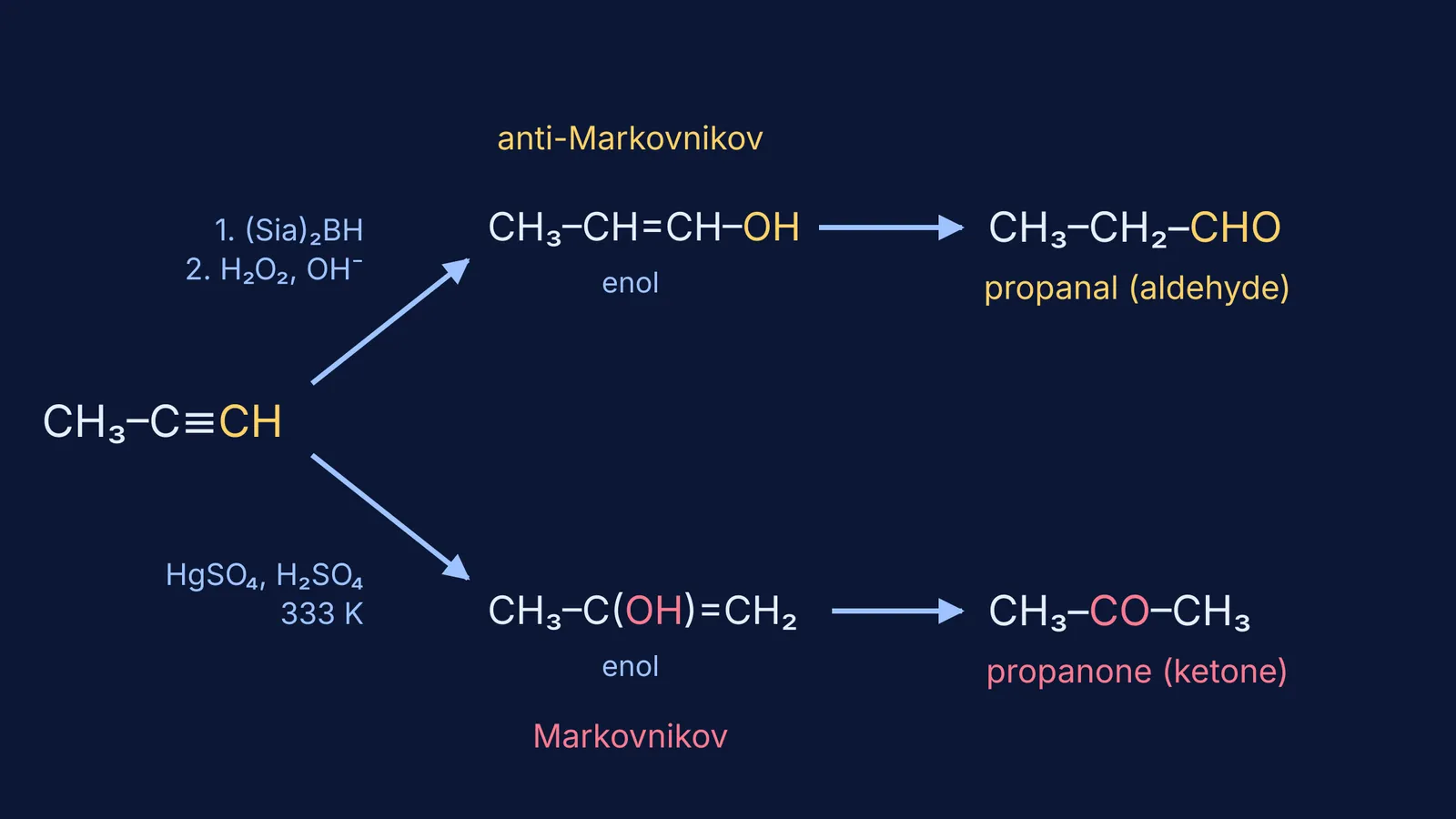
A question gives you propyne and two sets of reagents. One route ends at propanal, the other at propanone. If you can say which carbon ends up holding the OH, you can answer this kind of question with confidence. Here is why, with a worked example and an exam-hall check.
Why does hydroboration of a terminal alkyne give an aldehyde?
It comes down to position. In hydroboration the B–H bond adds across the triple bond, and boron goes to the less substituted carbon, the one at the end of the chain. The LibreTexts section on hydroboration-oxidation of alkynes/11:_Alkynes/11.10:_HydroborationOxidation) describes this as anti-Markovnikov addition: boron bonds to the less substituted carbon, hydrogen to the more substituted one, and both add to the same face of the molecule (syn addition).
Why does boron go to the end? The LibreTexts module on alkyne hydroboration/Alkynes/Reactivity_of_Alkynes/Hydroboration_Reactions_and_Oxidations) explains that the addition only looks anti-Markovnikov, because boron is the electrophile here, not hydrogen. The same module notes that a bulky borane, disiamylborane (made from diborane and 2-methyl-2-butene), is used because the crowded alkenylborane it forms resists a second addition, so the reaction stops at the alkene stage.
Next, alkaline hydrogen peroxide swaps boron for OH at the same carbon. That gives an enol with OH on the end carbon, R–CH=CH–OH. In the module's words, this enol rapidly rearranges to the aldehyde tautomer. An OH on an end carbon can only become a –CHO group, so the product has to be an aldehyde.
Why does HgSO4 hydration give a ketone instead?
The NCERT Class 11 chapter on hydrocarbons says one molecule of water adds to an alkyne on warming with mercuric sulphate and dilute sulphuric acid at 333 K to form carbonyl compounds. Its worked equation turns propyne into propanone. This addition follows Markovnikov's rule: hydrogen goes to the end carbon and OH goes to the inner one, giving CH3–C(OH)=CH2, which isomerises to the ketone.
Both LibreTexts pages put the contrast in one sentence: terminal alkynes can be turned into methyl ketones by mercuric-ion-catalysed hydration, or into aldehydes by hydroboration followed by oxidation.
One trap: ethyne. In the same NCERT chapter, ethyne with HgSO4 gives ethanal, an aldehyde. Both carbons of ethyne are end carbons, so the OH has nowhere else to go. It is a useful exception to remember.
Worked example: but-1-yne by both routes
Start with HC≡C–CH2–CH3 and call the end carbon C1.
Route A: disiamylborane, then H2O2 and NaOH
Boron adds to C1 and hydrogen to C2, giving R2B–CH=CH–CH2CH3.
Oxidation swaps boron for OH, giving the enol HO–CH=CH–CH2CH3.
The enol tautomerises to OHC–CH2–CH2CH3, which is butanal.
Route B: HgSO4 and dilute H2SO4
Hydrogen adds to C1 and OH to C2, giving the enol CH2=C(OH)–CH2CH3.
The enol tautomerises to CH3–CO–CH2CH3, which is butan-2-one.
Both products have the formula C4H8O. They are functional isomers, so a question can ask you to tell the two routes apart from the product alone.
How do you check your answer in the exam?
Run these five steps before you mark an option:
Is the alkyne terminal? Look for a C–H on a triple-bonded carbon.
Read the reagent. Borane first, then H2O2 and base, means the OH goes to the end carbon. Hg2+ with acid means the OH goes to the inner carbon.
Draw the enol and circle the carbon that holds the OH.
End carbon gives –CHO, an aldehyde. Inner carbon gives C=O in the chain, a ketone.
Ethyne gives ethanal by either route, because both of its carbons are end carbons.
If your answers keep landing on the wrong carbon, practise a few similar conversions where you can see each step. The Fermi Problem Library has worked problems with a step-by-step solver that explains the reasoning rather than printing an answer. If the shaky part is keto-enol tautomerism itself, the Fermi Concept Library gives each concept its own lesson and shows where it sits in the map of chemistry.
Where does this fit in your revision?
This reaction pair belongs to a bigger set of ways to make carbonyl compounds, which we compare in methods for preparing aldehydes and ketones. For more practice with Markovnikov addition across a triple bond, see why HX adds to alkynes to give gem-dihalides. For anti-Markovnikov addition by a different mechanism, see this route to 1-iodobutane using peroxide HBr and halogen exchange.
The chemistry has a good backstory too. The 1979 Nobel Prize in Chemistry went jointly to Herbert C. Brown and Georg Wittig for developing boron- and phosphorus-containing compounds, respectively, into important reagents in organic synthesis.
Next time you see a terminal alkyne, find the end carbon first. Everything else follows from where the OH lands.


