

On this page
Why does direct HI addition fail to give 1-iodobutane?
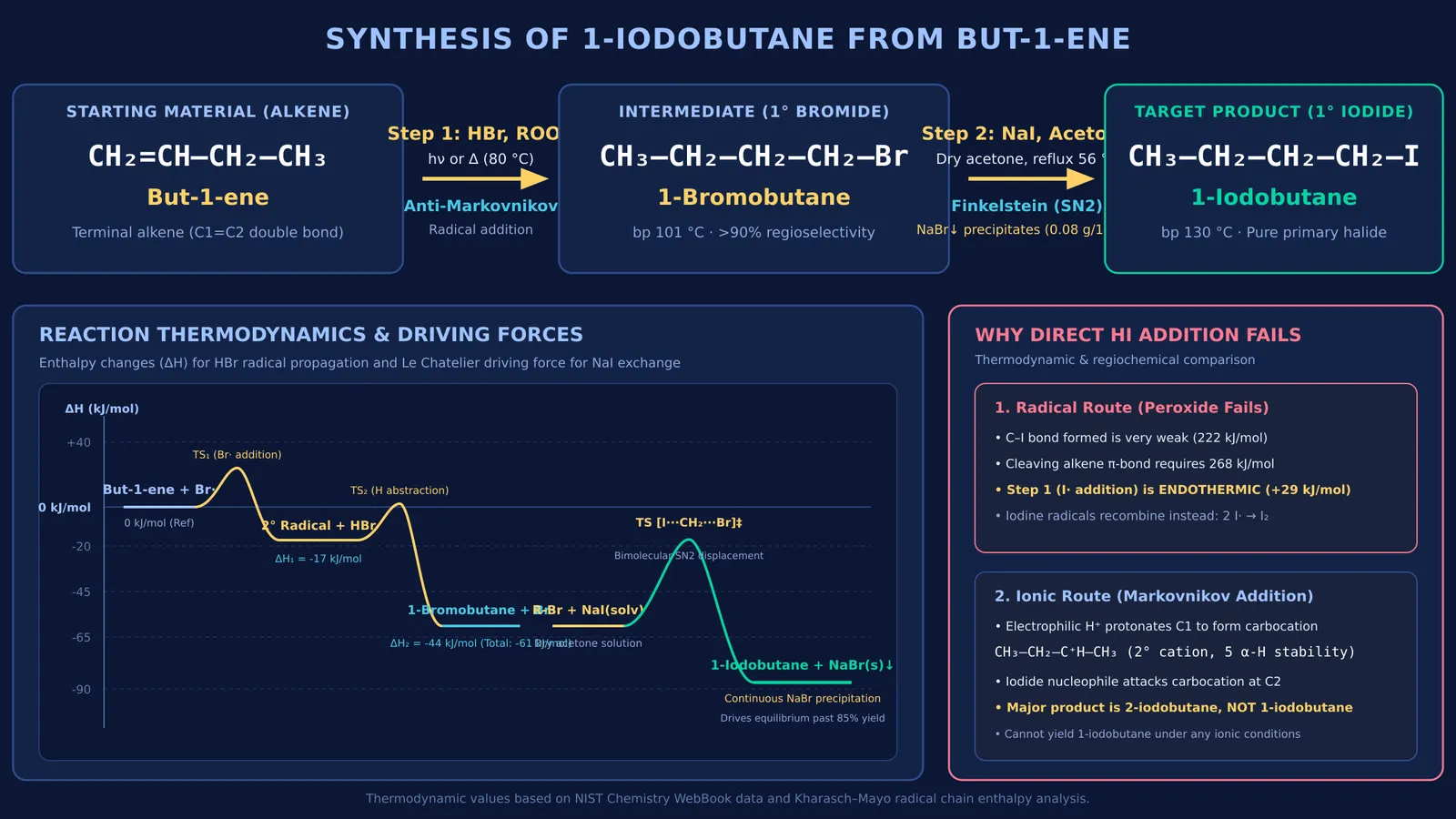
When you treat but-1-ene (CH3-CH2-CH=CH2) with hydrogen iodide (HI), electrophilic addition follows Markovnikov's rule. The proton adds to C1 to generate the secondary butyl carbocation (CH3-CH2-C⁺H-CH3), stabilized by hyperconjugation across five α-hydrogens. Iodide ion then traps the carbocation, yielding 2-iodobutane as the exclusive major product. Refer to our guide on Markovnikov's rule and the peroxide effect for the classical carbocation pathway.
Students preparing for competitive examinations often wonder whether adding an organic peroxide would flip the regiochemistry of HI to give 1-iodobutane. Thermochemical data compiled in the NIST Chemistry WebBook show why this fails. The carbon-iodine bond is weak, with a bond dissociation energy of roughly 222 kJ/mol, while cleaving the alkene π-bond requires 268 kJ/mol. Adding an iodine radical (I·) to the terminal alkene carbon is endothermic by approximately 29 kJ/mol. Instead of sustaining a chain reaction, iodine radicals combine exothermically to regenerate molecular iodine (I2). Consequently, HI cannot undergo free-radical chain addition, even with benzoyl peroxide present.
How does peroxide direct HBr to 1-bromobutane?
In contrast to HI and HCl, hydrogen bromide operates within a thermodynamic window where both propagation steps are exothermic. In their landmark 1933 study, Morris Kharasch and Frank Mayo at the University of Chicago demonstrated the peroxide effect, proving that traces of organic peroxides reverse the addition orientation of HBr across unsymmetrical alkenes.
The radical pathway begins when an organic peroxide undergoes homolytic cleavage upon heating to 80 °C or under ultraviolet light. The generated radical abstracts hydrogen from HBr to form a bromine radical (Br·). In the first propagation step, Br· attacks the terminal carbon (C1) of but-1-ene to form the more stable secondary carbon radical at C2. Forming the carbon-bromine bond releases 285 kJ/mol, overcoming the broken π-bond to make this step exothermic by 17 kJ/mol, based on values from the NIST Chemistry WebBook.
In the second propagation step, the secondary radical abstracts a hydrogen atom from another HBr molecule. Breaking H-Br requires 366 kJ/mol, but forming the C-H bond releases 410 kJ/mol, making this step exothermic by 44 kJ/mol according to the NIST Chemistry WebBook. Both chain steps proceed spontaneously, yielding 1-bromobutane in over 90% regioselectivity. For HCl, this step is endothermic by 21 kJ/mol because the H-Cl bond is too strong (432 kJ/mol).
Why does dry acetone drive the Finkelstein reaction?
Once you isolate 1-bromobutane, you convert it into 1-iodobutane through halogen exchange. First reported by German chemist Hans Finkelstein in his 1910 investigation, the reaction treats an alkyl bromide with sodium iodide (NaI) in anhydrous acetone at reflux.
The driving force rests on solubility differences governed by lattice energy and ionic solvation. In dry acetone at 25 °C, sodium iodide dissolves readily up to 50 g per 100 g of solvent because the polarisable iodide ion coordinates with acetone molecules, as documented by Finkelstein in 1910. Conversely, sodium bromide has higher lattice energy and poor solvation in aprotic acetone, dissolving to only 0.08 g per 100 g. As 1-bromobutane reacts with iodide, sodium bromide precipitates as a white solid. Under Le Chatelier's principle, continuous precipitation removes bromide from solution, driving the equilibrium past 85% conversion.
Mechanistically, this displacement follows bimolecular nucleophilic substitution (SN2). Because 1-bromobutane is an unhindered primary halide, iodide attacks the electrophilic carbon backside without steric crowding. In their kinetic investigations, L. Fowden, E. D. Hughes, and C. K. Ingold in the Journal of the Chemical Society confirmed that substitution follows second-order kinetics, with Rate = k[R-Br][I⁻]. Read our guide on SN1 vs SN2 mechanisms in haloalkanes to see why primary halides undergo substitution without carbocation rearrangements.
Learn more about the general scope of halogen exchange methods in our review of Finkelstein and Swarts reactions. When working through multistep organic sequences, the Fermi Problem Library offers worked problems with a step-by-step solver that explains the reasoning rather than printing an answer.
What is the step-by-step laboratory conversion roadmap?
To synthesise 1-iodobutane from but-1-ene reliably, follow this sequence:
Bubble but-1-ene into an organic solvent containing excess hydrogen bromide and benzoyl peroxide at 25 °C, following the radical addition conditions described by Kharasch and Mayo.
Quench with aqueous sodium bisulphite, separate the organic layer, and dry over anhydrous calcium chloride. Distil the mixture to isolate 1-bromobutane, which boils at 101 °C.
Dissolve 1.2 equivalents of anhydrous sodium iodide in dry acetone, and add the isolated 1-bromobutane.
Reflux the mixture at 56 °C for 2 hours, as detailed in Finkelstein's procedure. Observe white crystalline sodium bromide separating along the flask walls.
Filter off insoluble sodium bromide, wash the filtrate with cold water to remove residual salts and acetone, and separate the dense organic phase.
Dry over anhydrous sodium sulphate and collect pure 1-iodobutane boiling at 130 °C by fractional distillation.
To master how functional group interconversions and reaction conditions link together across organic chemistry, explore the Fermi Concept Library, which covers every concept in physics, chemistry, biology, mathematics and computing.


