

On this page
When an alkyne such as propyne reacts with two equivalents of hydrogen bromide (HBr), students often wonder why both bromine atoms attach to the identical carbon atom instead of splitting across adjacent carbons. A dihalide with both halogens on the same carbon is known as a geminal dihalide (from the Latin *gemini*, meaning twins), in contrast to a vicinal dihalide where halogens sit on neighbouring carbons.
The outcome seems counterintuitive at first glance. Halogens are electronegative elements that pull electron density toward themselves through inductive effects (-I). A student might expect the first bromine atom to repel the second, favouring a vicinal product like 1,2-dibromopropane. In organic synthesis, however, adding hydrogen halides (HX = HCl, HBr, HI) to terminal alkynes yields geminal dihalides exclusively, such as 2,2-dibromopropane from propyne. The governing factor is not steric or electrostatic repulsion, but the stability of the resonance-stabilised carbocation formed during the second protonation step.
How does the first addition step form a vinyl halide?
The reaction proceeds in two distinct electrophilic addition stages. In the first stage, the alkyne acts as a nucleophile, using its pi electron density to attack an electrophilic proton (H⁺) from HBr. For an unsymmetrical terminal alkyne like propyne (CH₃-C≡CH), the proton can add to either the terminal carbon (C1) or the internal carbon (C2).
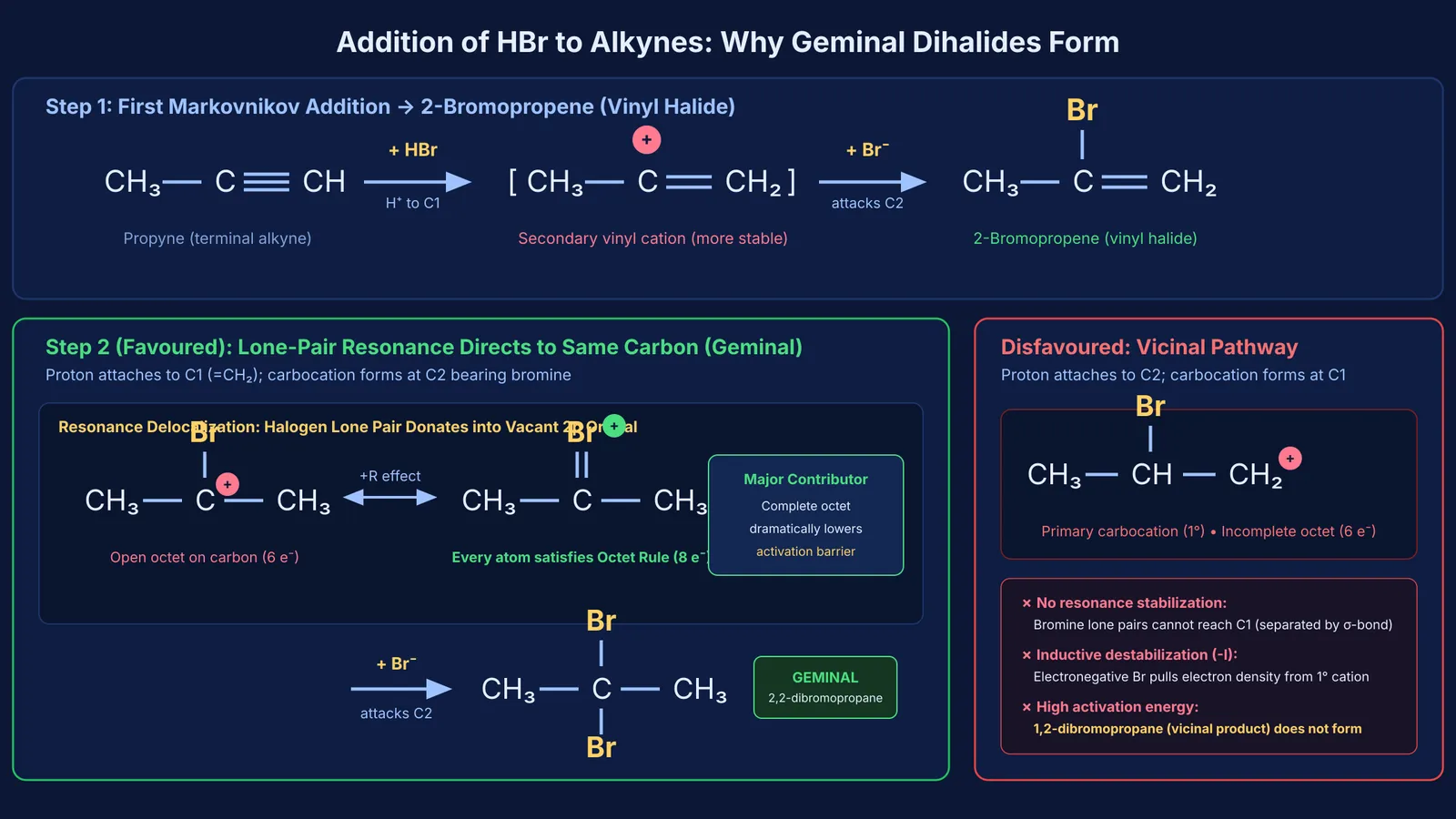
Protonation follows Markovnikov's rule: the electrophilic proton attaches to the carbon with more hydrogen atoms (C1). This creates a secondary vinyl cation intermediate, [CH₃-C⁺=CH₂], rather than an unstable primary vinyl cation, [CH₃-CH=C⁺H]. In physical organic chemistry, kinetic measurements by Robert C. Fahey and Do-Jae Lee (Journal of the American Chemical Society) established that electrophilic additions to alkynes proceed through these vinyl cationic pathways. As detailed in Peter J. Stang's review on unsaturated cations (Progress in Physical Organic Chemistry), secondary vinyl cations are substantially more stable than primary vinyl cations because alkyl hyperconjugation stabilizes the electron deficiency at the sp-hybridized carbon. Once the secondary vinyl cation forms, bromide ion (Br⁻) attacks the cationic center, producing 2-bromopropene, an isolated vinyl halide.
Why does the second proton prefer the already-halogenated carbon?
When 2-bromopropene reacts with the second equivalent of HBr, the regioselectivity of the second addition determines whether the product is geminal or vicinal:
Pathway A (Proton adds to C1): The proton attaches to the terminal =CH₂ group. The positive charge lands on C2, the carbon already bearing bromine: [CH₃-C⁺(Br)-CH₃].
Pathway B (Proton adds to C2): The proton attaches to C2. The positive charge lands on the terminal carbon: [CH₃-CH(Br)-C⁺H₂].
Pathway A dominates because of lone-pair resonance donation (+R effect). The bromine atom on C2 possesses three unshared lone pairs in its valence shell. It donates one lone pair into the adjacent vacant 2p orbital of the carbocation carbon:
CH₃-C⁺(Br)-CH₃ <-> CH₃-C(=Br⁺)-CH₃
In his landmark analysis of carbocation behavior, George A. Olah (Angewandte Chemie International Edition) demonstrated that an alpha-halogen substituent stabilizes an adjacent carbocation center through this lone-pair delocalization. In the second resonance contributor, every atom—both carbons and the bromine atom—satisfies the octet rule with a complete valence shell of eight electrons. By contrast, in Pathway B, the primary carbocation has only six valence electrons around carbon, and the nearby bromine atom pulls electron density away through sigma bonds, destabilizing it further. Because the octet-complete intermediate in Pathway A requires far lower activation energy, the second bromide ion attacks C2, delivering 2,2-dibromopropane as the sole geminal product.
Does inductive withdrawal ever overcome lone-pair resonance?
Students often ask why resonance dominates induction here, when halogen substituents on benzene rings are deactivating yet ortho/para-directing. The fundamental physical rule in organic mechanisms is that forming a complete octet always provides more stabilization energy than inductive polarization removes. Even though bromine has a higher Pauling electronegativity than carbon and pulls electron density through sigma bonds, the energy gained by filling the empty 2p orbital on carbon with a halogen lone pair dwarfs the inductive penalty.
On entrance examinations administered by bodies such as the National Testing Agency or school board tests aligned with CBSE Academic, questions frequently test whether students understand this distinction. Simply memorising that hydrogen attaches to the carbon with more hydrogens fails to explain why the second addition lands on C2. Looking at carbocation orbital overlap makes the mechanism transparent.
How can you predict products for terminal vs internal alkynes?
To solve electrophilic addition questions systematically on practice papers, apply this three-step decision framework:
Identify alkyne symmetry: Determine whether the triple bond is terminal (such as propyne) or internal (such as but-2-yne).
Track the first addition: For terminal alkynes, add H⁺ to the terminal carbon to form the secondary vinyl cation, then attach halide to yield the 2-haloalkene.
Apply alpha-halogen resonance in the second step: Form the carbocation on the carbon carrying the halogen to exploit lone-pair octet resonance. Attack with the second halide to complete the geminal dihalide.
Here is how classic exam cases resolve under this framework:
Propyne (CH₃-C≡CH) + 2 HBr: Yields 2-bromopropene, then 2,2-dibromopropane (geminal).
Ethyne (CH≡CH) + 2 HBr: Yields bromoethene, then 1,1-dibromoethane (ethylidene dibromide, geminal).
But-2-yne (CH₃-C≡C-CH₃) + 2 HBr: Yields 2-bromobut-2-ene, then 2,2-dibromobutane.
This mechanism connects closely with other addition reactions of unsaturated hydrocarbons, such as how the hydration of alkynes uses tautomerism to yield carbonyls, the acidity of terminal alkynes in substitution pathways, and how hydroboration-oxidation of alkenes achieves anti-Markovnikov alcohol formation.
When working through multi-step organic synthesis problems, the Fermi Problem Library has worked problems with a step-by-step solver that explains the reasoning rather than printing an answer. To explore where electrophilic additions fit within the syllabus, the Fermi Concept Library covers every concept in physics, chemistry, biology, mathematics and computing, each with its own lesson and its place in the map.


