

On this page
In organic chemistry, synthetic success depends on choosing reagents that achieve selective oxidation or nucleophilic addition without destroying sensitive groups. According to the CBSE Senior Secondary Chemistry Curriculum, Unit 8 carries 8 marks out of 70, making carbonyl preparations a major testing area. The Class 12 syllabus divides these methods into three groups: routes yielding both aldehydes and ketones, routes yielding aldehydes exclusively, and routes specific to ketones.
Which methods prepare both aldehydes and ketones?
Two starting materials—alcohols and alkynes—serve as universal precursors for both carbonyl families, where substrate structure determines the product.
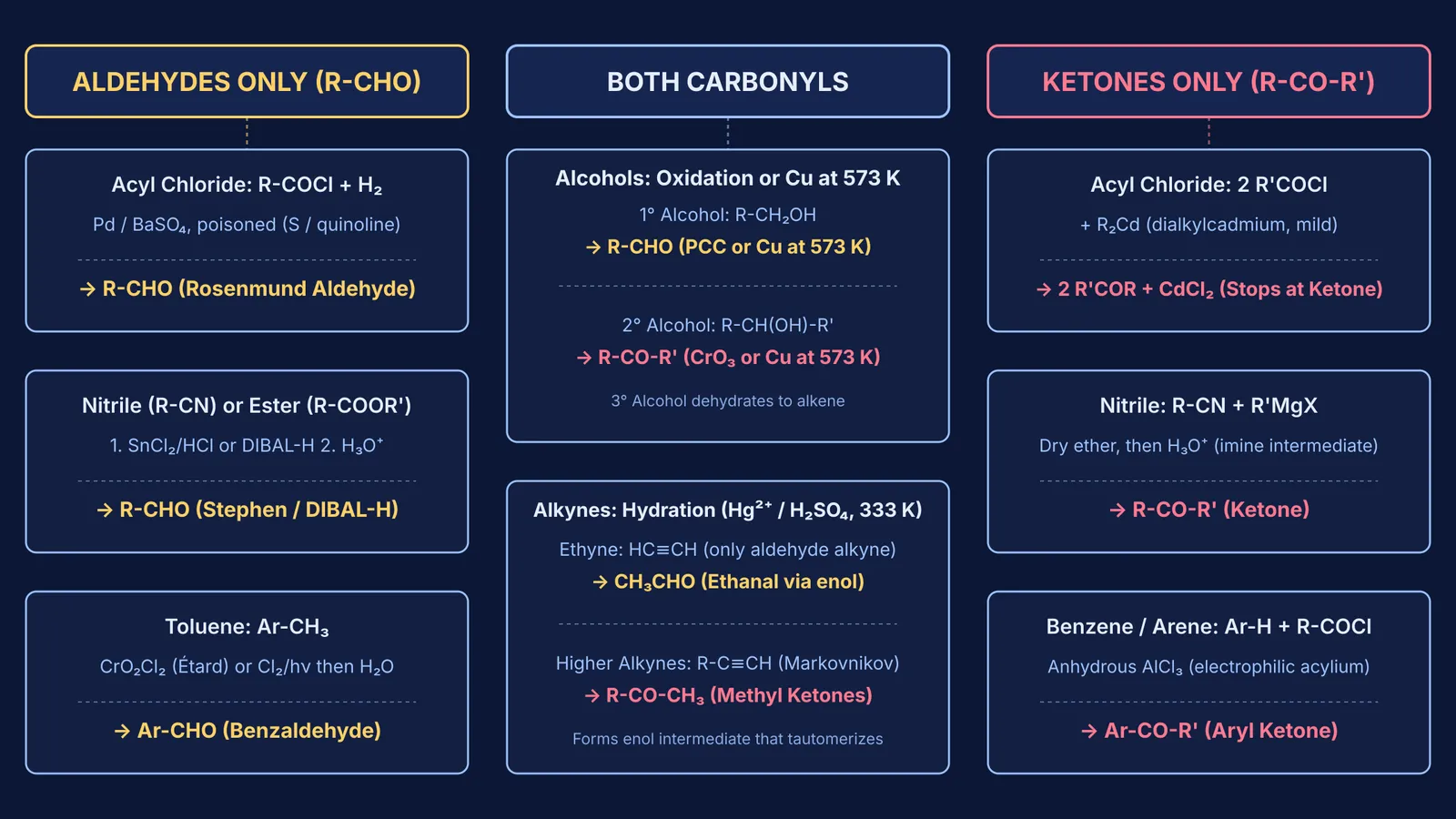
Primary alcohols oxidize to aldehydes, while secondary alcohols oxidize to ketones. Harsh oxidants like acidified potassium permanganate (KMnO₄) over-oxidize primary alcohols to carboxylic acids. To isolate aldehydes cleanly, NCERT Class 12 Chemistry Unit 8 specifies pyridinium chlorochromate (PCC) in anhydrous dichloromethane (CH₂Cl₂), or passing alcohol vapors over heated copper at 573 K (300 °C). Under these conditions, ethanol yields ethanal, while secondary alcohols like propan-2-ol yield propanone. Tertiary alcohols lack an α-hydrogen and dehydrate to alkenes instead.
Alkynes yield carbonyls through catalytic hydration in 40% sulphuric acid with 1% mercuric sulphate at 333 K (60 °C):
Ethyne (HC≡CH) hydrates to ethenol, which tautomerizes to ethanal. Ethyne is the only alkyne that yields an aldehyde.
Propyne and higher alkynes follow Markovnikov addition, forming enols that tautomerize exclusively into ketones.
To see how carbonyl reactivity diverges after preparation, review aldehydes and ketones reactions. The Fermi Concept Library maps every concept in chemistry with its place in the syllabus map, helping you trace these interconversions clearly.
How do you prepare aldehydes selectively from acyl derivatives and toluene?
Preparing aldehydes from acid derivatives or methylbenzenes, as outlined in NCERT Class 12 Chemistry Unit 8, requires reagents that arrest reduction or oxidation before carboxylic acids or alcohols form.
Acyl chlorides yield aldehydes via the Rosenmund reduction, hydrogenating over palladium supported on barium sulphate (Pd/BaSO₄) poisoned with sulfur or quinoline. The poison deactivates palladium enough to stop reduction at the aldehyde stage. Our guide to Rosenmund, Stephen and Etard reactions explores these mechanisms in detail.
Nitriles and esters yield aldehydes through controlled reduction:
Stephen reduction: Nitriles treated with stannous chloride (SnCl₂) and concentrated hydrochloric acid form an aldimine salt (R-CH=NH·HCl), which yields an aldehyde upon aqueous hydrolysis.
DIBAL-H reduction: At 195 K (−78 °C), diisobutylaluminium hydride reduces nitriles and aliphatic esters to imines that hydrolyze to aldehydes without attacking olefinic double bonds.
Aromatic aldehydes such as benzaldehyde are prepared from toluene by arresting oxidation at the benzylic carbon. The Étard reaction uses chromyl chloride (CrO₂Cl₂) in carbon disulfide (CS₂) to form an insoluble brown chromium complex that hydrolyzes to benzaldehyde. A DFT study by Markus Drees and Thomas Strassner (10.1021/ic200877f) detailed the radical C-H abstraction pathway of this reaction, following magnetic measurements by Wheeler (10.1139/v60-289) proving the chromium atoms in the complex are tetravalent. Industrially, free-radical chlorination of toluene yields benzal chloride (C₆H₅CHCl₂), which hydrolyzes at 373 K to benzaldehyde.
How do you prepare ketones exclusively without over-addition?
Ketone synthesis avoids the over-addition that occurs when strong organometallics react with carboxylic acid derivatives.
Acyl chlorides react uncontrollably with Grignard reagents to produce tertiary alcohols. To stop at the ketone, Grignard reagents are treated with cadmium chloride (CdCl₂) to form dialkylcadmium (R₂Cd). Dialkylcadmium displaces chloride from acyl chlorides (2 R'COCl + R₂Cd → 2 R'COR + CdCl₂), but is too weakly nucleophilic to attack the ketone product. For pitfalls with organometallics, see our guide to Grignard reagent reactions.
Nitriles also yield ketones cleanly. Reacting a nitrile with a Grignard reagent in dry ether produces a magnesium imine salt [R(R')C=N-MgX]. Because this negatively charged complex repels second nucleophilic attack, subsequent acid hydrolysis cleanly yields the ketone.
Aromatic ketones are prepared by Friedel-Crafts acylation, where benzene reacts with an acyl chloride in the presence of anhydrous aluminium chloride (AlCl₃) to produce alkyl aryl ketones like acetophenone.
How should you map preparation reactions for CBSE and JEE?
When approaching synthesis questions in board and competitive exams, apply this three-step decision framework drawn from NCERT Class 12 Chemistry Unit 8:
Check target carbonyl: For aldehydes, choose selective reductions (Rosenmund, Stephen, DIBAL-H) or selective oxidations (PCC, Étard). For ketones, choose dialkylcadmium, Grignard addition to nitriles, or secondary alcohol oxidation.
Track carbon count: If the carbon chain lengthens, use nitriles with Grignard reagents or acyl chlorides with dialkylcadmium.
Beware the hydration rule: Only ethyne hydrates to an aldehyde; all other alkynes yield ketones.
When practicing multi-step organic conversions where reagent choice determines reaction selectivity, the Fermi Problem Library provides worked problems with a step-by-step solver that explains the reasoning rather than printing an answer.


