

On this page
A tin of vanaspati sits solid on the kitchen shelf while the groundnut oil next to it stays runny. The difference is one reaction from Class 10 Chapter 4.
What happens when hydrogen is added to vegetable oil?
The NCERT Class 10 science chapter on carbon compounds (section 4.3.3) says unsaturated hydrocarbons add hydrogen in the presence of catalysts such as palladium or nickel to give saturated hydrocarbons, and that this reaction is commonly used to hydrogenate vegetable oils with a nickel catalyst.
A catalyst, the same page says, makes a reaction happen or run at a different rate, so nickel goes over the arrow, not among the reactants:
R₂C=CR₂ + H₂ → R₂CH–CHR₂ (nickel catalyst)
Each double bond takes up one H₂ molecule: one hydrogen atom joins each carbon, and the C=C becomes C–C. Nothing is removed, which makes it an addition reaction. Our explainer on addition vs substitution reactions in Class 10 carbon chemistry puts them side by side.
Why does an oil turn solid when it is hydrogenated?
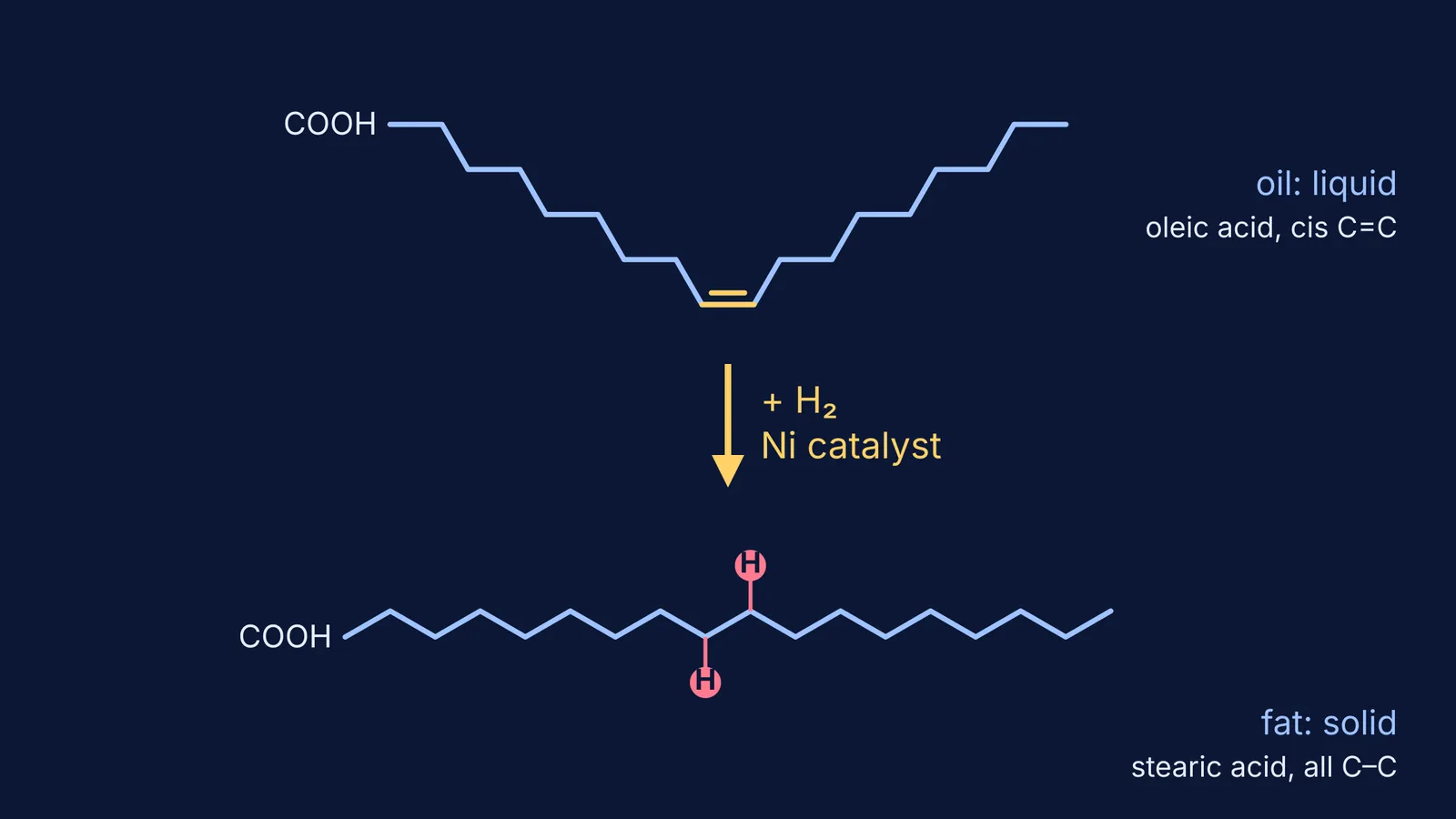
NCERT notes that vegetable oils generally have long unsaturated carbon chains, while animal fats have saturated carbon chains (NCERT, section 4.3.3). A cis double bond puts a bend in the chain, as the diagram at the top shows. Bent chains cannot pack as closely, so they melt at lower temperatures; without the double bond the chain is straight.
A worked example you can check:
Oleic acid is C₁₈H₃₄O₂, with one cis C=C between carbons 9 and 10 (PubChem).
Add one H₂ across that bond: C₁₈H₃₄O₂ + H₂ → C₁₈H₃₆O₂, which is stearic acid (PubChem).
Check the atoms: carbon stays at 18, hydrogen goes from 34 to 36.
Oleic acid melts at about 13 to 16 °C, while stearic acid, the same 18-carbon chain without the double bond, melts at about 69 °C (PubChem, oleic acid; PubChem, stearic acid). On a 30 °C afternoon, one is liquid and the other solid: the oil-to-vanaspati change in a single molecule.
Heading for JEE? See how heat of hydrogenation ranks alkene stability with real data.
Why are vegetable oils hydrogenated to make vanaspati?
The WHO fact sheet on trans fat describes an industrial process that adds hydrogen to vegetable oil, converting the liquid into a solid and giving partially hydrogenated oil. WHO says these fats tend to be cheaper than healthier fats and are solid at room temperature, which makes them suitable for a variety of processed foods. The same fact sheet lists vanaspati ghee among the foods that contain industrially produced trans fat.
The word to notice is partially. When the reaction stops before every double bond is used up, some remaining double bonds can end up in the straighter trans shape instead of the bent cis shape. Those are the trans fats WHO warns about.
Is vanaspati bad for health?
NCERT keeps its own answer short: animal fats generally contain saturated fatty acids, which are said to be harmful for health, and oils containing unsaturated fatty acids should be chosen for cooking (NCERT, section 4.3.3).
WHO adds the trans fat numbers (WHO trans fat fact sheet):
High trans fat intake increases the risk of death from any cause by 34% and of coronary heart disease deaths by 28%.
More than 278,000 deaths a year worldwide can be attributed to industrially produced trans fat.
WHO asks adults to keep trans fat below 1% of total energy intake, under 2.2 g a day on a 2,000-calorie diet.
WHO's healthy diet fact sheet caps saturated fat at 10% of energy and prefers unsaturated fats to both.
A report archived on the FSSAI website records that FSSAI's rules limited trans fat in oils and fats to 2% or less by January 2022. That is in line with the WHO best-practice limit of 2 g of industrial trans fat per 100 g of total fat in all foods.
This is chemistry, not diet advice: for a family heart-health question, ask a doctor or registered dietitian.
How do you write the hydrogenation answer in a Class 10 exam?
For a 3-mark question such as 'What is hydrogenation? Give its use', write four short lines:
Definition: the addition of hydrogen to an unsaturated hydrocarbon in the presence of a nickel or palladium catalyst, giving a saturated compound.
Equation: R₂C=CR₂ + H₂ → R₂CH–CHR₂, with Ni written over the arrow.
Use: it converts vegetable oils into solid fats such as vanaspati.
Health link: saturated fats are said to be harmful, so oils with unsaturated fatty acids are preferred for cooking.
Check for the common slips before you hand in:
Nickel written as a reactant instead of over the arrow.
The reaction called substitution.
Saturated and unsaturated swapped (saturated means only single C–C bonds).
Hydrogen added to only one carbon of the double bond.
If saturated, unsaturated, cis and trans still feel like one blurry idea, the Fermi Concept Library gives each concept its own lesson and its place in the map. To practise, the Fermi Problem Library has worked problems with a step-by-step solver that explains the reasoning rather than printing an answer.


