On this page
The hominid sequence is one short paragraph of the evolution chapter, packed with three brain sizes and a handful of dates that question setters like to swap. Here are the order, the traps and a quick recall plan.
What is the order of human evolution in NCERT?
Every exam number in this section comes from section 6.9, "Origin and Evolution of Man", in the NCERT Class 12 Biology chapter on evolution (2026-27 reprint). Read in order, the textbook gives this sequence:
Dryopithecus and Ramapithecus: about 15 mya. Hairy, walked like gorillas and chimpanzees. Ramapithecus was more man-like, Dryopithecus more ape-like.
Man-like primates in eastern Africa: about 3-4 mya. Probably no taller than 4 feet, but walked upright.
Australopithecines: about 2 mya, in East African grasslands. Hunted with stone weapons but mostly ate fruit.
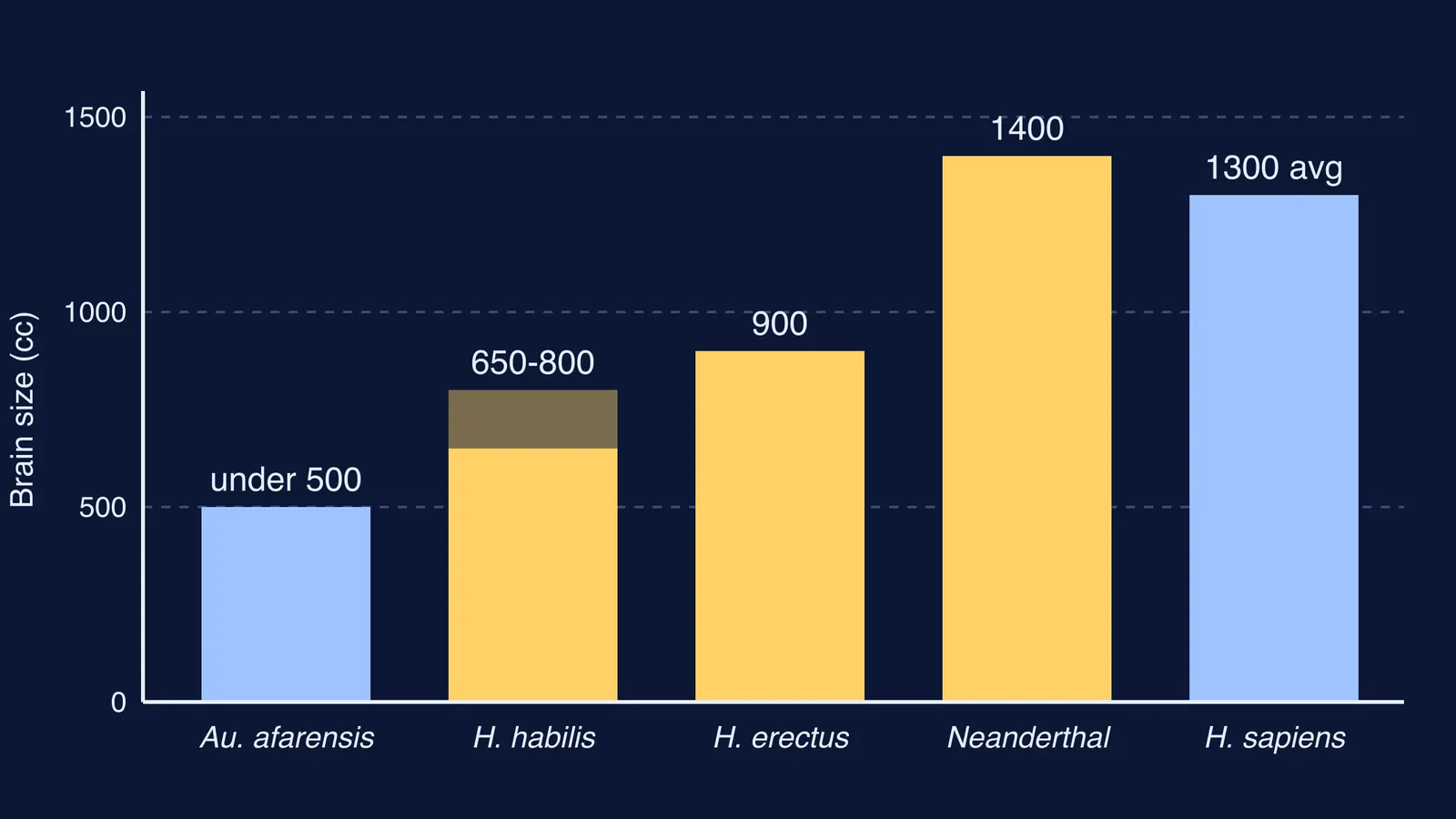
Homo habilis: the first human-like being, the hominid. Brain 650-800 cc. Probably did not eat meat.
Homo erectus: about 1.5 mya, known from fossils found in Java in 1891. Brain around 900 cc. Probably ate meat.
Neanderthal man: brain 1400 cc. Lived in the near east and central Asia between 1,00,000 and 40,000 years ago. Used hides to protect the body and buried their dead.
Homo sapiens: arose in Africa and spread across continents. Modern Homo sapiens arose during the ice age, between 75,000 and 10,000 years ago.
NCERT then adds three markers: cave art about 18,000 years ago (seen at the Bhimbetka rock shelter in Raisen district, Madhya Pradesh), and agriculture and settlements around 10,000 years ago.
For more detail, see our step-by-step walk from Dryopithecus to Homo sapiens.
Which hominid had a brain size of 900 cc?
Homo erectus, which "had a large brain around 900cc" (NCERT Class 12 Biology, section 6.9). The pairings students mix up most:
The 650-800 cc range belongs to Homo habilis, not Australopithecus.
1400 cc belongs to Neanderthal man, not Homo sapiens.
Java, 1891 points to Homo erectus.
"Probably did not eat meat" is Homo habilis. "Probably ate meat" is Homo erectus.
Hides and burying the dead point to Neanderthal man.
One rule covers most of these: NCERT's three brain sizes rise in order, from 650-800 cc (habilis) to 900 cc (erectus) to 1400 cc (Neanderthal). If an answer option breaks that rise, check it again.
Try it (a practice question we wrote): Match (a) Homo habilis, (b) Homo erectus, (c) Neanderthal man with (i) 900 cc, (ii) 1400 cc, (iii) 650-800 cc. Line up the species in order and let the brain sizes rise: a-iii, b-i, c-ii.
Why do other books give different dates?
NCERT gives rounded single figures; research figures are ranges that shift as new fossils are dated. The Smithsonian's Human Origins Program gives:
Australopithecus afarensis, the species of the "Lucy" skeleton, lived about 3.85 to 2.95 million years ago and usually had a brain under 500 cubic centimetres.
Homo habilis lived 2.4 to 1.4 million years ago in eastern and southern Africa.
Homo erectus lived between about 1.89 million and 110,000 years ago, in Africa and in western and eastern Asia.
Neanderthals lived about 400,000 to 40,000 years ago, with brains "just as large as ours and often larger".
Homo sapiens evolved in Africa about 300,000 years ago, and the modern human brain averages about 1300 cubic centimetres.
So NCERT's 1400 cc for Neanderthals, above today's human average, is not a misprint. In an exam answer, use the NCERT figure; the wider ranges help you understand the story. To see how those fossil ages are worked out in the first place, read how rock layers and radioactive decay date fossils.
How do you memorise the hominid sequence?
This plan uses only the figures in NCERT section 6.9 and takes about 10 minutes with a blank sheet:
Draw seven rows. Write the names in order from memory: Dryopithecus/Ramapithecus, man-like primates, Australopithecines, habilis, erectus, Neanderthal, sapiens.
Add one number to each row: 15 mya; 3-4 mya; 2 mya; 650-800 cc; 900 cc and 1.5 mya; 1400 cc; 75,000-10,000 years.
Add one tag to each row: walked like gorillas; 4 feet tall and upright; fruit and stone weapons; no meat; Java 1891 and meat; hides and burial; Africa and the ice age.
Cover the sheet, recall each row aloud and check it against NCERT. Circle every slip.
Do it again tomorrow and three days later, starting with the circled rows.
If a step still feels like a list of words, the Fermi Concept Library covers every concept in physics, chemistry, biology, mathematics and computing, each with its own lesson and its place in the map. When you want practice, the Fermi Problem Library has worked problems with a step-by-step solver that explains the reasoning rather than printing an answer.
Once this sequence sticks, move on to the rest of the chapter with our guide to natural selection, Hardy-Weinberg and the evidence for evolution.