

On this page
When you see a dinosaur skeleton in a museum, the plaque often states that the creature lived millions of years ago. But how do scientists actually know that? The bones themselves do not carry a timestamp, and despite what pop culture suggests, researchers do not use Carbon-14 dating to find out.
Instead, palaeontologists determine a fossil's age through a combination of ordering the rock layers and measuring the radioactive decay of elements in nearby volcanic ash.
Which fossil is older?
The foundation of geology is the Law of superposition. In its simplest form, this law states that in an undisturbed sequence of rocks, the oldest layers (strata) lie at the bottom, while newer material is deposited on top over time.
This principle allows scientists to establish relative dates. If a fossil of a sea sponge is found in a layer of rock below a fossil of a land reptile, the sponge lived earlier. This sequence helps determine which species existed successively, providing concrete evidence for how life has changed over time in an evolutionarily relevant way. However, superposition only gives an order of events, not a numerical age in years.
Why can't we date the fossil itself?
Most fossils are found in sedimentary rocks—rocks formed over time as mud, sand, and pebbles settle and compress. We cannot date these rocks directly because they are made of fragments from older rocks. If a geologist tried to date a grain of sand next to a dinosaur bone, they would only discover the age of the original source rock that weathered away to create the sand, not the age of the fossil itself (Radiometric dating).
How does radiometric dating work?
To find a numerical age, scientists need a rock that acts as a "closed system." When magma or lava cools into igneous rock, it locks in certain unstable radioactive isotopes, effectively setting a natural atomic clock to zero.
Over time, these parent isotopes lose energy and decay into stable daughter isotopes at a constant, measurable rate. The time it takes for half of the parent isotope to decay is called its half-life. By measuring the ratio of the remaining parent isotope to the accumulated daughter isotope, scientists can calculate exactly how much time has passed since the rock cooled below its closure temperature.
Why not use Carbon-14 for dinosaurs?
Carbon-14 (radiocarbon) dating is the most famous method, but it is useless for dating ancient fossils. It relies on the Carbon-14 absorbed by living things, which decays into Nitrogen-14 after they die.
However, Carbon-14 has a short half-life of 5,730 years. After about 58,000 to 62,000 years, so little Carbon-14 remains that the age can no longer be measured accurately (Radiometric dating). Since non-avian dinosaurs went extinct 66 million years ago (Dinosaur), their bones have absolutely zero measurable Carbon-14 left.
Bracketing: how is the age of a sedimentary rock found?
If we cannot date the sedimentary rock, and we cannot use Carbon-14 on the fossil, how do we get a date? Scientists use a technique called stratigraphic bracketing.
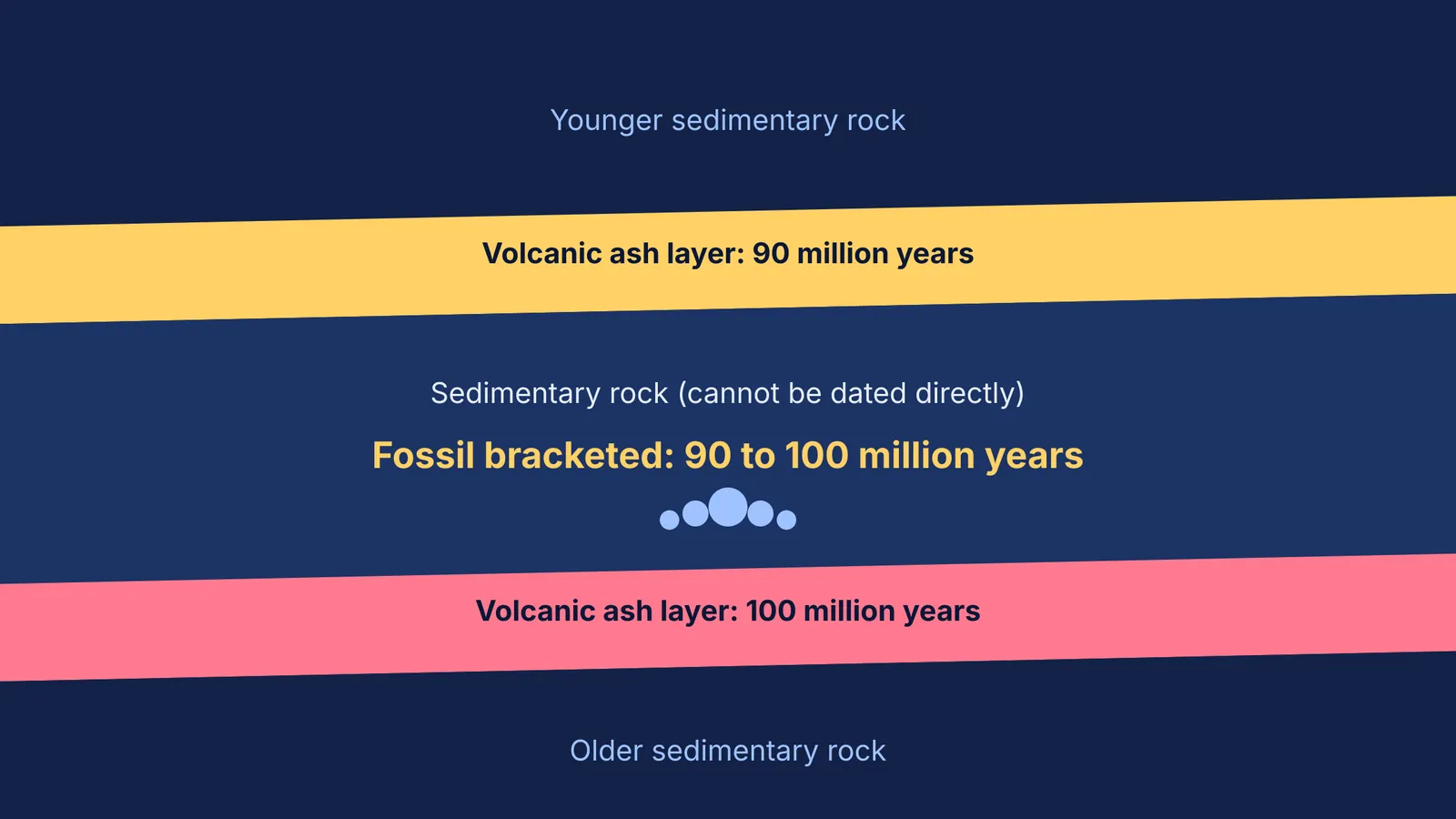
They look for layers of igneous rock—such as volcanic ash falls or lava flows—that are sandwiched above and below the sedimentary layer containing the fossil. Because these volcanic layers cooled from magma, they can be dated radiometrically using isotopes with very long half-lives. A common choice is Potassium-Argon dating, which tracks the decay of Potassium-40 into Argon-40 and has a half-life of 1.3 billion years (Radiometric dating).
If a fossil sits above an ash layer dated to 100 million years and below another ash layer dated to 90 million years, geologists know the fossil was deposited between 90 and 100 million years ago.
The limits of the fossil record
This combination of superposition and radiometric bracketing gives us a reliable timeline of Earth's history, but the evidence has limits. Fossilisation requires exceptional circumstances—usually rapid burial in an oxygen-free environment. Most creatures that have ever lived simply decomposed without a trace.
Because of this, the fossil record is incomplete. We have windows into the past, securely dated by the decay of ancient elements, but they remain snapshots rather than a continuous film. If you are tackling the mathematical side of decay yourself, you can also read our guide on Counting alpha and beta decays in a radioactive decay series.
If you have concept gaps when revising nuclear decay, the Fermi Concept Library contains every concept in physics, chemistry, biology, mathematics and computing, each with its own lesson and its place in the map. Understanding the physical mechanics makes the geological applications much easier to remember.


