

On this page
Since 1 April 2020, new cars in India have had to meet Bharat Stage VI emission norms, and India got there by skipping BS V altogether (DieselNet summary of Indian standards). A key part that cleans a petrol car's exhaust is the catalytic converter, and it is one of the clearest everyday examples of catalysis from Class 12 chemistry.
What does a catalytic converter do in a car?
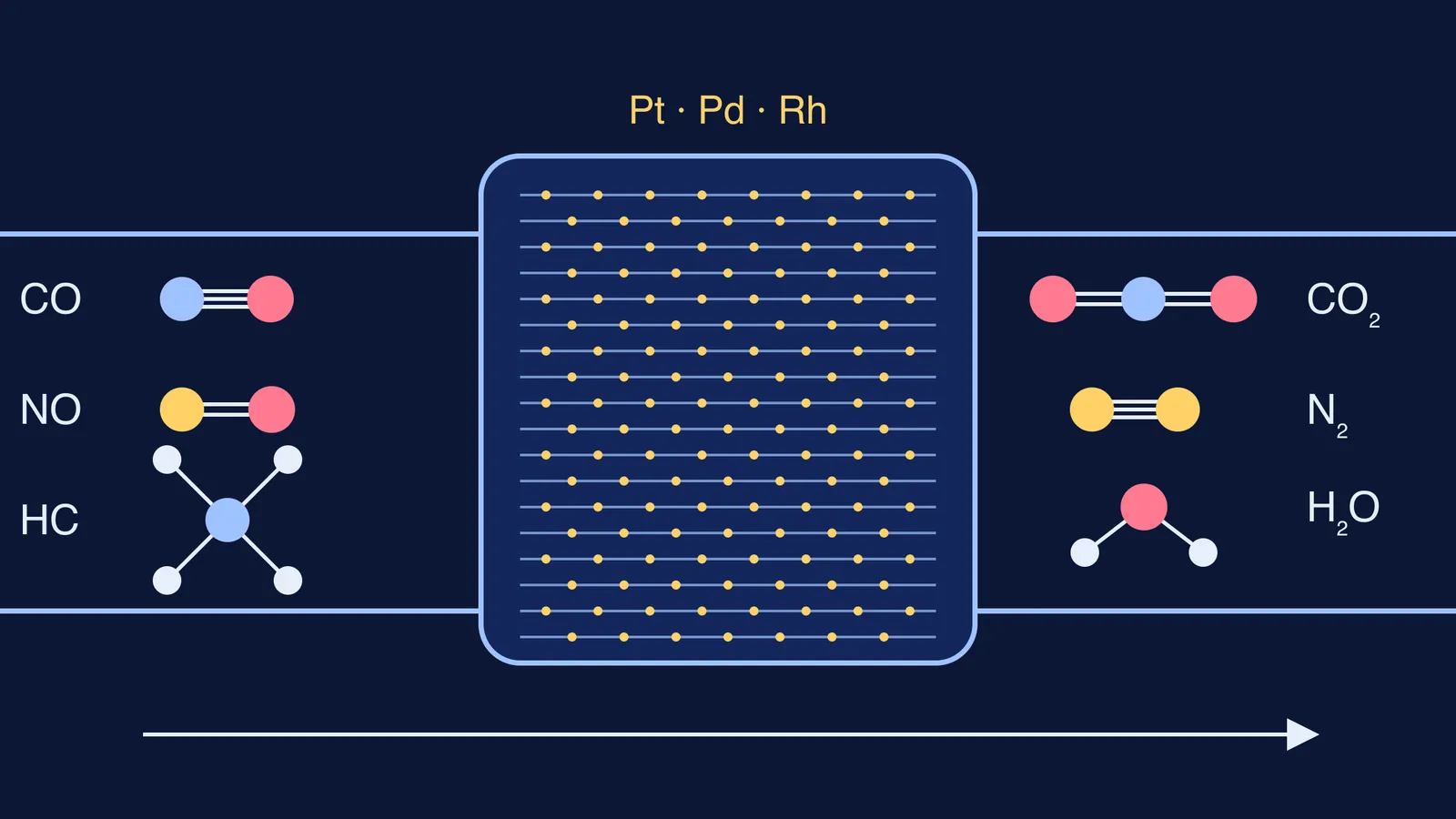
A petrol engine never burns its fuel perfectly. Three pollutants leave the cylinder: carbon monoxide (CO), unburnt hydrocarbons (HC, fuel that did not burn) and nitrogen oxides (NOx).
A three-way catalyst oxidises carbon monoxide and hydrocarbons to carbon dioxide and water while reducing NOx to nitrogen (AECC, the European emissions-control industry association). "Three-way" means three pollutants handled together. The main reactions, written the way your textbook would (reaction list):
2CO + O₂ → 2CO₂
Hydrocarbon + O₂ → CO₂ + H₂O (for propane: C₃H₈ + 5O₂ → 3CO₂ + 4H₂O)
2NO + 2CO → N₂ + 2CO₂
Notice the last one. Carbon monoxide, a pollutant, is used up to remove another pollutant.
Why platinum, palladium and rhodium?
Inside the can is a ceramic or metal substrate with a coating of alumina, ceria and other oxides, carrying combinations of platinum, palladium and rhodium (AECC). The substrate is made of a large number of parallel channels, so the exhaust brushes past a huge coated surface (Lock et al., 2021).
Each metal has a favourite job. Rhodium is often used as the active material for reducing nitrogen oxides to nitrogen (Johnson Matthey patent US6692712B1). Palladium is used mainly for oxidation, and platinum for both oxidation and reduction (overview). A 2020 review of three-way catalyst design examines how the ratios and loading of these metals affect conversion (Rood et al., 2020).
Gases reacting on a solid make this heterogeneous catalysis; our post on why transition metals make good catalysts explains why these metals suit the job.
For the numbers, see our worked example on how many times the rate rises when a catalyst lowers activation energy.
Why does the air-fuel mix matter so much?
Oxidising and reducing at once needs a chemically balanced exhaust. Three-way catalysts work in a closed loop with a lambda (oxygen) sensor that keeps adjusting the air-to-fuel ratio of a petrol engine (AECC). One catalyst maker's patent puts maximum conversion of CO, HC and NOx at lambda = 1 ± 0.005, with the engine swinging continually between slightly lean and slightly rich (Umicore patent US11331651B2). That is a window of half a percent either side of the exact mix.
The ceria in the coating helps here: it stores oxygen. CO and hydrocarbons are oxidised better when the stored oxygen is high, and NOx is reduced better when it is low (Lock et al., 2021). This is also why diesel cars need a different setup: their exhaust has so much oxygen that a three-way catalyst cannot be used, so they rely on diesel oxidation catalysts and other devices (AECC).
Fuel matters too. In the United States, cars from 1975 came with a catalytic converter that needed lead-free fuel (US EPA, 1996).
Why does a cold car pollute more?
A catalyst has to be hot to work. Modern three-way catalysts commonly reach conversion efficiencies above 95%, but after a cold start, tailpipe emissions stay much higher for the 40 to 100 seconds the catalyst takes to heat up (Lock et al., 2021). The same paper notes that, for many regulatory test procedures, cold-start emissions make up 60 to 80% of the emissions from a whole test of about 30 minutes.
The first minute or so after a cold start is the converter's weak spot. Vehicle exhaust is only one part of the picture in our post on why smog is worse in North India in winter.
How do you explain a catalytic converter in an exam answer?
Take 2NO + 2CO → N₂ + 2CO₂ and assign oxidation numbers. In NO, nitrogen is +2; in N₂ it is 0, so nitrogen is reduced. In CO, carbon is +2; in CO₂ it is +4, so carbon is oxidised. CO is the reducing agent, NO the oxidising agent.
A five-point answer:
Type: heterogeneous catalysis (solid catalyst, gaseous reactants).
Catalyst: platinum, palladium and rhodium on a coated honeycomb in the exhaust.
Reactions: CO and hydrocarbons oxidised to CO₂ and H₂O; NOx reduced to N₂.
Why it works: the metal surface adsorbs the gases and provides a path with lower activation energy; the catalyst is not used up.
Limits: it needs to be hot, needs an air-fuel mix close to lambda = 1, and petrol three-way converters need lead-free fuel.
Activation energy is easier to see than to read: the Fermi Simulation Lab has interactive simulations for ideas like this, and the Fermi Concept Library gives each chemistry concept, redox included, its own lesson.


