

On this page
Every winter, cities across North India disappear under a thick blanket of smog. While the smoke comes from familiar sources—vehicle exhaust, construction dust, and stubble burning—the reason it stays at breathing height instead of blowing away comes down to the physics of the atmosphere.
Understanding how weather and geography trap this pollution explains why the air quality drops so sharply as the temperature falls, and why the problem is much harder to solve than simply putting out fires.
What is a temperature inversion?
To understand winter smog, you have to look at how air normally moves. During the summer, the ground heats up in the sun. This warms the air directly above it. Because warm air is less dense than cold air, it rises, carrying pollutants high into the atmosphere where they disperse. This upward movement is called convection.
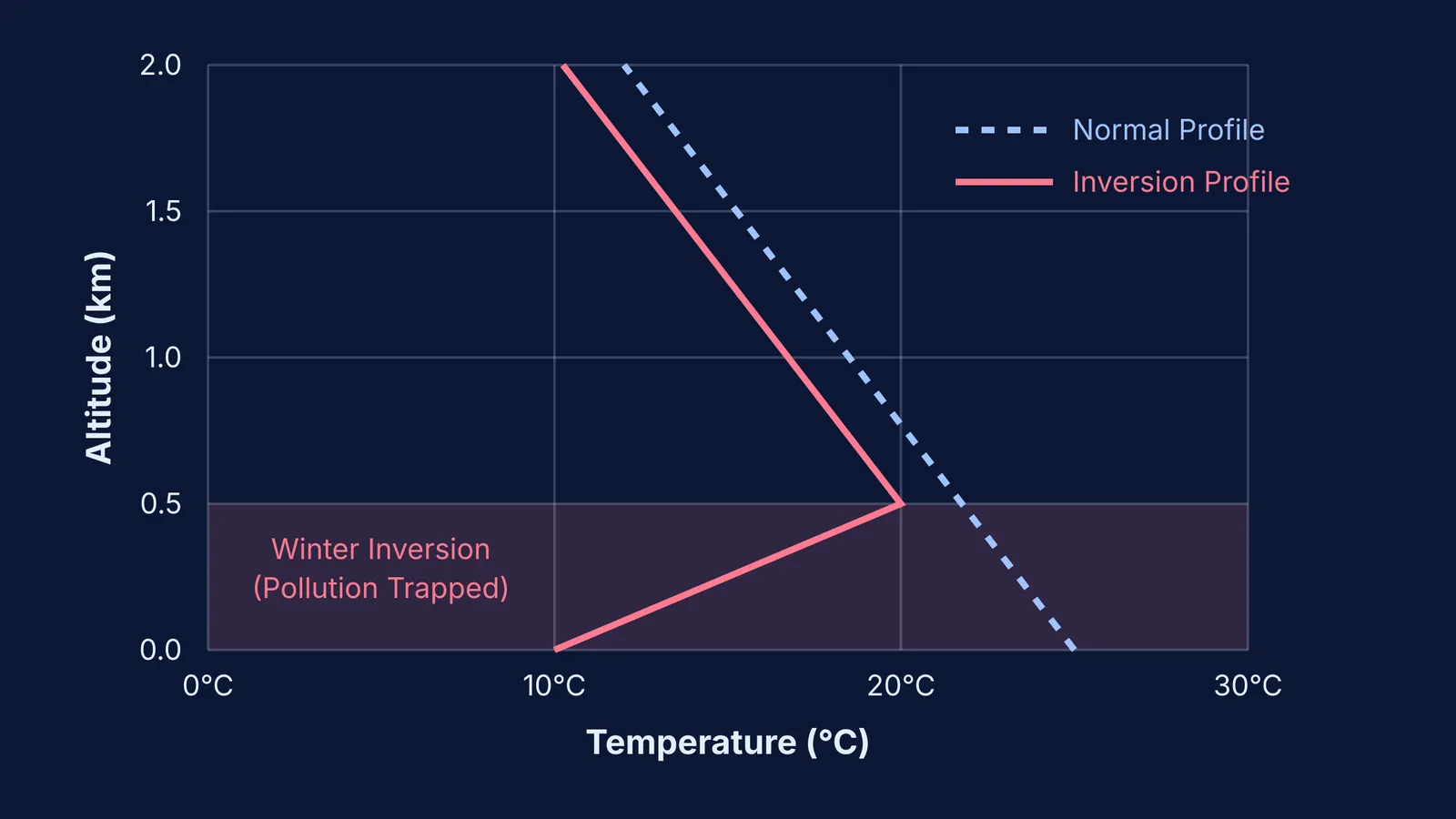
In winter, this process flips. During long, cold nights, the ground loses heat quickly. It cools the air touching it, leaving a layer of dense, heavy cold air at the surface. Meanwhile, a layer of relatively warmer air settles above it.
Because the cold air is heavier, it cannot rise through the warm layer above it. The warm air acts as a physical lid on the atmosphere—a phenomenon called a temperature inversion. Any smoke or dust released into the cold surface air is trapped there.
Understanding how density and temperature control these massive air movements can be tricky to picture from a textbook. The Fermi Simulation Lab provides interactive simulations for the ideas that are easier to see than to read, letting you experiment with how convection and gas density work in real time. Simulations or static diagrams? Both have their place, but simulations help build intuition for moving systems.
Why does the geography of North India trap smog?
A temperature inversion happens in many parts of the world, but North India's geography turns it into a perfect trap.
The Indo-Gangetic Plain is a vast, flat basin bounded by the massive wall of the Himalayas to the north and the Hindu Kush to the northwest. During the winter, cold winds from the mountains sink into the plains. When regional wind speeds slow down, this bowl-like topography prevents the trapped air from moving horizontally. With nowhere to go vertically because of the inversion lid, and nowhere to go horizontally because of the mountains and low wind speeds, the air simply stagnates.
A 2024 study published in Nature Communications tracked the impact of this stagnation. The researchers investigated the role of atmospheric stagnation during 101 days of extreme pollution in the Indo-Gangetic Plain. They found that these prolonged stagnation events significantly contribute to the accumulation of pollutants, causing PM2.5 levels to often exceed 45 μg/m³ across the region.
Where does the smoke come from?
While the weather and the mountains build the trap, human activity fills it. Once the inversion lid is shut, every source of pollution accumulates day after day:
Stubble burning: In October and November, farmers in Punjab and Haryana clear their fields by burning crop residue. The massive plumes of smoke are caught in the slow-moving winds and pulled into the stagnant basin.
Biomass heating: As the cold sets in, millions of people burn wood, coal, and dried waste for warmth, adding dense soot directly into the local air.
Everyday emissions: Vehicle exhaust, road dust, and industrial emissions that would normally disperse into the upper atmosphere in summer are instead forced to stay near the ground.
These particles also act as "nuclei" for water vapour to condense around. The high humidity of winter mixes with the trapped smoke to form true smog (a blend of smoke and fog). Unlike a clean winter mist that burns off in the morning sun, this smog is thick, persistent, and full of fine particulate matter that can easily enter the lungs. Furthermore, the stagnant conditions allow chemical reactions to occur between trapped gases like sulfur dioxide and nitrogen oxides, creating secondary aerosols that add even more mass to the PM2.5 count.
How can you connect these concepts for exams?
If you are studying for board exams or competitive tests like JEE and NEET, environmental physics is a prime area where different concepts connect. Try linking them together instead of memorising facts in isolation. (For more on why connecting ideas works better than passive reading, see our post on Carl Wieman: why a Nobel physicist moved beyond the lecture).
When you review a topic like winter smog, break it down by the underlying principles:
Thermodynamics and Heat Transfer: How does the ground lose heat at night? Consider the role of thermal radiation and why clear winter nights lead to colder ground temperatures than cloudy ones.
Fluid Mechanics: Why does warm air rise and cold air sink? Review the relationship between temperature, density, and buoyancy.
Chemistry: What happens when sulfur dioxide and nitrogen oxides are trapped together in humid air? Look into the formation of secondary aerosols and acid rain.
Geography and Physics: How do mountain ranges affect wind patterns and atmospheric pressure?
By looking at the "why" behind the smog, you can turn a daily news headline into a practical application of the science you are learning. Building a framework around real-world problems makes the equations easier to remember when exam day arrives.


