On this page
If you have written E = −13.6 eV in a test and wondered how anything can have less than zero energy, the answer is about where we put zero. Once you see the reference point, the minus sign becomes the most useful part of the formula.
Why is the energy of an electron in a hydrogen atom negative?
Only differences in energy are measurable, so physicists are free to choose where zero sits. For an atom, the natural choice is the electron and proton infinitely far apart, with the electron at rest. The electrical potential energy between them is then zero at infinity and becomes more negative as they come closer, because the attraction pulls them together and the pair gives up energy as they approach.
The electron in an orbit does have positive kinetic energy, but in the Bohr model it is only half the size of the negative potential energy, so the total stays below zero. The OpenStax University Physics textbook puts it directly: "An electron remains bound in the hydrogen atom as long as its energy is negative." As n grows without limit the energy rises to zero, and at that point the electron is no longer bound but free.
The same choice of zero explains a familiar result from gravitation, worked through in our post on why gravitational potential energy is negative. A planet in orbit and an electron in an atom are both bound, and both have negative total energy.
What does −13.6 eV actually mean?
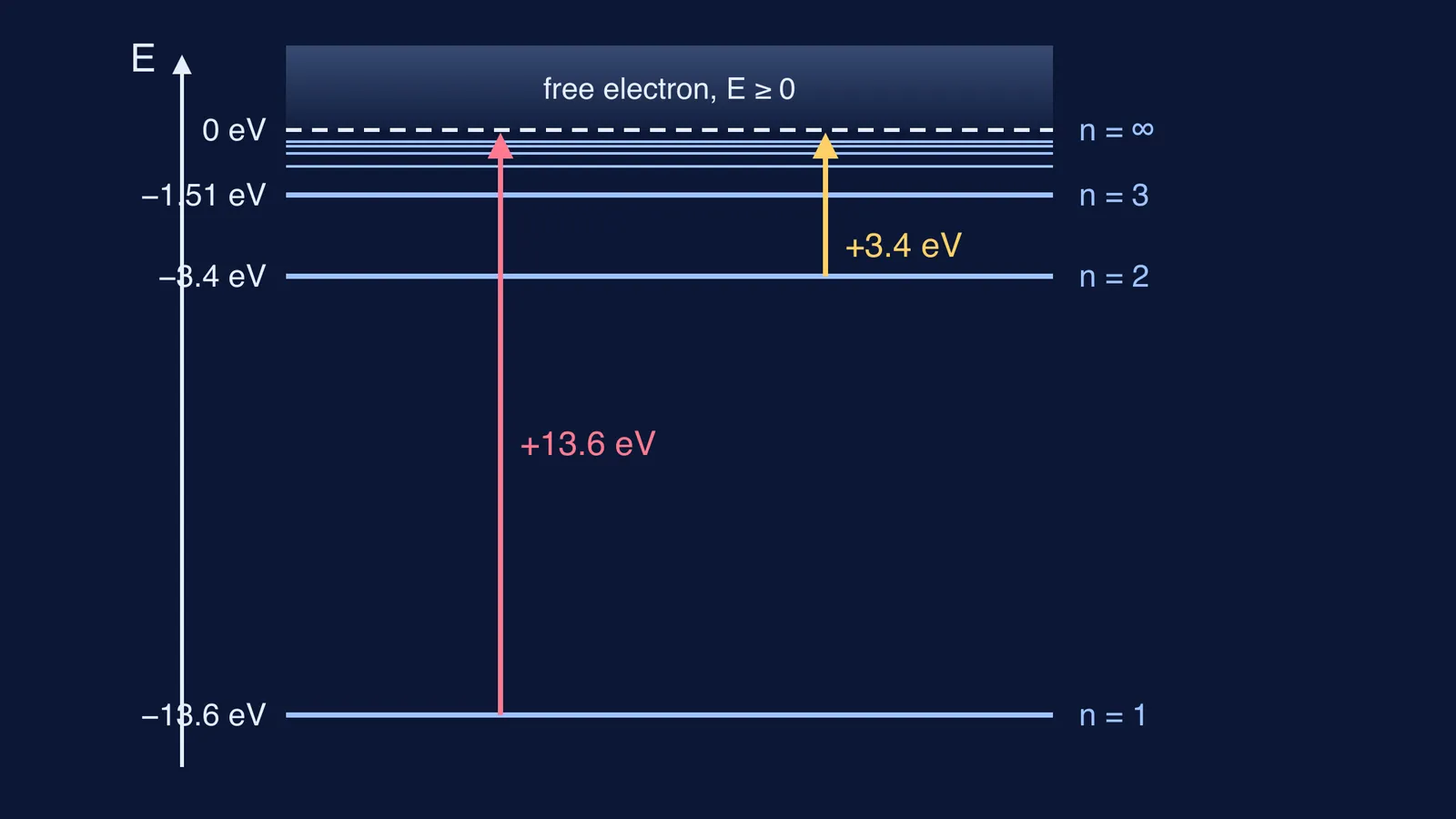
In the Bohr model, the energy of level n is E = −13.6 eV/n², where 13.6 eV equals 2.17 × 10⁻¹⁸ J (OpenStax). The ground state, n = 1, sits at −13.6 eV.
Read that number as a debt. The electron is 13.6 eV short of being free, so you must supply 13.6 eV to pull it from the ground state out to rest at infinity. That energy is the ionisation energy, which OpenStax defines as "the energy that is needed to remove the electron from the atom".
The NIST Handbook of Basic Atomic Spectroscopic Data lists the ionisation energy of hydrogen as 13.598433 eV; 13.6 eV is the rounded textbook value.
You can also split the −13.6 eV. Since the kinetic energy is half the size of the potential energy, the ground state has kinetic energy +13.6 eV and potential energy −27.2 eV, which add to −13.6 eV. Our post on why KE = −E and PE = 2E in a Bohr orbit derives this split.
How do you find the ionisation energy from n = 2?
Use the Bohr formula E = −13.6 eV/n² from OpenStax and treat ionisation as a jump from one level to zero.
Energy of the starting level: E₂ = −13.6/2² = −13.6/4 = −3.4 eV.
Energy of the final state: a free electron at rest, so E∞ = 0.
Energy you must supply: ΔE = E(final) − E(initial) = 0 − (−3.4) = +3.4 eV.
In joules: 2.17 × 10⁻¹⁸ J ÷ 4 ≈ 5.4 × 10⁻¹⁹ J.
Sanity check: the answer is positive, because you put energy in, and it is a quarter of 13.6 eV, because an electron in n = 2 is less tightly bound than one in n = 1.
The pattern holds for every level: the ionisation energy from level n is 13.6/n² eV.
From n = 1: 13.6 eV
From n = 2: 3.4 eV
From n = 3: about 1.51 eV
From n = 4: 0.85 eV
The 3.4 eV from n = 2 is also the energy at the edge of the Balmer series, since every Balmer line ends on n = 2. Our post on the series limit in the hydrogen spectrum works that out for Lyman and Balmer.
Which sign mistakes cost marks here?
Dropping the minus sign on a level's energy, then subtracting the wrong way.
Confusing the energy of a level (negative) with the energy needed to remove the electron from it (positive).
Writing ΔE = E(initial) − E(final). Always take final minus initial, then ask whether energy goes in or comes out.
Calling the ground state the "highest" level because 13.6 is the biggest number on the diagram. At −13.6 eV it is the lowest.
If the sign keeps tripping you, the Fermi Problem Library has worked problems with a step-by-step solver that explains the reasoning rather than printing an answer, so you can check each line and not just the final answer. To see how the same zero-at-infinity idea runs through gravitation, electrostatics and atoms, each has its own lesson in the Fermi Concept Library.
Next time you see a negative energy level, read it as how far the electron is from freedom, and the rest of the chapter follows from there.