

On this page
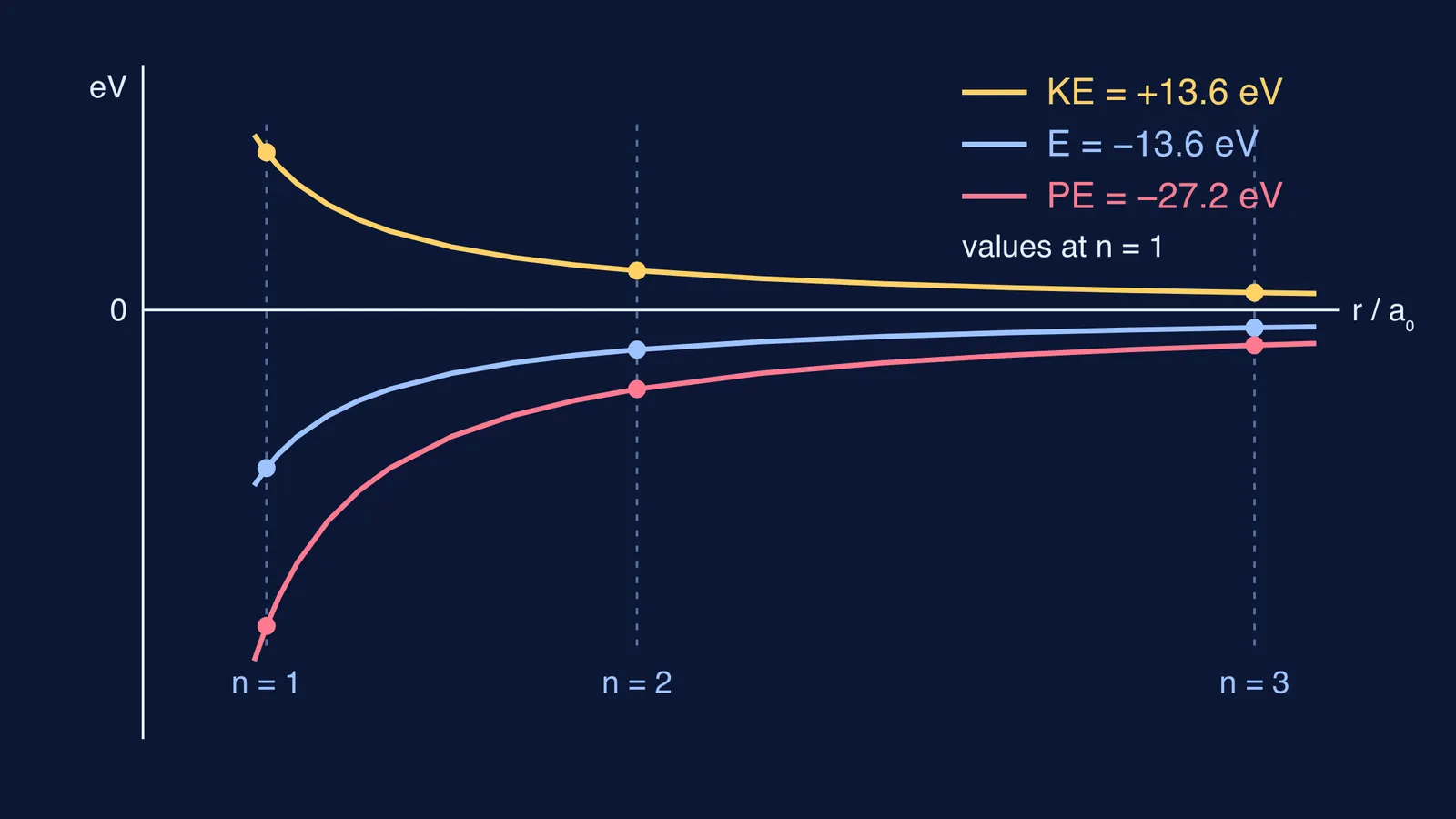
If a JEE Main, JEE Advanced or board exam question gives you one of the three energies of an electron in a Bohr orbit, you already have the other two. The ratio KE : PE : E is always 1 : −2 : −1, for every orbit and every hydrogen-like ion, as long as potential energy is measured from zero at infinity.
What is the relation between kinetic, potential and total energy in a Bohr orbit?
Niels Bohr's 1913 paper, On the constitution of atoms and molecules in the Philosophical Magazine, pictured hydrogen's electron moving in a circle around the nucleus. OpenStax University Physics Volume 3 writes out the energies of that orbit: the kinetic energy is positive, the potential energy is −e²/(4πε₀r), and the total energy is their sum.
Put those formulas side by side and three relations drop out:
KE = −E (kinetic energy is minus the total energy)
PE = 2E (potential energy is twice the total energy)
PE = −2 × KE (potential energy is minus twice the kinetic energy)
The ground-state energy of hydrogen in the Bohr model is −13.6 eV, as OpenStax gives it. So in the ground state KE = +13.6 eV and PE = −27.2 eV. The precise value behind that number, the Rydberg energy, is 13.605 693 122 990 eV in the NIST CODATA 2022 tables; 13.6 eV is that, rounded.
Why is kinetic energy equal to minus the total energy?
OpenStax states that the electrostatic pull of the nucleus is the centripetal force that keeps the electron on its circle. Write k = 1/(4πε₀) and follow four lines:
Force balance: mv²/r = ke²/r².
Multiply both sides by r/2: ½mv² = ke²/(2r). That is the kinetic energy.
Potential energy of the electron and proton, zero at infinity: PE = −ke²/r, which is exactly −2 × KE.
Add them: E = KE + PE = KE − 2 KE = −KE.
Step 1 never used Bohr's quantum rule: the 1 : −2 : −1 ratio holds for any circular orbit held by an inverse-square attraction. Bohr's quantisation only decides which radii are allowed (rₙ = a₀n² for hydrogen, a₀n²/Z for a hydrogen-like ion), and so which energies. For the full working of a₀ and the 13.6 eV, see our step-by-step post on deriving the Bohr radius and energy.
How do you use KE = −E and PE = 2E in numericals?
The level formula from OpenStax is Eₙ = −Z²E₀/n², where E₀ is 13.6 eV and Z is the nuclear charge. Find E first, then read off the other two.
Hydrogen, n = 2: E = −13.6/4 = −3.4 eV, so KE = 3.4 eV and PE = −6.8 eV.
He⁺, n = 1 (Z = 2): E = −13.6 × 4 = −54.4 eV, so KE = 54.4 eV and PE = −108.8 eV.
Hydrogen excited from n = 1 to n = 2: E rises by 10.2 eV (−13.6 to −3.4). KE falls by 10.2 eV (13.6 to 3.4). PE rises by 20.4 eV (−27.2 to −6.8). The electron absorbs 10.2 eV and still slows down: the absorbed energy and the lost kinetic energy both go into potential energy.
Ionising hydrogen from the ground state takes 13.6 eV, the same as its kinetic energy there. OpenStax notes that this Bohr ionisation limit agrees with experiment.
Example 3 is a common trap: “energy goes up, so speed goes up” feels right and is wrong. KE falls as 1/n², so the electron is slower in higher orbits.
What mistakes cost marks on this topic?
Run this checklist before you mark an answer:
Zero of potential energy. The relations assume PE = 0 at infinity. Move the zero and PE and E shift by a constant while KE does not, so KE = −E fails. See choosing the zero of potential energy.
A negative KE. If you write a negative kinetic energy, a sign has slipped. Here is why kinetic energy can never be negative.
Forgetting Z². He⁺ and Li²⁺ levels scale with Z², and so do KE and PE.
Mixing “energy of the level” with “energy needed”. The level is negative; the energy you supply to excite or ionise is positive.
If your working keeps breaking at the same step, the Fermi Problem Library has worked problems with a step-by-step solver that explains the reasoning rather than printing an answer, so you can see where your sign went wrong. If the gap is in the idea itself, the Fermi Concept Library gives every concept in physics its own lesson and its place in the map, so you can go back a step to circular motion or Coulomb's law.
Try it now: cover the answers above, take Li²⁺ in n = 3, and find all three energies from E alone.


