

On this page
In 1913, Niels Bohr proposed a model of the hydrogen atom combining classical physics with quantum mechanics. By balancing the electrostatic pull of the nucleus with the electron's motion and restricting the orbits to specific angular momenta, he predicted the sizes and energies of the electron's orbits.
This derivation is a common long-answer question in board exams and forms the foundation for modern physics problems. Here is the step-by-step derivation.
What are Bohr's postulates for the hydrogen atom?
To find the radius and energy, start with Bohr's two main assumptions about the electron's orbit (OpenStax):
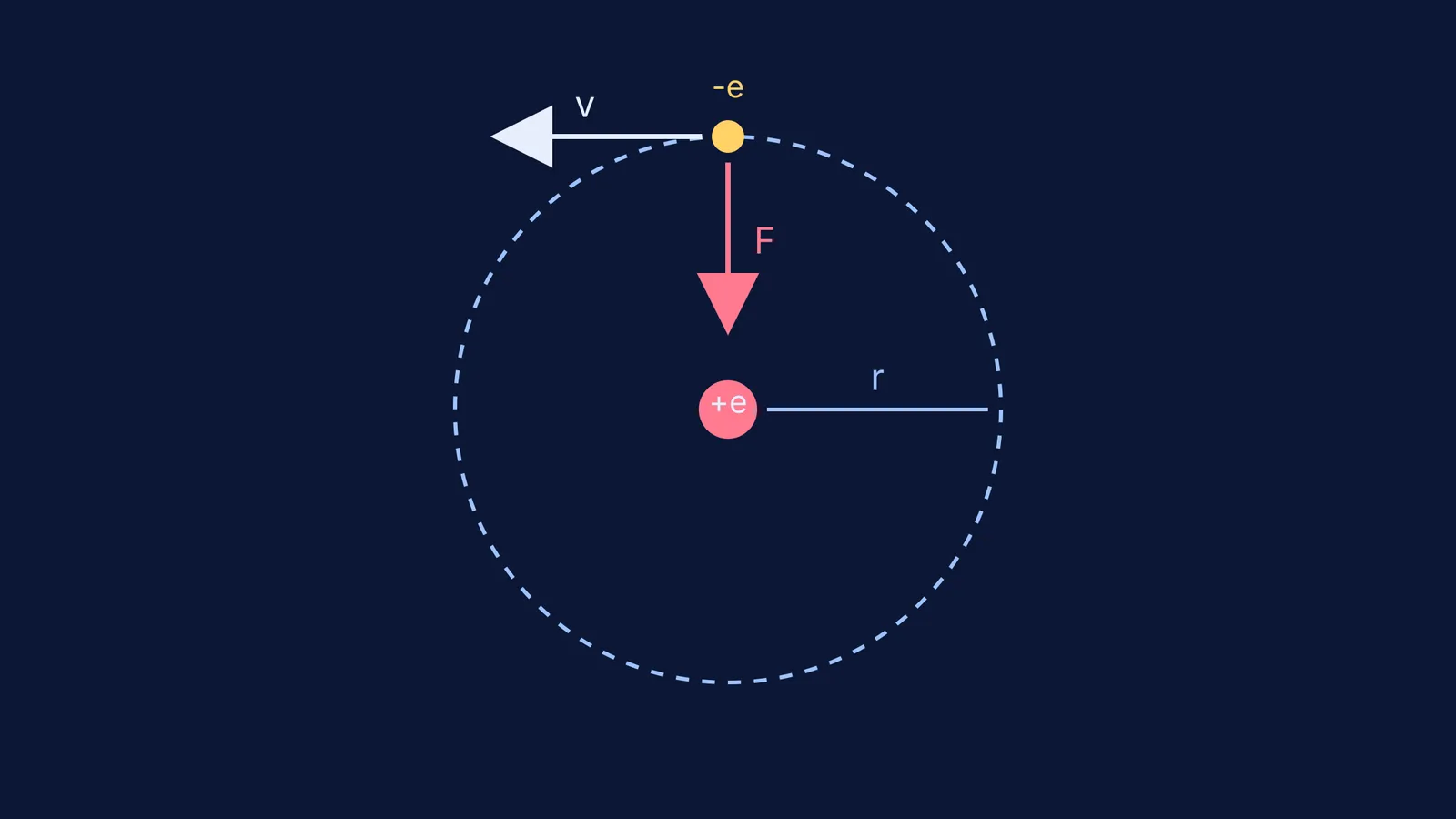
Circular orbits: The electron moves in a circular orbit around the nucleus. The required centripetal force is provided by the electrostatic attraction between the positive nucleus and negative electron.
Quantisation of angular momentum: The electron only orbits in allowed paths where its angular momentum (mvr) is an integer multiple of h / 2π.
The angular momentum condition is written as: mvr = nh / 2π
where:
m is the mass of the electron
v is the orbital speed
r is the radius of the orbit
n is the principal quantum number (1, 2, 3...)
h is the Planck constant
How to derive the radius of the nth Bohr orbit?
Begin by setting the centripetal force equal to the electrostatic force. The hydrogen nucleus has a charge of +e and the electron has -e.
mv² / r = (1 / 4πε₀) × (e² / r²)
Simplify by multiplying both sides by r: mv² = e² / (4πε₀r)
Eliminate the speed (v) using Bohr's condition. Rearrange the angular momentum equation: v = nh / (2πmr)
Substitute v into the force equation: m × [nh / (2πmr)]² = e² / (4πε₀r)
Square the terms: m × (n²h² / 4π²m²r²) = e² / (4πε₀r)
Cancel m on the left: n²h² / (4π²mr²) = e² / (4πε₀r)
Rearrange to solve for the radius (r): r = (ε₀h² / πme²) × n²
This gives the radius of the nth orbit (r_n). The term in the bracket is constant.
For the first orbit (n = 1), the Bohr radius (a₀) is 5.29 × 10⁻¹¹ m or 0.529 Å (OpenStax). The radius of any higher orbit scales with the square of the orbit number: r_n = a₀ × n²
How to derive the energy of the nth Bohr orbit?
The total energy (E) is the sum of kinetic energy (K) and potential energy (U).
From the force balance equation: mv² = e² / (4πε₀r)
Multiply by 1/2 for kinetic energy: K = e² / (8πε₀r)
The potential energy at distance r is: U = (1 / 4πε₀) × (+e)(-e) / r U = -e² / (4πε₀r)
Add them for total energy E: E = K + U E = [e² / (8πε₀r)] - [e² / (4πε₀r)] E = -e² / (8πε₀r)
The negative energy means the electron is bound. Substitute r into this equation for the nth orbit (E_n): E_n = -e² / [8πε₀ × (ε₀h²n² / πme²)]
Rearrange to get the final expression: E_n = -(me⁴ / 8ε₀²h²) × (1 / n²)
For the ground state (n = 1), the energy is -2.17 × 10⁻¹⁸ J, or -13.6 eV (OpenStax).
So, the energy simplifies to: E_n = -13.6 / n² eV
How do you apply the Bohr formulas?
You can use these derivations to compare states. For example, the second orbit (n = 2) radius is 4 times the Bohr radius (2.116 Å). Its energy is -13.6 / 4 = -3.4 eV (OpenStax). The energy difference between orbits gives the emitted or absorbed photon energy.
If you are stuck on these rules, the Fermi Problem Library breaks down the steps to adjust the derivation for different atomic numbers.
Understanding this model makes it easier to predict atomic behaviour, such as why 2s and 2p have the same energy in hydrogen or calculating the speed of an electron accelerated through a potential difference. You can also visualise these structures by testing a build an atom simulation.


