

On this page
When a stationary electron is placed in an electric field, it feels a force and accelerates. If it moves through a potential difference V, the electric field does work on it. This work is converted entirely into kinetic energy.
The energy gained is simply the electron's charge (e) multiplied by the potential difference (V). For a single electron, e is the elementary charge, which is 1.602 × 10⁻¹⁹ coulombs. This means the kinetic energy gained is eV joules.
The electronvolt is a versatile unit in quantum physics; for instance, it is the standard unit for calculating E = 1240/λ: the quick photon-energy formula in eV and nm.
How do you find the speed of an electron?
At everyday voltages, you can find the speed by setting the electrical energy equal to the classical formula for kinetic energy, K = ½mv².
eV = ½mv²
Rearranging this gives the speed v:
v = √(2eV/m)
Using the electron's mass (m = 9.109 × 10⁻³¹ kg), we can calculate how fast it travels:
At 100 volts: The electron reaches 5.93 × 10⁶ m/s, which is about 2% of the speed of light.
At 1,000 volts (1 kV): It reaches 1.87 × 10⁷ m/s, or just over 6% of the speed of light.
These speeds are incredibly high compared to everyday objects, but they are still low enough that the classical formula works well. Once the electron is up to speed, its velocity dictates how it will interact with other fields, such as taking a helical path of a charge in a magnetic field: radius and pitch.
When working through these calculations, keeping track of the units and powers of ten can be tricky. If you get stuck on a homework problem about electron acceleration, the Fermi Problem Library has worked problems with a step-by-step solver that explains the reasoning rather than printing an answer.
When does the speed get too close to the speed of light?
The classical formula assumes mass remains constant and there is no cosmic speed limit. But according to Einstein's theory of relativity, nothing can travel faster than the speed of light in a vacuum (c = 2.998 × 10⁸ m/s).
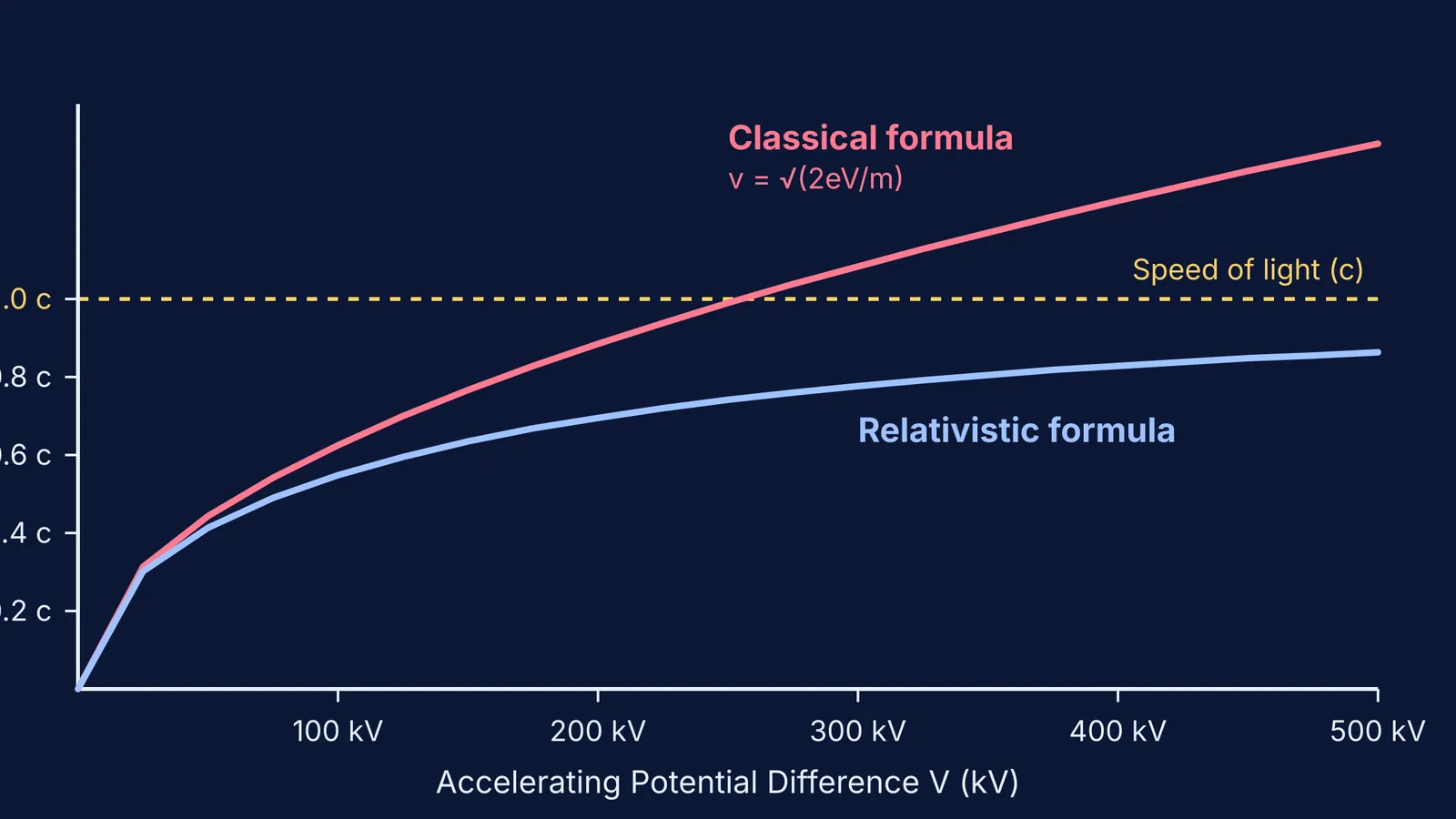
If you use the classical formula for a potential difference of 300 kV, you get a speed of 1.08c — a physically impossible result. The classical formula starts to fail noticeably much earlier than that. By the time the accelerating voltage reaches 10 kV, the electron is moving at roughly 20% of the speed of light, and the classical prediction is off by about 1.5%. At 100 kV, the classical formula overestimates the speed by 14%.
If you want to review the boundaries where classical physics gives way to relativity, the Fermi Concept Library has every concept in physics, chemistry, biology, mathematics and computing, each with its own lesson and its place in the map.
What is the relativistic formula for electron speed?
When the potential difference is on the order of tens of kilovolts (like in a medical X-ray machine operating at 100 kV), you must use the relativistic expression for kinetic energy.
Relativistic kinetic energy is the total energy minus the rest mass energy: K = mc²(γ − 1)
Here, γ is the Lorentz factor, defined as 1 / √(1 − v²/c²).
To find the true speed, you set the electrical work eV equal to the relativistic kinetic energy: eV = mc²(γ − 1)
The rest mass energy of an electron (mc²) is roughly 511 keV. So, if you accelerate an electron through 100 kV, the kinetic energy is 100 keV.
The ratio eV/mc² is 100 / 511 = 0.196.
This means γ − 1 = 0.196, so γ = 1.196.
Solving γ = 1 / √(1 − v²/c²) gives v ≈ 0.548c.
The electron is traveling at nearly 55% of the speed of light. This is safely below the absolute speed limit, and significantly slower than the 62.5% that the classical formula wrongly predicted.


