

On this page
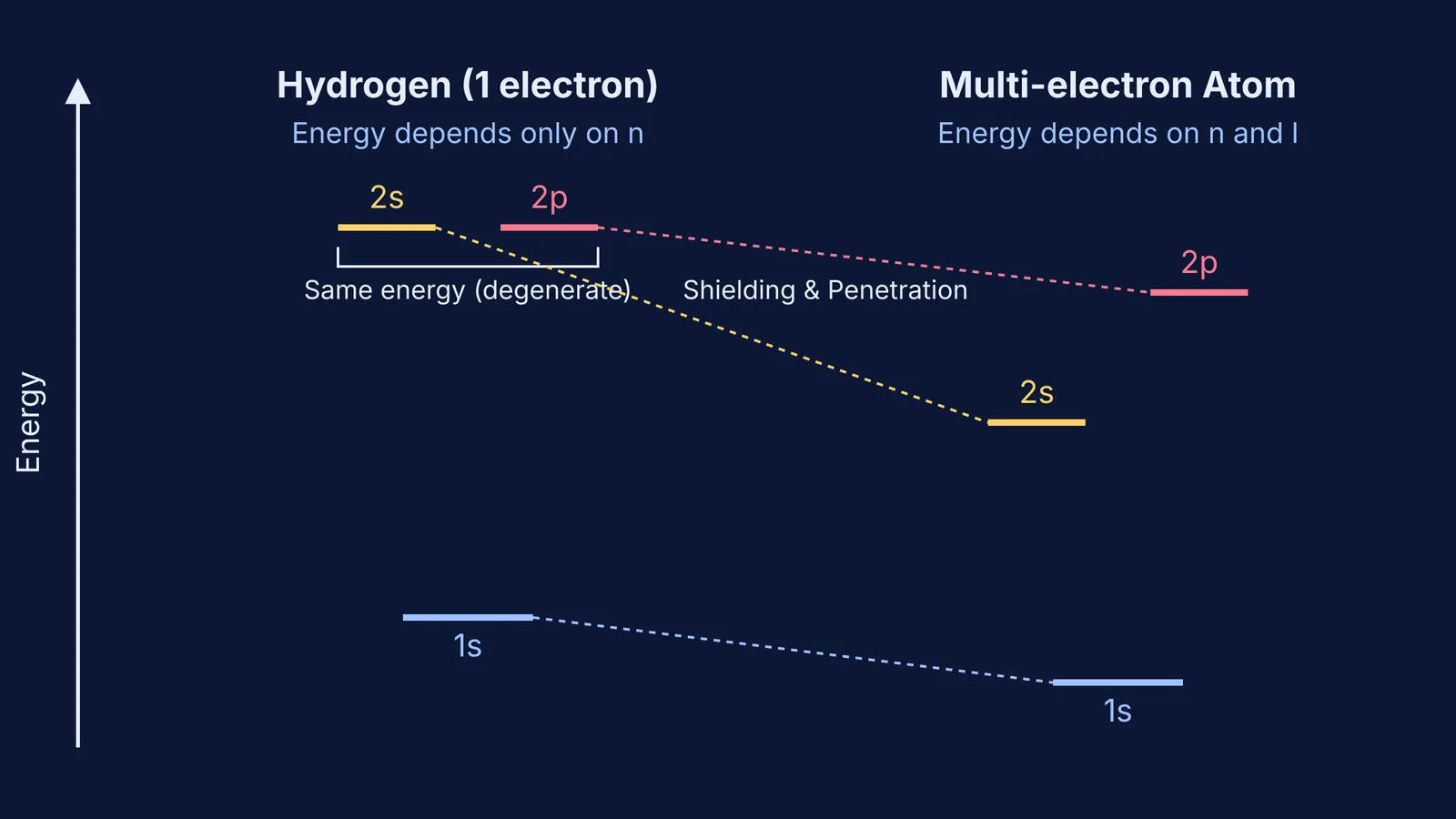
In a hydrogen atom, the 2s and 2p subshells sit at the exact same energy level. Yet in chemistry class, when you write the electron configuration for carbon or oxygen, you always fill the 2s subshell before the 2p because 2s is lower in energy.
This contradiction trips up many students preparing for JEE and NEET. The difference comes down to the number of electrons. In hydrogen, there is only one electron, so there is no repulsion between electrons. In multi-electron atoms, the electrons push against each other, splitting the energy levels apart.
Here is the physical reason why this happens, and why the rules change as soon as you look at any element past hydrogen.
Why 2s and 2p have the same energy in hydrogen?
A hydrogen atom consists of one proton and one electron. The only force at play is the electrostatic pull of the nucleus on that single electron.
Because the potential is a pure, unshielded pull from a point charge, the quantum mechanics of the hydrogen atom yield a beautifully simple result. The energy of the electron depends entirely on its principal quantum number, n, and is given by the formula E = -13.6/n² eV.
Since the 2s and 2p subshells both have n = 2, they have the exact same energy of -3.4 eV. In physics, when two or more states share the same energy, we call them degenerate. If you need to review how quantum numbers define these states, the Concept Library maps out the entire structure of the atom.
Why do subshells split in multi-electron atoms?
As soon as you add a second electron to make helium, or a third to make lithium, the simple n² rule breaks down. The electrons are no longer just pulled by the nucleus; they are also pushed away by each other.
This electron-electron repulsion introduces a new dynamic. The inner electrons act as a screen, blocking the outer electrons from feeling the full positive charge of the nucleus. The amount of pull an outer electron actually feels is called the effective nuclear charge.
Because of this shielding effect, the energy of a subshell in a multi-electron atom depends on both its principal quantum number (n) and its shape (l). This is why energy levels that are identical in hydrogen split apart in heavier elements, a phenomenon that scales up dramatically when atoms pack together, which you can read about in our guide to energy bands: conductors, semiconductors and insulators compared.
How does penetration cause the shielding effect?
To understand why 2s drops below 2p, we have to look at the shapes of the orbitals.
Orbitals are probability clouds, and they do not have hard edges. The concept of penetration describes how effectively an outer electron can pierce through the cloud of inner electrons.
An electron in a spherical 2s orbital has a small probability of being found very close to the nucleus, right inside the dense 1s core. A 2p orbital, which is shaped like a dumbbell, has a node at the nucleus—meaning the electron has exactly zero probability of being there.
Because the 2s electron penetrates the inner shell more effectively than the 2p electron, it spends more time close to the positive pull of the protons. It is less shielded from the nucleus.
If the difference between orbits, orbitals, and subshells is blurring together, Fermi's AI tutor can work out what you already know and build a plan for the session, so you sit down to a clear next step.
Because the 2s electron feels a stronger effective nuclear charge, it is pulled in more tightly. The stronger attraction binds the electron more strongly, which lowers its potential energy/06%3A_Electronic_Structure_of_Atoms/6.07%3A_Many-Electron_Atoms). The 2p electron, staying further out, is more shielded, feels less pull, and sits at a higher energy.
How can you tell if two subshells are degenerate?
When facing a multiple-choice question in a chemistry exam, use this checklist to decide if two subshells have the same energy:
Look at the number of electrons: Does the atom or ion have exactly one electron (like H, He⁺, or Li²⁺)? If yes, energy depends only on n.
Check the principal quantum number (n): If it is a one-electron system and both subshells share the same n (like 3s and 3p), they have the exact same energy.
Identify multi-electron systems: If the atom has two or more electrons, the subshells will split.
Apply the (n + l) rule: For multi-electron atoms, the subshell with the lower (n + l) value has the lower energy. If the (n + l) values are tied, the one with the lower n has the lower energy.
Why does the Aufbau principle rely on this splitting?
This splitting is the foundation of the Aufbau principle. Because the 2s subshell has a lower energy than the 2p subshell in multi-electron atoms, electrons will always fill the 2s slot first to minimise the total energy of the atom.
Without penetration and shielding, all subshells with the same principal quantum number would fill randomly. The predictable ordering of 1s, 2s, 2p, 3s, and 3p is what gives elements their distinct valencies. It is the reason carbon behaves like carbon, allowing you to draw the electron dot structures of covalent molecules in Class 10 with absolute certainty about which electrons are on the outside.


