

On this page
Why is kinetic energy never negative?
In classical mechanics, kinetic energy represents the energy an object possesses due to its motion. For any particle of mass m moving at speed v, kinetic energy is defined as:
K = ½ m v²
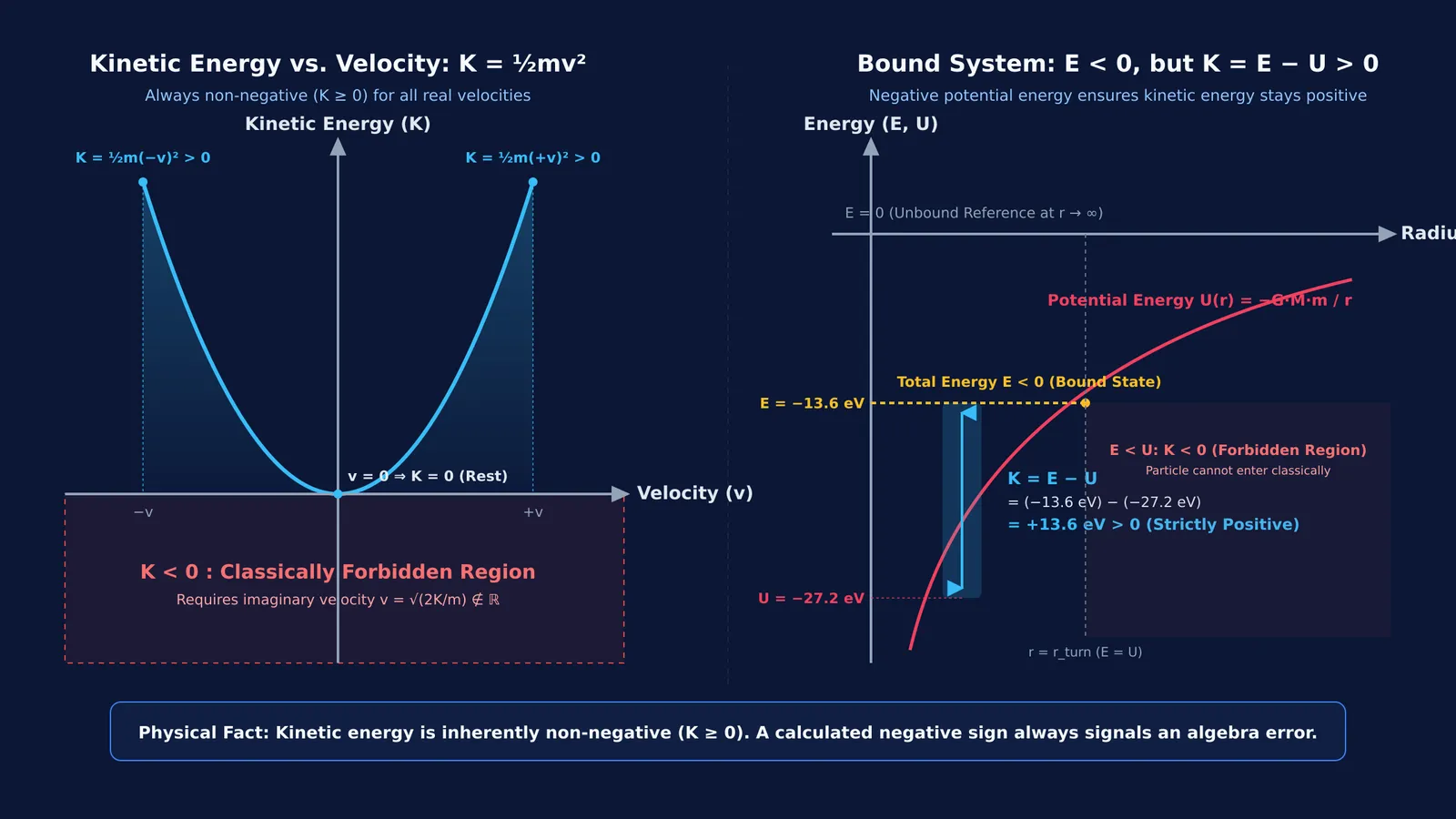
Because mass m is intrinsically positive for physical particles and the speed v is squared, this quantity cannot drop below zero. Even with a negative velocity vector, say v = −12 m/s, squaring that speed yields a positive value: (−12)² = +144 m²/s². As formalised in NCERT Class 11 Physics, kinetic energy is a scalar quantity that is strictly non-negative: K ≥ 0. It equals zero when an object is completely at rest and remains positive whenever the object moves.
This principle holds across modern physics as well. In Einstein's special relativity, kinetic energy is K = (γ − 1) m c², where the Lorentz factor γ = 1 / √(1 − v² / c²). Because particles with mass cannot reach or exceed the speed of light c, γ ≥ 1, keeping relativistic kinetic energy non-negative. If a negative kinetic energy appears on your paper, the laws of physics have not failed—an algebraic sign slip has occurred.
Why do students get negative answers in physics numericals?
Arriving at a negative value for kinetic energy is a frequent hurdle in exam preparation. Physics education research shows that students rarely struggle with K = ½ m v² itself; the difficulty lies in connecting scalar energy to directional forces.
In an interview study published in the *American Journal of Physics*, Ronald A. Lawson and Lillian C. McDermott (1987) investigated how university students applied the work-energy theorem to frictionless pucks pushed by identical forces over identical distances. Among 28 students interviewed (16 in algebra-based physics and 12 in honors calculus-based physics), 0% of algebra-based students and only 50% of honors students concluded that both pucks gained equal kinetic energy. A written survey of approximately 1,000 students by Tara O’Brien Pride, Stamatis Vokos, and Lillian C. McDermott (1998) found that only 15% answered the kinetic energy comparison correctly.
Further research by Chandralekha Singh and David Rosengrant (2003) using the 25-item Energy and Momentum Conceptual Survey found that calculus-based students averaged approximately 49% post-instruction, routinely stumbling over algebraic signs.
In practice, negative kinetic energy usually traces to three mistakes:
Confusing K with ΔK: The change in kinetic energy (ΔK = K_final − K_initial) is negative whenever an object slows down. Forgetting the delta turns a deceleration of ΔK = −50 J into an impossible K = −50 J.
Inverting the work-energy theorem: Writing W_net = K_final − K_initial means K_final = K_initial + W_net. When friction does negative work, students often compute K_final = W_net − K_initial.
Dropping brackets around negative velocity: In one-dimensional motion, evaluating ½ m (−v)² as −½ m v² improperly moves the negative sign outside the square.
When working through mechanics numericals, the Fermi Problem Library provides worked problems with a step-by-step solver that explains the reasoning rather than printing an answer, helping you catch sign slips early.
How does kinetic energy differ from potential energy?
Much of the confusion around signs occurs because potential energy *can* be negative. While kinetic energy is absolute and depends solely on motion, potential energy depends on relative position and the chosen reference level.
For gravitational and electrostatic attraction, zero potential energy is set at infinity: U(∞) = 0. Because attractive forces pull objects together naturally, bringing masses or opposite charges closer releases energy, making potential energy negative: U(r) = −G M m / r.
In bound systems, such as an electron in a hydrogen atom, total energy is also negative. In the hydrogen ground state, total energy is E = −13.6 eV, while potential energy is U = −27.2 eV. Students often assume that negative total energy implies negative kinetic energy. But conservation of energy gives:
K = E − U = (−13.6 eV) − (−27.2 eV) = +13.6 eV
Kinetic energy remains strictly positive. The negative total energy simply means the particle is bound. If total energy were less than potential energy (E < U), K would be negative, which classical physics forbids as a classically forbidden region.
To build a clearer picture of conservative fields, the Fermi Concept Library covers every concept in physics, chemistry, biology, mathematics and computing, each with its own lesson and its place in the map.
How do you catch sign errors under exam pressure?
When a negative kinetic energy appears during a timed test, do not panic or erase the minus sign. Use this three-step audit to diagnose the error:
Trace the work-energy theorem: If a 2 kg block moves at 10 m/s (K_initial = 100 J) against 15 N of friction over 5 m, friction does W = −75 J. Then K_final = 100 J + (−75 J) = 25 J. Getting −175 J indicates you subtracted initial energy from work.
Distinguish state from change: Check whether you sought kinetic energy at an instant (K ≥ 0) or the change ΔK across an interval. Deceleration yields a negative ΔK, which is physically valid.
Verify bound-state signs: When solving K = E − U, ensure that subtracting a negative potential energy produces a positive addition.


