On this page
Every hydrogen series in your textbook ends at a sharp edge: the lines get closer and closer and then stop. That edge is the series limit. Below we explain what it means, work out the Lyman and Balmer limits with real numbers, and show why the Lyman limit and hydrogen's ionisation energy are the same thing.
What is the series limit in the hydrogen spectrum?
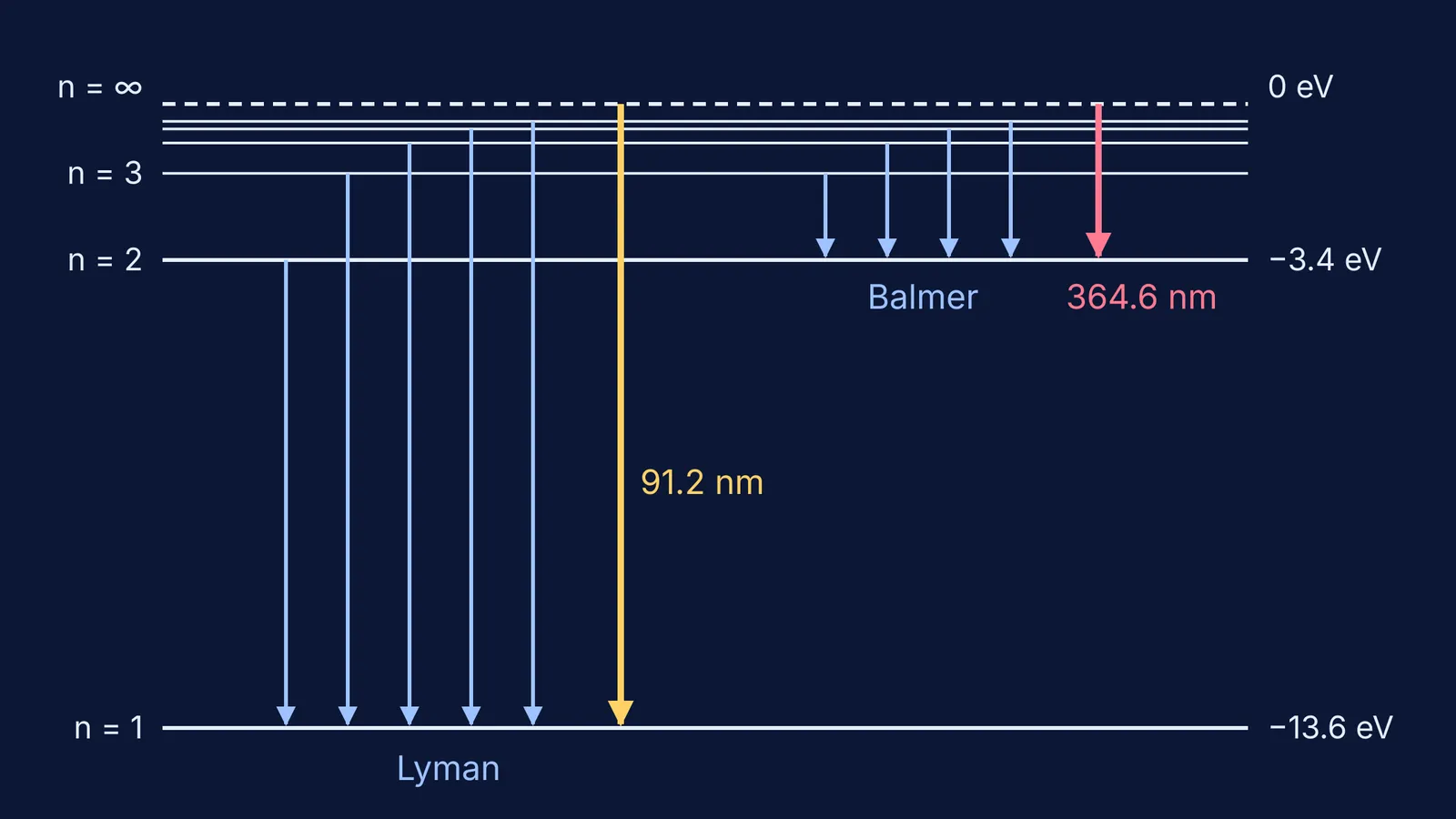
The wavelengths of hydrogen's lines follow the Rydberg formula, 1/λ = R(1/n₁² − 1/n₂²), where n₁ is the lower level and n₂ the upper one (hydrogen spectral series overview). Each series fixes n₁: Lyman has n₁ = 1, Balmer has n₁ = 2 and Paschen has n₁ = 3.
As n₂ grows, 1/n₂² shrinks, so each new line moves only a little further and the lines crowd together. The series limit is the line you get when n₂ tends to infinity, so 1/n₂² becomes zero and 1/λ = R/n₁². That is the largest possible 1/λ in the series, so the series limit is the shortest wavelength, the highest frequency and the highest photon energy in that series.
Physically, n₂ = ∞ means the electron starts just free of the atom, with zero energy, and falls all the way into level n₁.
How do you calculate the Lyman and Balmer series limits?
Use hydrogen's own measured value. NIST lists the ionisation energy of hydrogen as 109,678.7717 cm⁻¹ (NIST hydrogen data table), which is the Lyman-limit wavenumber, so we use it as R_H here. It is slightly smaller than the CODATA 2022 value R∞ = 10,973,731.568 157 m⁻¹ (NIST constant value), mainly because the proton is not infinitely heavy. Most textbooks round to 1.097 × 10⁷ m⁻¹.
Worked example, step by step:
Lyman limit (n₁ = 1): 1/λ = R_H, so λ = 1/109,678.77 cm⁻¹ = 9.1175 × 10⁻⁶ cm = 91.18 nm. That is in the ultraviolet.
Balmer limit (n₁ = 2): 1/λ = R_H/4, so λ = 4 × 91.175 nm = 364.7 nm in vacuum.
With the rounded textbook value: λ = 4/(1.097 × 10⁷ m⁻¹) = 3.646 × 10⁻⁷ m = 364.6 nm.
Published tables give a Lyman limit of 91.175 nm in vacuum, a Balmer limit of 364.6 nm and a Paschen limit of 820.4 nm, with the Balmer and Paschen values measured in air (hydrogen spectral series overview). The small gap between 364.7 and 364.6 nm is the air-versus-vacuum difference, not an error in your working.
The shortcut to remember: the series limit wavelength scales as n₁². So the Balmer limit is 4 times the Lyman limit and the Paschen limit is 9 times it.
How is the series limit linked to ionisation energy?
The Lyman limit photon is emitted when a free electron at rest drops into n = 1. Run that backwards and you have the energy needed to pull the electron out of the ground state: the ionisation energy. NIST gives hydrogen's ionisation energy as both 13.598433 eV and 109,678.7717 cm⁻¹ (NIST hydrogen data table), and that wavenumber is exactly 1/λ for the Lyman limit.
The same logic works for other series. The Balmer limit photon carries 13.6/4 = 3.4 eV, the energy needed to ionise hydrogen from n = 2. For hydrogen-like ions such as He⁺ or Li²⁺, the Rydberg formula gains a factor of Z² (hydrogen spectral series overview), so the Lyman limit wavelength divides by Z²: about 22.8 nm for He⁺ (Z = 2) and about 10.1 nm for Li²⁺ (Z = 3).
Which series limit questions come up most, and how do you check your answer?
Three ratio questions appear again and again, and none of them needs the value of R:
Lyman limit is λ; find the Balmer limit. Answer: 4λ.
Ratio of longest to shortest wavelength in the Lyman series: 1/(1 − 1/4) divided by 1, which is 4/3.
Ratio of longest to shortest in the Balmer series: H-alpha has 1/λ = R(1/4 − 1/9) = 5R/36, the limit has R/4, so the ratio is (36/5)/4 = 9/5.
Before you move on, run this four-point check:
Did you put n₂ = ∞ for shortest and n₂ = n₁ + 1 for longest?
Is n₁² in the numerator of λ, not the denominator?
Are your units consistent (cm⁻¹ with cm, m⁻¹ with m)?
Does the answer land in the right region: ultraviolet for Lyman, near 365 to 656 nm for Balmer (hydrogen spectral series overview)?
If you keep picking the wrong n₂, try a few problems where every step is shown. The Fermi Problem Library has worked problems with a step-by-step solver that explains the reasoning rather than printing an answer. If energy levels themselves feel shaky, the Fermi Concept Library gives each concept in physics and chemistry its own lesson and its place in the map.
Next time you see a series limit question, write 1/λ = R/n₁² first and the rest follows.