

On this page
In gravitation you meet U = −GMm/r, with a minus sign that looks like a mistake. It is not. It comes from one choice about where to put zero, and once you see that choice, the sign of the total energy tells you whether a satellite stays or leaves.
Why is gravitational potential energy negative?
Only differences in potential energy matter, so you may pick where it is zero. For two masses, the standard choice is infinity: OpenStax University Physics, section 13.3 writes U = −GMm/r and states that "the potential energy is zero when the two masses are infinitely far apart."
Gravity pulls masses together, so as they move in from infinity, gravity does positive work and potential energy falls. Starting at zero and only falling, it can only go below zero. The same OpenStax section notes that U "becomes increasingly more negative as the masses get closer."
Picture a well with the planet at the bottom and infinity at ground level. Anything closer is below ground; the size of U says how deep.
Can gravitational potential energy ever be positive?
With zero at infinity, no. At any finite r, −GMm/r is negative; it only approaches zero as r grows without limit.
With a different zero, yes. In mgh problems you put zero at the floor, and a book on a shelf has positive potential energy. Both conventions give the same measurable answers, because only changes in U enter your equations. More on this in why you can choose the zero of potential energy.
What does positive total energy mean for an orbit?
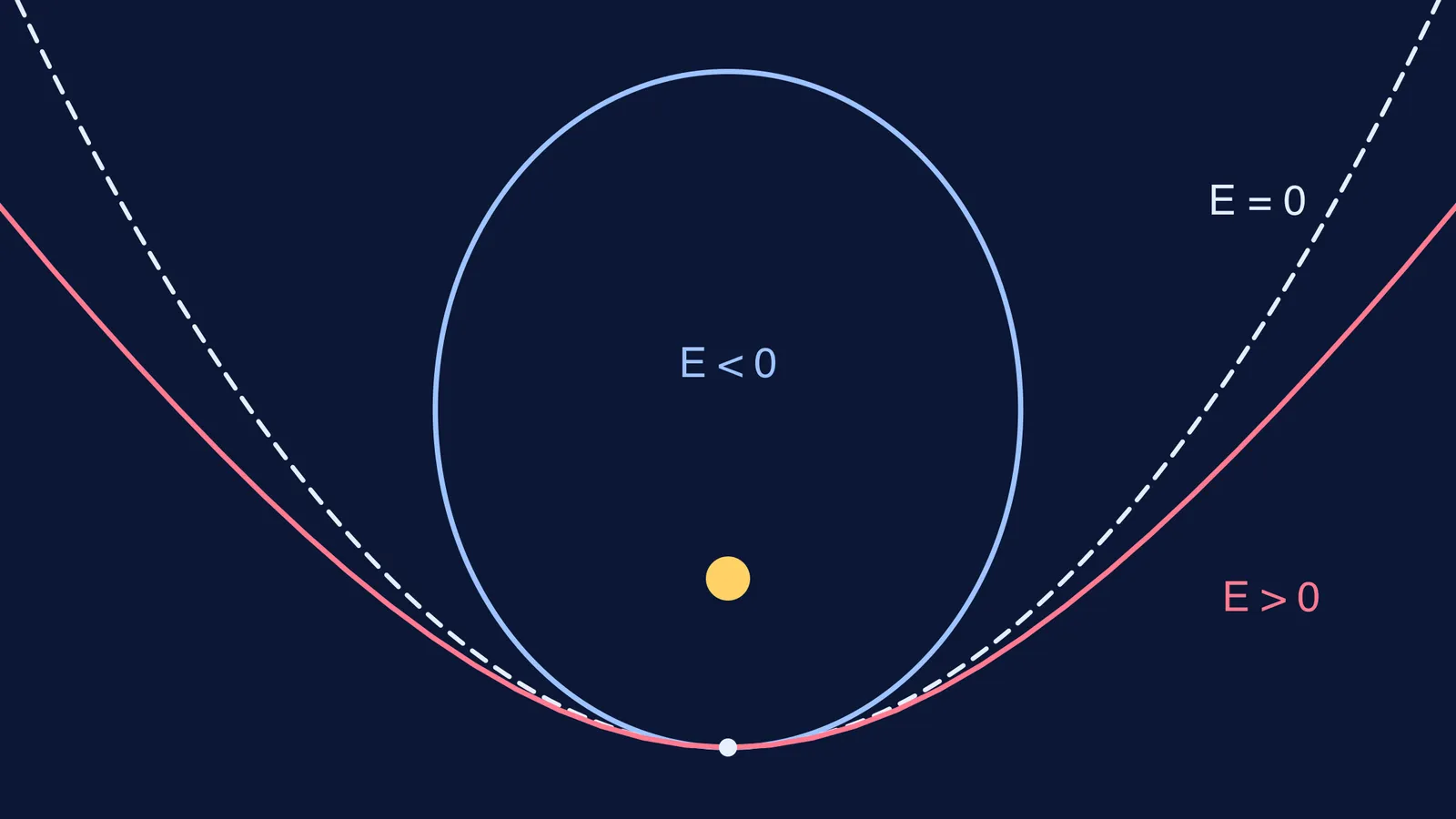
Kinetic energy is never negative, so E = K + U pits speed against depth. OpenStax section 13.3 sets out three cases:
E < 0: kinetic energy runs out at some finite distance, so the object is gravitationally bound and "can never exceed this finite distance".
E = 0: the object "gives up the last of its kinetic energy just as it reaches infinity", which is exactly escape speed.
E > 0: "kinetic energy remains at r = ∞", and the object does not come back.
Each case has its own shape. OpenStax on Kepler's laws shows that negative total energy gives an ellipse or circle (eccentricity 0 ≤ e < 1), zero energy gives a parabola (e = 1), and positive energy gives a hyperbola (e > 1) that passes the central mass "once and only once".
For a circular orbit, E = −GMm/2r: kinetic energy is half the size of potential energy (OpenStax 13.4).
Positive-energy orbits are real. The interstellar object 'Oumuamua, found on 19 October 2017 by Pan-STARRS1, was tracked leaving at about 38.3 km/s relative to the Sun, according to NASA. NASA JPL's Small-Body Database lists its eccentricity as 1.2: a hyperbola.
Worked example: one satellite, three speeds
Take a 1,000 kg satellite 400 km above Earth, so r = 6,371 + 400 = 6,771 km. Earth's GM is 3.986 × 10^14 m³/s² and its mean radius is 6,371 km, from NASA's Earth fact sheet.
Potential energy: U = −GMm/r = −(3.986 × 10^14 × 1,000) ÷ (6.771 × 10^6) ≈ −5.89 × 10^10 J, about −58.9 GJ.
Circular orbit: v = √(GM/r) ≈ 7.67 km/s, so K ≈ +29.4 GJ and E ≈ −29.4 GJ. Negative, so the satellite is bound in a circle.
Escape speed at this height: v = √(2GM/r), √2 times the circular speed, about 10.85 km/s. Now K exactly cancels U and E = 0: a parabola.
Give it 11 km/s instead. K = ½ × 1,000 × (11,000)² ≈ 60.5 GJ, so E ≈ +1.6 GJ. Positive: a hyperbola, and the satellite leaves Earth for good.
U was −58.9 GJ in every line; only the speed changed, and it alone decided the sign of E. Launch direction does not enter the energy sum, which is why escape speed is independent of direction.
How do you check the sign in an exam?
Run through this before you commit an answer:
Is U negative at every finite r? A positive U with zero at infinity means a sign slipped.
For a circular orbit, is K = −E and U = 2E? If not, recheck your speed.
Did the energy needed to escape come out positive? Binding energy is the amount you must add to lift E to zero.
Does the sign of E match the path in the question: ellipse below zero, parabola at zero, hyperbola above?
Drag makes E more negative and shrinks the orbit, the puzzle behind why atmospheric drag speeds a satellite up.
If the sign still feels slippery, the Fermi Concept Library gives each idea here its own lesson, and the Fermi Problem Library has worked problems with a step-by-step solver that explains the reasoning rather than printing an answer.


