

On this page
Friction is supposed to slow things down. If you slide a block across a floor, it quickly comes to a stop. But in the vacuum of space, the rules of motion play out differently. When a satellite in low Earth orbit scrapes against the thin upper atmosphere, the air drag does not slow it down. Instead, the friction causes the satellite's speed to increase.
This counter-intuitive behaviour is known as the satellite drag paradox. It is a classic problem in physics, formally outlined as a general mechanics paradox by Leon Blitzer in the American Journal of Physics (1971). The paradox rests on the fact that an orbit is a delicate, continuous balance between kinetic energy (the energy of speed) and gravitational potential energy (the energy of height).
Why does drag lower total energy?
A satellite circling the Earth possesses total mechanical energy, which is the sum of its kinetic energy (K) and its potential energy (U). Because gravity is an attractive force, we define potential energy as negative: U = −GMm / r, where G is the gravitational constant, M is Earth's mass, m is the satellite's mass, and r is the distance from the centre of the Earth.
For a circular orbit, the kinetic energy is exactly half the magnitude of the potential energy. This makes the total energy E = −GMm / (2r).
When a satellite hits the thin air of the thermosphere, the drag force does negative work. This strips total mechanical energy from the satellite. To lose energy, the total energy E must become a larger negative number. Looking at the formula, the only way E can become more negative is if the orbital radius r shrinks. The satellite can no longer maintain its altitude and begins to spiral inward.
Why does a satellite speed up when air drag acts?
As the satellite falls into a lower orbit, it drops deeper into Earth's gravity well. This steep drop causes a massive loss in potential energy.
According to the virial theorem of orbital mechanics, for every two joules of potential energy the satellite loses, it only needs to lose one joule of total energy. The "spare" joule does not vanish; it is converted directly into kinetic energy.
The satellite ends up moving faster precisely because it is closer to the Earth, even though it was friction that pushed it there.
What is the satellite drag paradox?
The paradox is that a resistive force (drag) acting opposite to the direction of motion results in a net forward acceleration. As Blitzer noted in his 1971 analysis of the paradox, the acceleration in the direction of motion is exactly the same as if the drag force were reversed and actively pushing the satellite forward.
Of course, the drag is not actually pushing the satellite. The acceleration comes entirely from Earth's gravity. The drag merely destabilises the orbit, forcing gravity to pull the satellite down and whip it around the Earth at a faster rate.
If you are confused by how energy shifts between kinetic and potential forms, the Fermi Concept Library maps out every law of orbital mechanics, showing exactly how total energy relates to speed and radius. This interplay is the same math used to trace planetary orbits, a puzzle solved centuries ago as seen in How Johannes Kepler found his three laws in Tycho Brahe's data.
What happens when the satellite gets too low?
This speed increase cannot last forever. As the satellite falls closer to Earth, the atmosphere becomes exponentially thicker.
In the upper reaches of low Earth orbit (around 400 to 500 kilometres), the air is so thin that the satellite might take years to decay according to the ESA, slowly gaining speed the entire time. However, once the satellite drops below 150 kilometres, the air density spikes. The drag force becomes so overwhelming that gravity can no longer compensate. At this point, the satellite finally begins to lose linear speed, rapidly shedding kinetic energy as intense heat until it burns up in the atmosphere.
Worked example: Calculating the speed jump
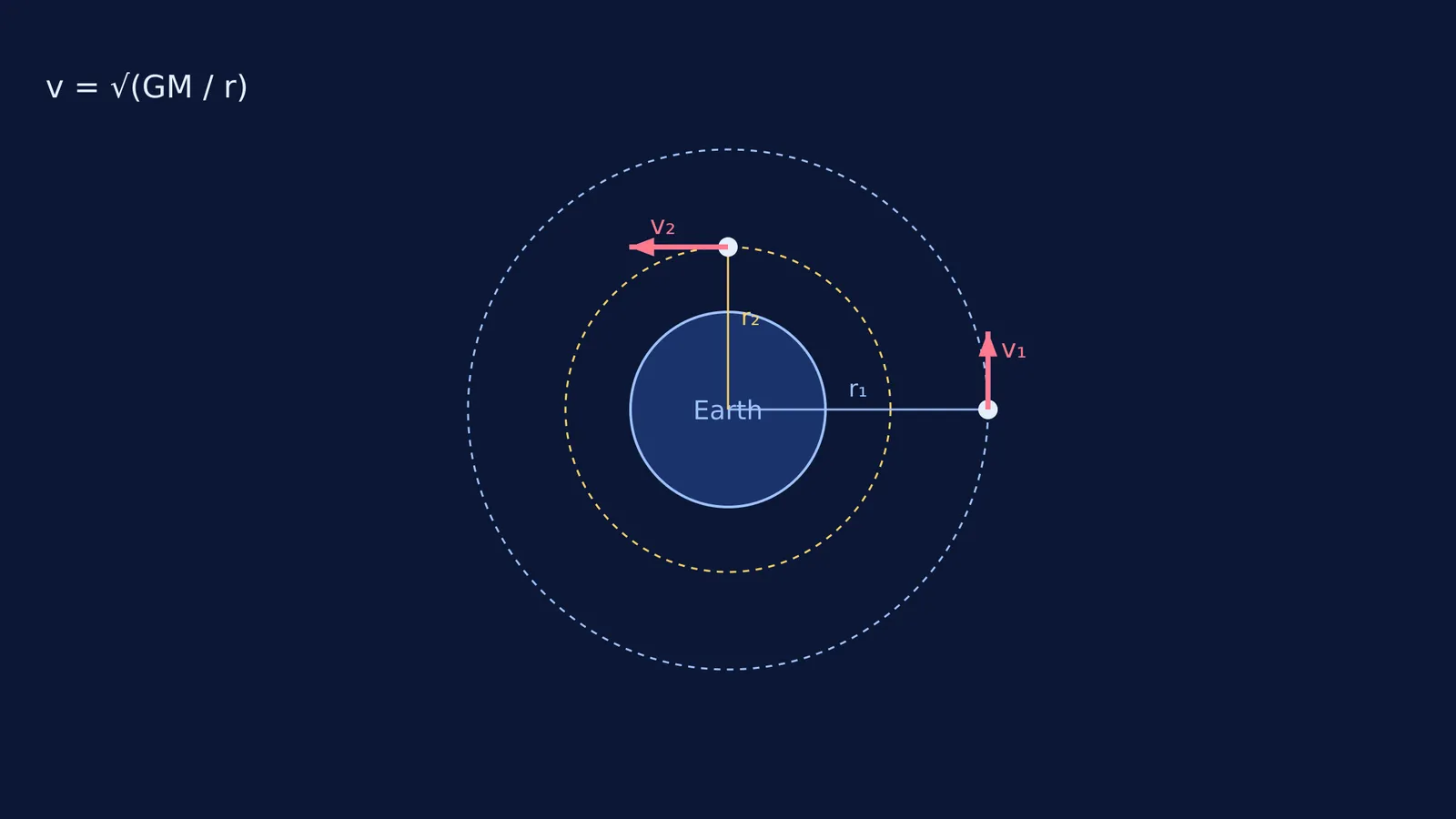
Let us run the numbers for a satellite dropping from a 500 km altitude down to a 350 km altitude due to atmospheric drag. This is a common numerical problem for students reviewing Gravitation and satellites: orbital speed, energy and escape speed.
Identify the constants: From the NASA Earth Fact Sheet, Earth's mass is M = 5.97 × 10²⁴ kg, and its radius is 6371 km. The gravitational constant is G = 6.67 × 10⁻¹¹ N m²/kg².
Find the initial speed: At an altitude of 500 km, the orbital radius from the centre of the Earth is r₁ = 6871 × 10³ m. The initial speed is v₁ = √(GM / r₁) = 7613 m/s.
Find the final speed: At an altitude of 350 km, the radius has shrunk to r₂ = 6721 × 10³ m. The new speed increases to v₂ = √(GM / r₂) = 7697 m/s.
Despite the constant friction of the atmosphere dragging against it, the satellite is now travelling 84 m/s faster than it was before. This mechanism applies to all orbits, and you can see a similar trade-off between distance and speed when studying Kepler's second law from angular momentum: areal velocity worked.


