On this page
Packaged food spoils in two ways: microbes grow in it, and its fats react with oxygen and turn rancid. Food additives split the same way. Preservatives such as sodium benzoate and sorbic acid slow the microbes; antioxidants such as BHT and BHA slow the oxidation. If you met rancidity in our explainer on corrosion and rancidity, this is the chemistry behind the fix.
How does sodium benzoate work as a preservative?
In acidic food, some benzoate ions pick up a proton and become benzoic acid, a weak acid with a pKa of about 4.2 at 25 °C (PubChem, benzoic acid).
Only the uncharged acid does the damage. In the classical model, the neutral acid diffuses across a microbe's membrane, then dissociates in the less acidic cell interior, draining the proton gradient across the membrane and letting the anion build up inside (van Beilen and colleagues, 2014). The same paper notes that weak-acid preservatives are most effective at pH values below their pKa.
Why does sodium benzoate suit acidic foods better?
The uncharged fraction of a weak acid is 1 / (1 + 10^(pH − pKa)), from the Henderson–Hasselbalch equation. For benzoic acid, pKa 4.2 (PubChem):
At pH 3.0: 10^(−1.2) = 0.063, so 1 / 1.063 ≈ 0.94. About 94% is the active acid.
At pH 4.2: 10^0 = 1, so exactly half is active.
At pH 6.0: 10^1.8 ≈ 63, so 1 / 64 ≈ 0.016. Under 2% is active.
The same dose is roughly 60 times weaker at pH 6 than at pH 3. That is why benzoate belongs in acidic drinks, pickles and sauces rather than in near-neutral foods.
Is sorbic acid different from sodium benzoate?
Sorbic acid, often added as potassium sorbate, uses the same weak-acid trick, but its pKa is 4.76 (van Beilen and colleagues, 2014). At pH 6.0 the formula gives 1 / (1 + 10^1.24) ≈ 0.054, so about 5% stays active, roughly three and a half times benzoate's share.
pKa is not the whole story. The same paper gives acetic acid a similar pKa of 4.76, yet found that sorbic acid acts more as an uncoupler, cutting the membrane potential of the bacterium Bacillus subtilis far more than acetic acid does. The authors link this to sorbic acid being the more potent preservative.
How do BHT and BHA stop fats going rancid?
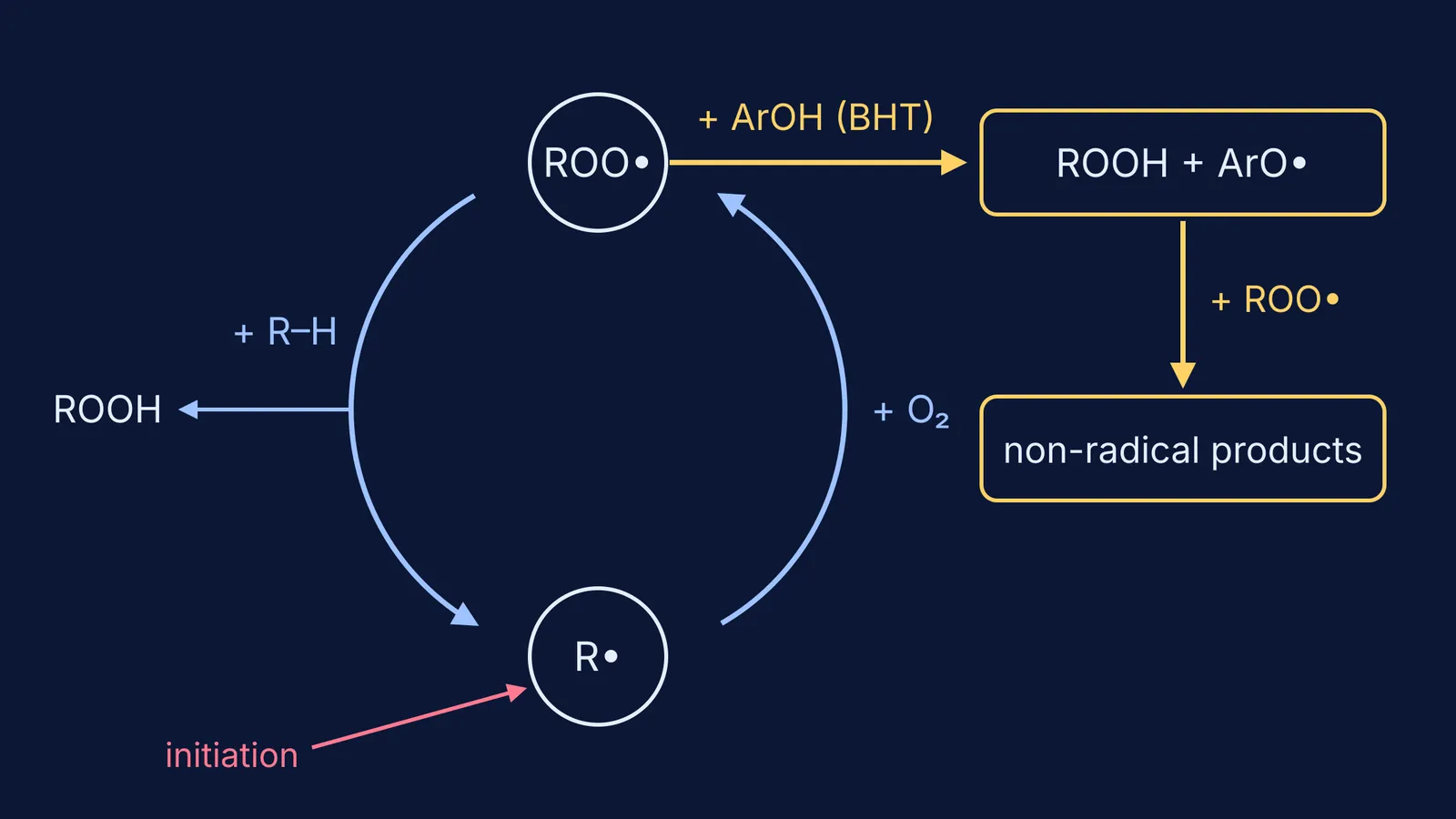
Rancidity is a free-radical chain reaction, with the same initiation, propagation and termination pattern as free-radical chlorination of methane. Writing a fat molecule as R–H, the steps are (Viglianisi and Menichetti, 2019):
Initiation: a first radical, R•, forms.
Propagation 1: R• + O₂ → ROO•, a peroxyl radical.
Propagation 2: ROO• + R–H → ROOH + R•, and the new R• loops back to step 1.
Chain breaking: ROO• + ArOH → ROOH + ArO•, where ArOH is a phenolic antioxidant.
Each turn of the loop leaves behind one hydroperoxide and passes the radical on, so a single initiation can damage many fat molecules. The same review calls BHT and BHA the core skeleton of phenolic antioxidant additives used worldwide to extend shelf life. Their O–H bonds are weak, about 77 kcal/mol for BHT and 80 kcal/mol for BHA, so they give up a hydrogen atom to a peroxyl radical readily, competing with propagation step 2.
The phenoxyl radical ArO• that forms does not carry the chain on. It combines with a second peroxyl radical instead, so one hindered phenol such as BHT removes about two chain carriers (Raycroft and colleagues, 2020).
If free radicals or bond energies still feel shaky, the Fermi Concept Library has a lesson for every chemistry concept and shows its place in the map, so you can fill the gap before coming back to food chemistry.
Are these preservatives safe to eat?
Regulators judge these additives by an acceptable daily intake (ADI), given in milligrams per kilogram of body weight per day. The European Food Safety Authority (EFSA) set these figures in its re-evaluations:
Benzoic acid and benzoates: 5 mg/kg body weight per day, expressed as benzoic acid (EFSA, 2016).
Sorbic acid and potassium sorbate: 11 mg/kg body weight per day, expressed as sorbic acid (EFSA, 2019).
BHA: 1.0 mg/kg body weight per day (EFSA, 2011).
BHT: 0.25 mg/kg body weight per day (EFSA, 2012).
For a 50 kg student, the benzoate figure works out to 50 × 5 = 250 mg of benzoic acid a day. EFSA's 2016 opinion did find estimated intake above the ADI in a brand-loyal scenario, especially for toddlers and children who regularly drink flavoured drinks. For questions about your own or your child's diet, ask a doctor or a registered dietitian.
To practise, rerun the fraction formula at pH 3.5 and 5.0, or work similar problems in the Fermi Problem Library, where a step-by-step solver explains the reasoning rather than printing an answer. For more label chemistry, read how artificial sweeteners work.