On this page
In April 1952, Geoffrey Wilkinson, an assistant professor at Harvard, argued with Myron Rosenblum, Mark Whiting and Robert Burns Woodward that an orange iron compound called ferrocene was built like a sandwich (Journal of the American Chemical Society, 1952). Fourteen years later his group in London reported a rhodium catalyst that still carries his name.
Who was Geoffrey Wilkinson?
Wilkinson was born on 14 July 1921 near Todmorden in West Yorkshire, the son of a house painter, according to his Nobel Prize autobiography. He graduated from Imperial College in 1941, worked on the wartime nuclear project in Canada, then made new isotopes at Berkeley with Glenn Seaborg. He turned to transition metal complexes at MIT in 1950, joined Harvard in 1951, and in 1956 took up the chair of inorganic chemistry at Imperial College.
The 1973 Nobel Prize in Chemistry went to Ernst Otto Fischer and Wilkinson "for their pioneering work, performed independently, on the chemistry of the organometallic, so called sandwich compounds" (Nobel Prize press release).
How did Wilkinson work out ferrocene's sandwich structure?
Ferrocene was first reported by Thomas Kealy and Peter Pauson in Nature in December 1951. They pictured each five-carbon ring joined to iron by a single bond from one carbon atom (Wikipedia: Ferrocene). Wilkinson, already working on metal–alkene complexes, later wrote that he "was primed for the appearance of the celebrated Kealy and Pauson note" (Nobel autobiography).
The clues did not fit. A data entry citing the 1952 paper states that "the molecule is diamagnetic and the dipole moment is effectively zero" (DrugFuture chemical database). No unpaired electrons and no overall polarity point to a very symmetric molecule. Ferrocene also turned out to behave like benzene, resisting addition but undergoing Friedel-Crafts acylation (LibreTexts, Roberts and Caserio/31%3A_Transition_Metal_Organic_Compounds/31.01%3A_Metallocenes)).
The shape that fits every clue is an iron atom between two parallel flat rings, with all ten carbons bonded equally to the metal. Mark Whiting, Woodward's postdoc, coined the name "ferrocene" (ferrocene history), and later in 1952 Philip Eiland and Ray Pepinsky published an X-ray examination of the crystal. On credit, the Nobel press release is precise: Fischer and Wilkinson "did not prepare the first sandwich but they were the first to grasp the odd nature of the compound and its conceptual importance" (Nobel Prize press release).
Why is ferrocene so stable? A worked example
1. Count the electrons. Treat each ring as the cyclopentadienyl anion, C5H5−, which brings 6 π electrons. That leaves iron as Fe2+, a d6 ion. The total is 6 + 6 + 6 = 18 outer-shell electrons, the same count as the noble gas krypton (LibreTexts/31%3A_Transition_Metal_Organic_Compounds/31.01%3A_Metallocenes)).
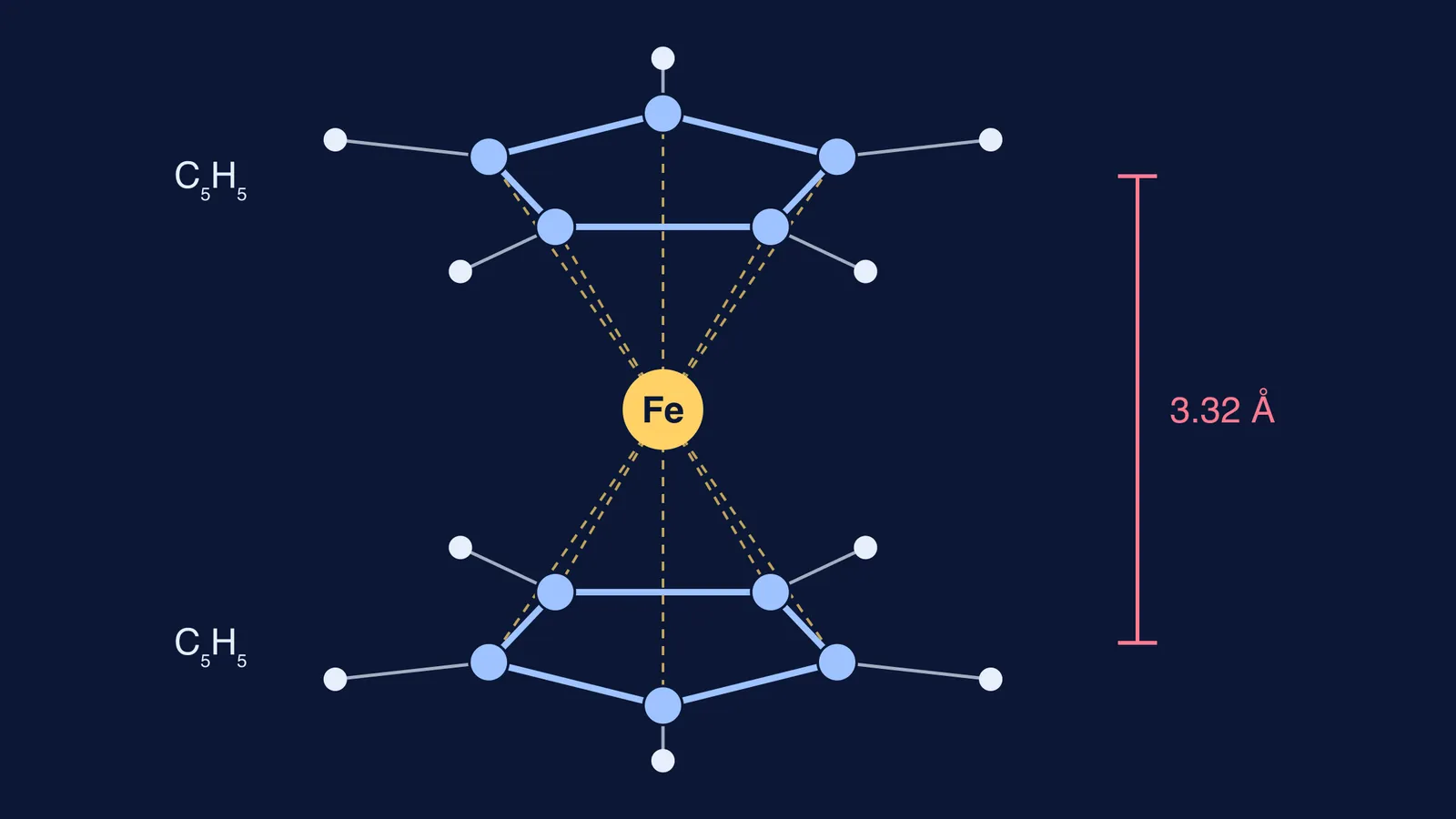
2. Find the shape from two measured distances. Every Fe–C distance is 2.064 Å and every ring C–C bond is 1.440 Å (ferrocene structure data).
A regular pentagon with side s has circumradius R = s ÷ (2 sin 36°) = 1.440 ÷ 1.176 = 1.225 Å.
Iron sits on the axis through both ring centres, so (Fe–C)² = R² + d², with d the iron-to-ring distance.
d = √(2.064² − 1.225²) = √(4.260 − 1.501) = √2.759 = 1.661 Å.
The two rings are 2 × 1.661 = 3.32 Å apart.
The diagram at the top uses these numbers, with the rings staggered as in the room-temperature crystal. If the electron count feels shaky, the Fermi Concept Library gives every chemistry concept its own lesson and its place in the map, so you can fill the gap first.
What is Wilkinson's catalyst and how does it work?
At Imperial, his work on metal–hydrogen bonds "led to work on homogeneous catalytic reactions such as hydrogenation and hydroformylation of olefins" (Nobel autobiography). In 1966, J. A. Osborn, F. H. Jardine, J. F. Young and Wilkinson described tris(triphenylphosphine)halogenorhodium(I) and its use for "catalytic homogeneous hydrogenation of olefins and acetylenes" (Journal of the Chemical Society A, 1966). The chloride, RhCl(PPh3)3, is the one now called Wilkinson's catalyst.
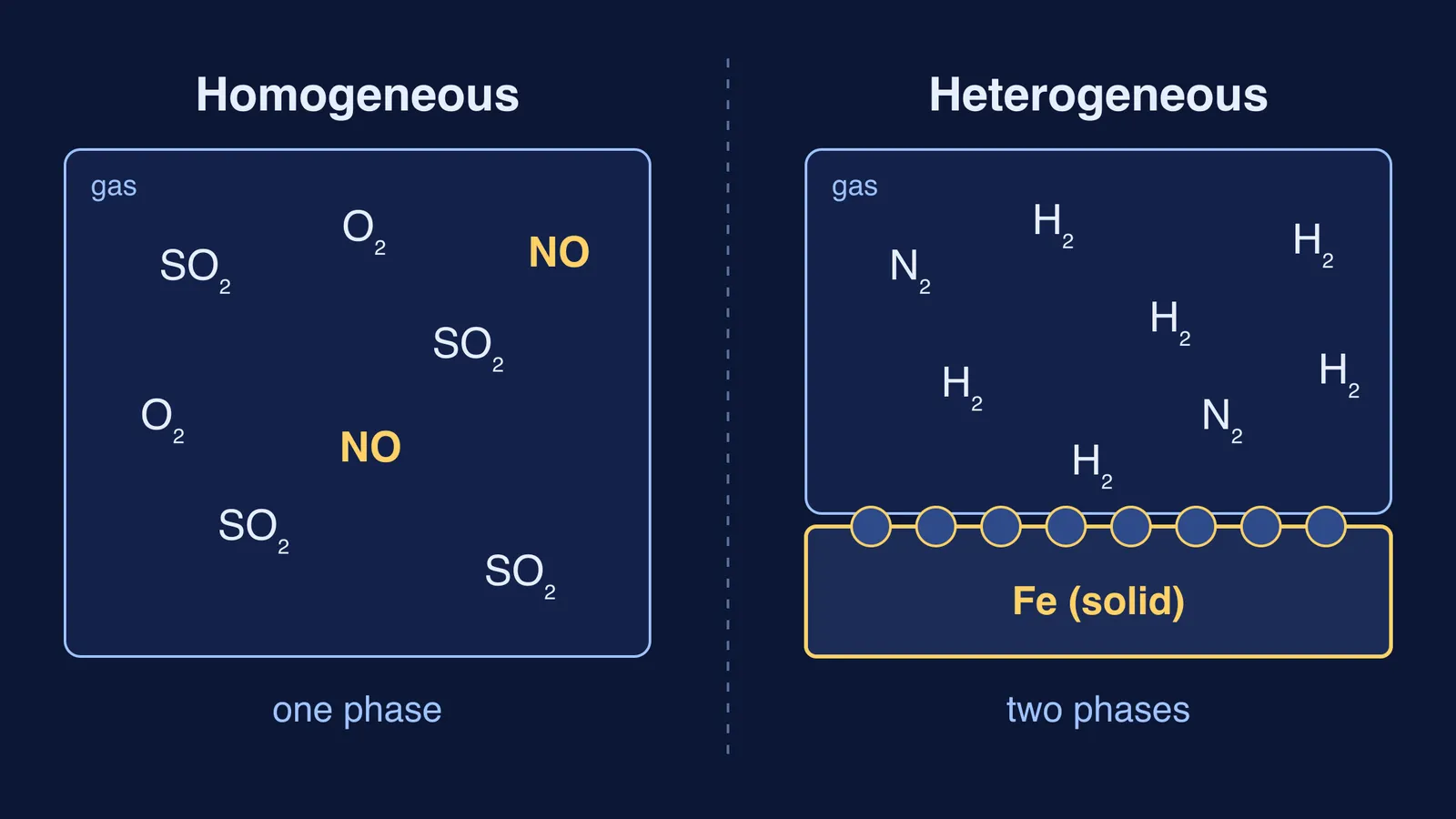
Homogeneous means it is dissolved in the same solution as the alkene, unlike the metal surfaces in the catalytic hydrogenation over Ni, Pt and Pd you meet first. The cycle, as set out in LibreTexts/07%3A_Organometallic_Reactions_and_Catalysis/7.03%3A_Organometallic_Catalysts/7.3.05%3A_Hydrogenation_by_Wilkinson's_Catalyst), runs like this:
Square planar RhCl(PPh3)3, a rhodium(I) complex, loses one PPh3.
H2 adds to rhodium (oxidative addition), giving rhodium(III).
The alkene binds next to a hydride.
Migratory insertion moves a hydrogen onto carbon, leaving a rhodium–alkyl.
Reductive elimination releases the alkane and returns rhodium to the +1 state.
Go deeper with our explainer on Wilkinson's catalyst: structure, mechanism and uses, or see where the idea went next with Ryoji Noyori's chiral catalysts.
How should you revise Wilkinson's chemistry?
Without notes:
Draw ferrocene and do the 18-electron count.
Name the two measurements that pointed away from the single-bond structure.
Write the five steps of the cycle, with rhodium's oxidation state beside each.
Say in one sentence how a homogeneous catalyst differs from nickel powder.
If a problem on counting electrons stumps you, the Fermi Problem Library has worked problems with a step-by-step solver that explains the reasoning rather than printing an answer.
The textbook sandwich began as an argument from evidence; try making it yourself.