

On this page
Wilkinson's catalyst, structurally known as chloridotris(triphenylphosphine)rhodium(I) or RhCl(PPh₃)₃, changed how chemists approach the reduction of double bonds. Before its discovery, adding hydrogen to an alkene mostly required heterogeneous catalytic hydrogenation—solid metals like nickel or palladium sitting in a liquid mixture.
Sir Geoffrey Wilkinson first reported his famous work on the hydrogenation catalyst that now bears his name in 1965. His discovery was a landmark in organometallic chemistry. Because this rhodium complex dissolves in hydrocarbon solvents like benzene, it acts as a homogeneous catalyst. This means the catalyst and the reactants are in the same phase, leading to highly selective and efficient reactions without the need for extreme temperatures or pressures.
What is Wilkinson's catalyst?
Wilkinson's catalyst is an application of coordination compounds featuring rhodium, a d⁸ transition metal ion.
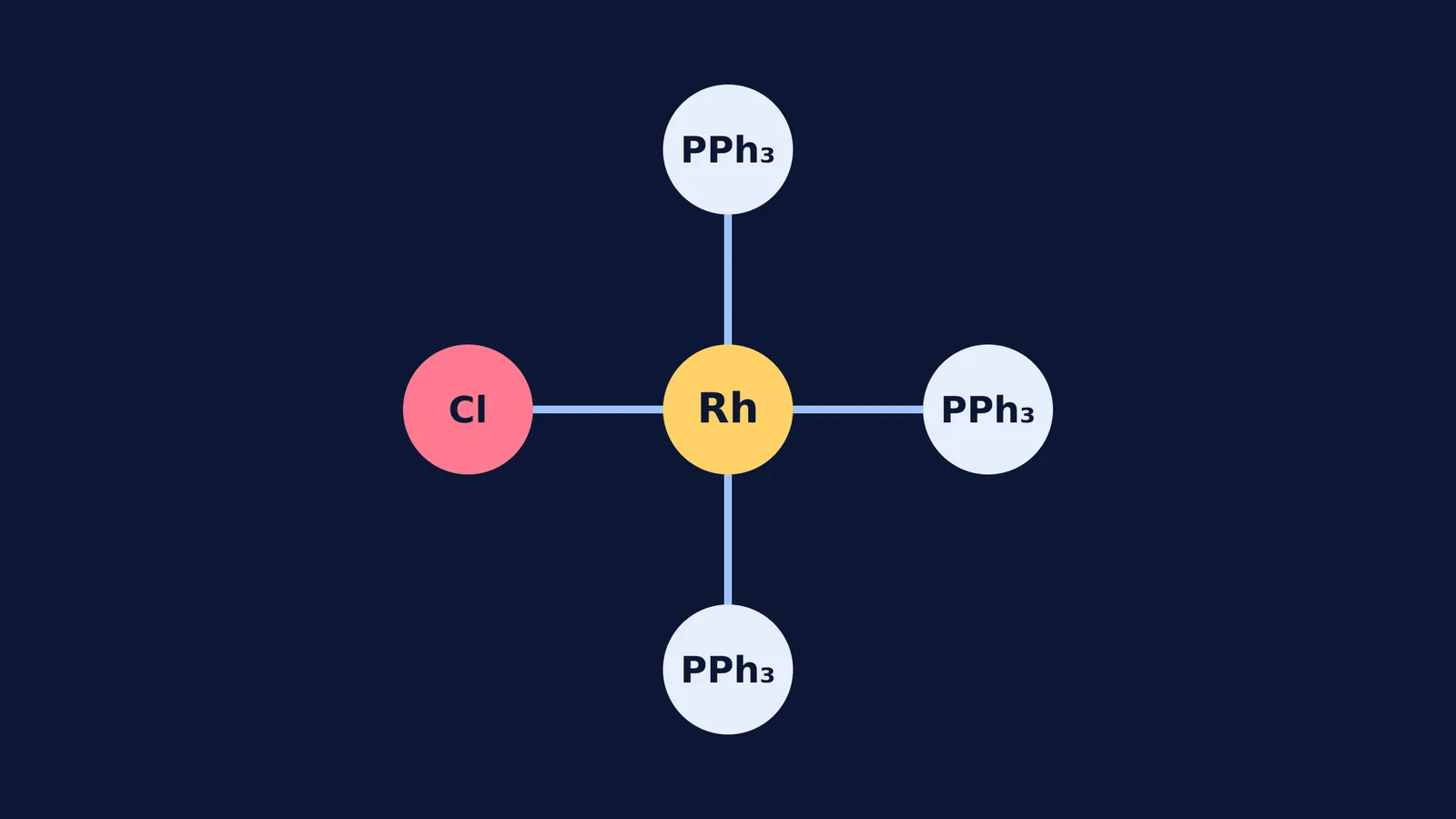
If you look at the structure from the perspective of the 18-electron rule, the rhodium atom is surrounded by four ligands: one chloride ion (Cl⁻) and three bulky triphenylphosphine molecules (PPh₃). Each of these four ligands provides two electrons, giving the rhodium(I) center a total of 16 valence electrons.
Because it has 16 electrons rather than the stable 18, the compound is coordinatively unsaturated. This "missing" electron pair is what makes it catalytically active; it has the space and electronic appetite to bind incoming substrates like hydrogen gas (H₂) and alkenes. If you are struggling to picture how these ligands arrange themselves, the Fermi Concept Library explains the valence bond theory for complexes and the crystal field splitting that drives these geometries.
What are its physical properties?
In its solid form, Wilkinson's catalyst is a red-brown powder. It is entirely insoluble in water, but it dissolves readily in chlorinated solvents like dichloromethane and chloroform, and slightly less so in aromatic hydrocarbons like benzene or toluene. As a d⁸ complex of Rh(I), it is diamagnetic.
When you dissolve the red-brown solid in a non-polar solvent, the triphenylphosphine ligands exhibit a property known as lability—meaning they can detach and reattach in solution. In some cases, the catalyst loses one ligand and dimerises to form a red, poorly soluble complex with the formula [RhCl(PPh₃)₂]₂. This lability is the exact feature that allows the catalyst to create open coordination sites for incoming reactant molecules.
What is the mechanism of Wilkinson's catalyst?
The catalytic cycle for hydrogenating an alkene into an alkane follows four distinct steps.
Ligand dissociation: The 16-electron RhCl(PPh₃)₃ complex loses one triphenylphosphine ligand in solution to form a highly reactive 14-electron intermediate, RhCl(PPh₃)₂.
Oxidative addition: A molecule of hydrogen gas (H₂) adds to the metal center. The rhodium is oxidized from Rh(I) to Rh(III), and the H–H bond is cleaved to form two rhodium-hydride (Rh–H) bonds.
Alkene coordination and migratory insertion: The alkene binds to the metal, creating a π-complex. The hydrogen atom then migrates from the rhodium to one of the alkene's carbon atoms, converting the double bond into a single bond and creating an alkyl group attached to the metal.
Reductive elimination: The second hydrogen atom transfers to the remaining carbon, releasing the fully saturated alkane and regenerating the 14-electron RhCl(PPh₃)₂ catalyst to start the cycle again.
When drawing these cycles, it is easy to lose track of the oxidation state and electron count at each step. If you are practising these mechanisms for an exam, the Fermi Problem Library will walk you through the electron counting step by step rather than just giving you the final structure.
What are the main uses of Wilkinson's catalyst?
The primary use of Wilkinson's catalyst is the hydrogenation of alkenes and alkynes.
Because it operates in a homogeneous solution, it is highly sensitive to the shape of the substrate. It will preferentially hydrogenate less hindered, terminal double bonds while leaving crowded, internal double bonds untouched. This selectivity is incredibly valuable in organic synthesis, allowing chemists to reduce one specific part of a complex molecule without altering the rest.
Beyond simple hydrogenation, the catalyst is also active for:
Hydroboration: Adding a boron-hydrogen bond across an alkene.
Hydroacylation: Adding an aldehyde C–H bond across an alkene to form a ketone.
Hydrosilylation: Adding a silicon-hydrogen bond across an alkene.
How does it decarbonylate aldehydes?
In addition to adding hydrogen, Wilkinson's catalyst is famous for its ability to remove a carbonyl group from an aldehyde. This process, known as decarbonylation, converts an aldehyde into an alkane while extracting a carbon monoxide molecule.
During the reaction, the catalyst pulls the carbon monoxide to form a highly stable, yellow rhodium carbonyl complex, *trans*-RhCl(CO)(PPh₃)₂. Because the carbon monoxide binds so tightly to the rhodium metal center, the reaction is typically stoichiometric rather than catalytic; the rhodium is consumed as it traps the CO. To make the process truly catalytic and regenerate the active rhodium complex, chemists must apply very high temperatures to drive the carbon monoxide gas out of the solution.


